Download Mendeley
High-resolution analysis of the human T-cell leukemia virus capsid protein reveals insights into immature particle morphology.
Arndt, W.G., Ramezani, A., Talledge, N., Yu, G., Yang, H., Chen, B., Perilla, J.R., Zhang, W., Mansky, L.M.(2025) Nat Commun 17: 444-444
- PubMed: 41381513 Search on PubMedSearch on PubMed Central
- DOI: https://doi.org/10.1038/s41467-025-67129-1
- Primary Citation Related Structures:
9N0W, 9N92 - PubMed Abstract:
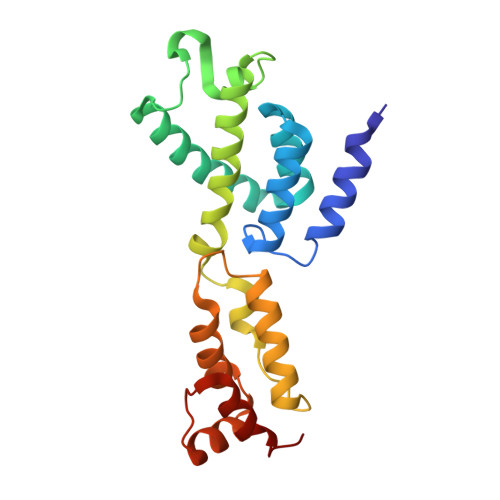
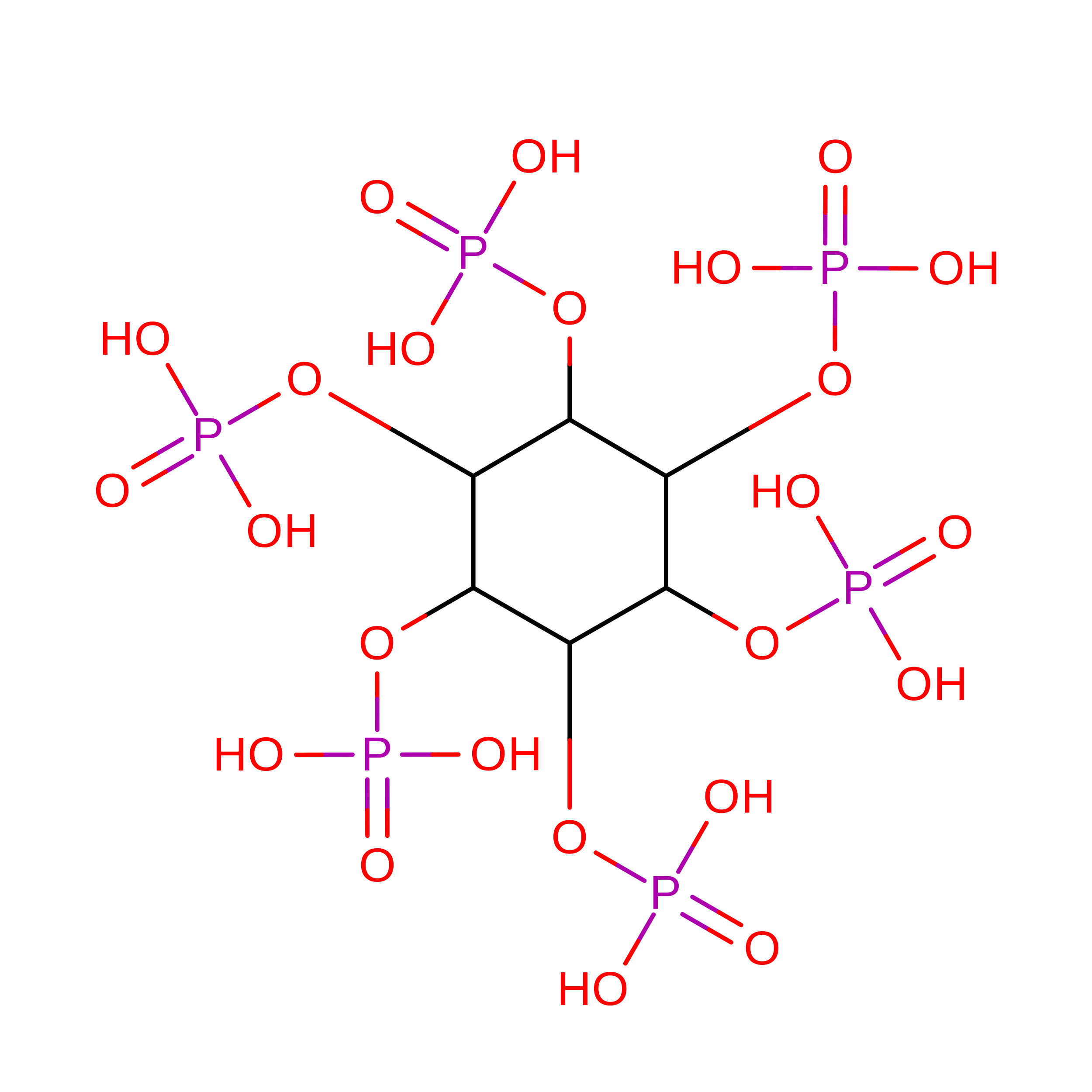
Infection with human T-cell leukemia virus type 1 (HTLV-1) can result in adult T-cell leukemia/lymphoma and HTLV-1 associated-myelopathy/tropical spastic paraparesis. The Gag polyprotein - the major structural protein - is crucial for driving virus particle assembly, with the capsid (CA) domain as the key determinant for Gag multimerization. Here, we characterize the immature CA lattice from immature virus particles by using cryo-electron microscopy and tomography (cryo-EM/ET). We report resolving the immature CA lattice to 3.4 Å resolution by single particle analysis (SPA). Our reconstruction reveals that the lattice is stabilized through a trimeric NTD inter-hexamer interface and a dimeric CTD inter-hexamer interface. Further analysis by cryo-ET reveals clear heterogeneity, notably the varying lattice curvatures and the varying distances from the CA layer to the membrane. Intriguingly, inositol hexakisphosphate (IP6) is dispensable for HTLV-1 immature particle assembly and proper immature lattice formation. These observations provide deeper insights into the molecular basis of HTLV-1 immature particle morphology as well as aid in revealing therapeutic targets.
- Biochemistry, Molecular Biology, and Biophysics Graduate Program, University of Minnesota-Twin Cities, Minneapolis, MN, USA.
Organizational Affiliation: