9N5Y | pdb_00009n5y

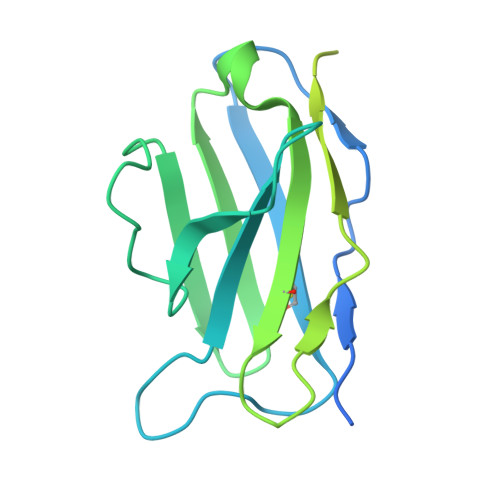
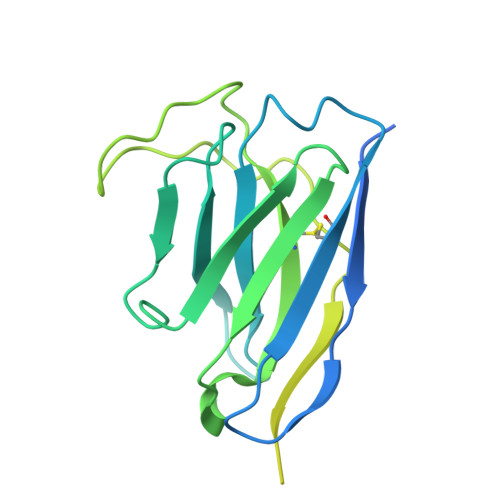
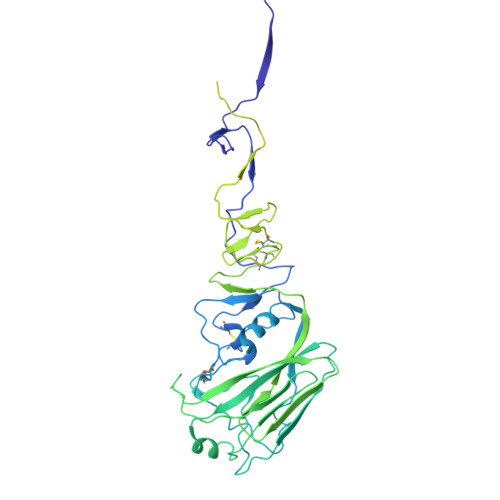
Hemagglutinin CA09 homotrimer bound to AEL31302/AEL31311 Fab


Experimental Data Snapshot

  • Method: ELECTRON MICROSCOPY
  • Resolution: 4.10 Å
  • Aggregation State: PARTICLE 
  • Reconstruction Method: SINGLE PARTICLE 

wwPDB Validation   3D Report Full Report


This is version 1.1 of the entry. See complete history


Literature

Predicting the conformational flexibility of antibody and T cell receptor complementarity-determining regions.

Spoendlin, F.C.Fernandez-Quintero, M.L.Raghavan, S.S.R.Turner, H.L.Gharpure, A.Loeffler, J.R.Wong, W.K.Bujotzek, A.Georges, G.Ward, A.B.Deane, C.M.

(2025) Nat Mach Intell 7: 1755-1767

  • DOI: https://doi.org/10.1038/s42256-025-01131-6
  • Primary Citation of Related Structures:  
    9N5Y, 9N5Z

  • PubMed Abstract: 

    Many proteins are highly flexible and their ability to adapt their shape can be fundamental to their functional properties. For example, the flexibility of antibody complementarity-determining region (CDR) loops influences binding affinity and specificity, making it a key factor in understanding and designing antigen interactions. With methods such as AlphaFold, it is possible to computationally predict a single, static protein structure with high accuracy. However, the reliable prediction of structural flexibility has not yet been achieved. A major factor limiting such predictions is the scarcity of suitable training data. Here we focus on predicting the structural flexibility of functionally important antibody and T cell receptor CDR3 loops. To this end, we constructed ALL-conformations by extracting CDR3s and CDR3-like loop motifs from all structures deposited in the Protein Data Bank. This dataset comprises 1.2 million loop structures representing more than 100,000 unique sequences and captures all experimentally observed conformations of these motifs. Using this dataset, we develop ITsFlexible, a deep learning tool with graph neural network architecture. We trained the model to binary classify CDR loops as 'rigid' or 'flexible' from inputs of antibody structures. ITsFlexible outperforms all alternative approaches on our crystal structure datasets and successfully generalizes to molecular dynamics simulations. We also used ITsFlexible to predict the flexibility of three CDRH3 loops with no solved structures and experimentally determined their conformations using cryogenic electron microscopy.


  • Organizational Affiliation
    • Department of Statistics, University of Oxford, Oxford, UK.

Macromolecules
Find similar proteins by:  (by identity cutoff)  |  3D Structure
Entity ID: 1
MoleculeChains Sequence LengthOrganismDetailsImage
Fab light chain antibody AEL31302A [auth L],
D [auth O],
G [auth M]
237Homo sapiensMutation(s): 0 
Entity Groups  
Sequence Clusters30% Identity50% Identity70% Identity90% Identity95% Identity100% Identity
Sequence Annotations
Expand
  • Reference Sequence
Find similar proteins by:  (by identity cutoff)  |  3D Structure
Entity ID: 2
MoleculeChains Sequence LengthOrganismDetailsImage
Fab heavy antibody AEL31311B [auth I],
E [auth P],
H [auth J]
251Homo sapiensMutation(s): 0 
Entity Groups  
Sequence Clusters30% Identity50% Identity70% Identity90% Identity95% Identity100% Identity
Sequence Annotations
Expand
  • Reference Sequence
Find similar proteins by:  (by identity cutoff)  |  3D Structure
Entity ID: 3
MoleculeChains Sequence LengthOrganismDetailsImage
Hemagglutinin554Influenza A virus (A/California/01/2009(H1N1))Mutation(s): 0 
Gene Names: HA
UniProt
Find proteins for A0A3S7XTA4 (Influenza A virus)
Explore A0A3S7XTA4 
Go to UniProtKB:  A0A3S7XTA4
Entity Groups  
Sequence Clusters30% Identity50% Identity70% Identity90% Identity95% Identity100% Identity
UniProt GroupA0A3S7XTA4
Glycosylation
Glycosylation Sites: 4
Sequence Annotations
Expand
  • Reference Sequence
Oligosaccharides

Help

Entity ID: 4
MoleculeChains Length2D Diagram Glycosylation3D Interactions
2-acetamido-2-deoxy-beta-D-glucopyranose-(1-4)-2-acetamido-2-deoxy-beta-D-glucopyranoseM [auth G],
N [auth H]
2N-Glycosylation
Glycosylation Resources
GlyTouCan:  G42666HT
GlyCosmos:  G42666HT
GlyGen:  G42666HT
Small Molecules
Ligands 1 Unique
IDChains Name / Formula / InChI Key2D Diagram3D Interactions
NAG
Query on NAG

Download Ideal Coordinates CCD File 
AA [auth B]
BA [auth D]
CA [auth D]
O [auth A]
P [auth A]
AA [auth B],
BA [auth D],
CA [auth D],
O [auth A],
P [auth A],
Q [auth A],
R [auth C],
S [auth C],
T [auth C],
U [auth C],
V [auth C],
W [auth E],
X [auth E],
Y [auth E],
Z [auth B]
2-acetamido-2-deoxy-beta-D-glucopyranose
C8 H15 N O6
OVRNDRQMDRJTHS-FMDGEEDCSA-N
Experimental Data & Validation

Experimental Data

  • Method: ELECTRON MICROSCOPY
  • Resolution: 4.10 Å
  • Aggregation State: PARTICLE 
  • Reconstruction Method: SINGLE PARTICLE 
EM Software:
TaskSoftware PackageVersion
MODEL REFINEMENTPHENIX1.21.2_5419

Structure Validation

View Full Validation Report


Entry History & Funding Information

Deposition Data


Funding OrganizationLocationGrant Number
Not funded--

Revision History  (Full details and data files)

  • Version 1.0: 2025-11-12
    Type: Initial release
  • Version 1.1: 2025-12-03
    Changes: Data collection