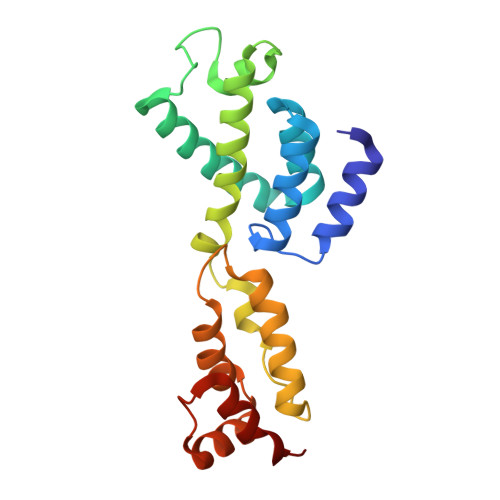
9N0W | pdb_00009n0w

HTLV-1 Gag capsid from immature particles


Experimental Data Snapshot

  • Method: ELECTRON MICROSCOPY
  • Resolution: 3.44 Å
  • Aggregation State: PARTICLE 
  • Reconstruction Method: SINGLE PARTICLE 

wwPDB Validation 3D Report Full Report

Validation slider image for 9N0W

This is version 1.1 of the entry. See complete history

Literature

High-resolution analysis of the human T-cell leukemia virus capsid protein reveals insights into immature particle morphology.

Arndt, W.G.Ramezani, A.Talledge, N.Yu, G.Yang, H.Chen, B.Perilla, J.R.Zhang, W.Mansky, L.M.

(2025) Nat Commun 17: 444-444

  • DOI: https://doi.org/10.1038/s41467-025-67129-1
  • Primary Citation Related Structures: 
    9N0W, 9N92

  • PubMed Abstract: 

    Infection with human T-cell leukemia virus type 1 (HTLV-1) can result in adult T-cell leukemia/lymphoma and HTLV-1 associated-myelopathy/tropical spastic paraparesis. The Gag polyprotein - the major structural protein - is crucial for driving virus particle assembly, with the capsid (CA) domain as the key determinant for Gag multimerization. Here, we characterize the immature CA lattice from immature virus particles by using cryo-electron microscopy and tomography (cryo-EM/ET). We report resolving the immature CA lattice to 3.4 Å resolution by single particle analysis (SPA). Our reconstruction reveals that the lattice is stabilized through a trimeric NTD inter-hexamer interface and a dimeric CTD inter-hexamer interface. Further analysis by cryo-ET reveals clear heterogeneity, notably the varying lattice curvatures and the varying distances from the CA layer to the membrane. Intriguingly, inositol hexakisphosphate (IP6) is dispensable for HTLV-1 immature particle assembly and proper immature lattice formation. These observations provide deeper insights into the molecular basis of HTLV-1 immature particle morphology as well as aid in revealing therapeutic targets.


  • Organizational Affiliation
    • Biochemistry, Molecular Biology, and Biophysics Graduate Program, University of Minnesota-Twin Cities, Minneapolis, MN, USA.

Macromolecule Content 

  • Total Structure Weight: 64.31 kDa 
  • Atom Count: 4,521 
  • Modeled Residue Count: 579 
  • Deposited Residue Count: 579 
  • Unique protein chains: 1

Macromolecules

Find similar proteins by:|  3D Structure
Entity ID: 1
MoleculeChains  Sequence LengthOrganismDetailsImage
Gag proteinA [auth B],
B [auth C],
C [auth A]
193Human T-cell leukemia virus type IMutation(s): 0 
Gene Names: gag
UniProt
Find proteins for Q82230 (Human T-cell leukemia virus type I)
Explore Q82230 
Go to UniProtKB:  Q82230
Entity Groups
Sequence Clusters30% Identity50% Identity70% Identity90% Identity95% Identity100% Identity
UniProt GroupQ82230
Sequence Annotations
Expand
Reference Sequence

Experimental Data & Validation

Experimental Data

  • Method: ELECTRON MICROSCOPY
  • Resolution: 3.44 Å
  • Aggregation State: PARTICLE 
  • Reconstruction Method: SINGLE PARTICLE 
EM Software:
TaskSoftware PackageVersion
RECONSTRUCTIONRELION5.0b-3_cu11.8
MODEL REFINEMENTPHENIX1.20.1_4487

Structure Validation

View Full Validation Report


Entry History 

& Funding Information

Deposition Data


Funding OrganizationLocationGrant Number
National Institutes of Health/National Institute Of Allergy and Infectious Diseases (NIH/NIAID)United StatesR01GM151775
National Institutes of Health/National Institute Of Allergy and Infectious Diseases (NIH/NIAID)United StatesR21DE032878
National Institutes of Health/National Institute Of Allergy and Infectious Diseases (NIH/NIAID)United StatesF31AI184673
National Institutes of Health/National Institute Of Allergy and Infectious Diseases (NIH/NIAID)United StatesT32AI083196

Revision History  (Full details and data files)

  • Version 1.0: 2025-12-24
    Type: Initial release
  • Version 1.1: 2026-01-21
    Changes: Data collection, Database references