9MUG | pdb_00009mug

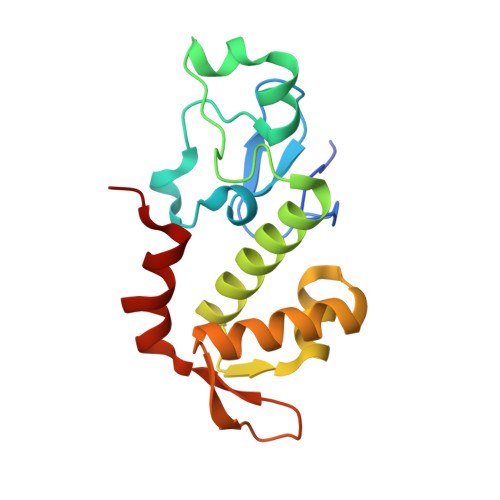
Structure of Schistosoma mansoni Hop1 chromatin binding region


Experimental Data Snapshot

  • Method: X-RAY DIFFRACTION
  • Resolution: 1.45 Å
  • R-Value Free: 
    0.158 (Depositor), 0.161 (DCC) 
  • R-Value Work: 
    0.129 (Depositor), 0.132 (DCC) 
  • R-Value Observed: 
    0.130 (Depositor) 

wwPDB Validation   3D Report Full Report


This is version 1.1 of the entry. See complete history


Literature

Bipartite chromatin recognition by Hop1 from two diverged Holozoa.

Rodriguez, A.A.Cirulli, A.E.Chau, K.Nguyen, J.Ye, Q.Corbett, K.D.

(2025) Life Sci Alliance 8

  • DOI: https://doi.org/10.26508/lsa.202503428
  • Primary Citation of Related Structures:  
    9MUG, 9MYP

  • PubMed Abstract: 

    In meiosis, ploidy reduction is driven by a complex series of DNA breakage and recombination events between homologous chromosomes, orchestrated by meiotic HORMA domain proteins (HORMADs). Meiotic HORMADs possess a central chromatin binding region (CBR) whose architecture varies across eukaryotic groups. Here, we determine high-resolution crystal structures of the meiotic HORMAD CBR from two diverged aquatic Holozoa, Schistosoma mansoni and Patiria miniata , which reveal tightly associated plant homeodomain (PHD) and winged helix-turn-helix (wHTH) domains. We show that PHD-wHTH CBRs bind duplex DNA through their wHTH domains, and identify key residues that disrupt this interaction. Combining experimental and predicted structures, we show that the CBRs' PHDs likely interact with the tail of histone H3, and may discriminate between unmethylated and trimethylated H3 lysine 4. Finally, we show that Holozoa Hop1 CBRs bind nucleosomes in vitro in a bipartite manner involving both the PHD and wHTH domain. Our data reveal how meiotic HORMADs with PHD-wHTH CBRs can bind chromatin and potentially discriminate between chromatin states to drive meiotic recombination to specific chromosomal regions.


  • Organizational Affiliation
    • Department of Cellular and Molecular Medicine, University of California San Diego, La Jolla, CA, USA.

Macromolecules
Find similar proteins by:  (by identity cutoff)  |  3D Structure
Entity ID: 1
MoleculeChains Sequence LengthOrganismDetailsImage
HORMA domain-containing protein155Schistosoma mansoniMutation(s): 0 
UniProt
Find proteins for A0A3Q0KSN1 (Schistosoma mansoni)
Explore A0A3Q0KSN1 
Go to UniProtKB:  A0A3Q0KSN1
Entity Groups  
Sequence Clusters30% Identity50% Identity70% Identity90% Identity95% Identity100% Identity
UniProt GroupA0A3Q0KSN1
Sequence Annotations
Expand
  • Reference Sequence
Experimental Data & Validation

Experimental Data

  • Method: X-RAY DIFFRACTION
  • Resolution: 1.45 Å
  • R-Value Free:  0.158 (Depositor), 0.161 (DCC) 
  • R-Value Work:  0.129 (Depositor), 0.132 (DCC) 
  • R-Value Observed: 0.130 (Depositor) 
Space Group: P 21 21 21
Unit Cell:
Length ( Å )Angle ( ˚ )
a = 33.032α = 90
b = 64.959β = 90
c = 65.26γ = 90
Software Package:
Software NamePurpose
PHENIXrefinement
XDSdata reduction
Aimlessdata scaling
PHASERphasing

Structure Validation

View Full Validation Report


Entry History & Funding Information

Deposition Data


Funding OrganizationLocationGrant Number
National Institutes of Health/National Institute of General Medical Sciences (NIH/NIGMS)United StatesR35 GM144121

Revision History  (Full details and data files)

  • Version 1.0: 2025-08-13
    Type: Initial release
  • Version 1.1: 2025-10-15
    Changes: Database references