9MOZ | pdb_00009moz

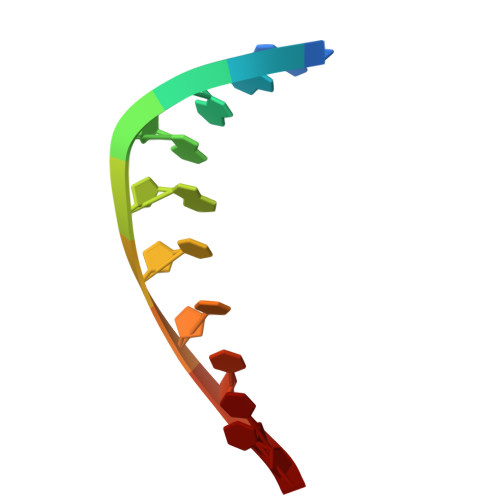
Crystal structure of mithramycin analogue MTM SA-5-methyl-Trp in complex with DNA AGAGGCCTCT

  • Classification: DNA
  • Organism(s): synthetic construct
  • Mutation(s): No 

  • Deposited: 2024-12-28 Released: 2025-04-30 
  • Deposition Author(s): Hou, C., Tsodikov, O.V.
  • Funding Organization(s): National Institutes of Health/National Cancer Institute (NIH/NCI)

Experimental Data Snapshot

  • Method: X-RAY DIFFRACTION
  • Resolution: 2.23 Å
  • R-Value Free: 
    0.249 (Depositor), 0.256 (DCC) 
  • R-Value Work: 
    0.228 (Depositor), 0.232 (DCC) 
  • R-Value Observed: 
    0.229 (Depositor) 

Starting Model: experimental
View more details

wwPDB Validation   3D Report Full Report


Ligand Structure Quality Assessment 


This is version 1.2 of the entry. See complete history


Literature

The Position of Indole Methylation Controls the Structure, DNA Binding, and Cellular Functions of Mithramycin SA-Trp Analogues.

Hou, C.Bhosale, S.Yasuda, K.Yetirajam, R.Leggas, M.Rohr, J.Tsodikov, O.V.

(2025) Chembiochem 26: e202401084-e202401084

  • DOI: https://doi.org/10.1002/cbic.202401084
  • Primary Citation of Related Structures:  
    9MOZ, 9MP1

  • PubMed Abstract: 

    Mithramycin (MTM) is a polyketide anti-cancer natural product, which functions by noncovalent binding to DNA in the minor groove without intercalation, resulting in inhibiting transcription at G/C-rich promoters. MTM is a potent inhibitor of cancer cells, such as Ewing sarcoma, driven by abnormal fusions involving ETS family transcription factors FLI1 and ERG. However, MTM is rather toxic and non-selective; therefore, safer, selective analogues of MTM are required for use in clinic as anti-cancer drugs. In this study by using a combination of X-ray crystallographic, biophysical, cell and molecular biological techniques, we explored structural and functional consequences of 3-side chain methylation at positions 5, 6 and 7 of the indole ring of the potent analogue MTM SA-Trp. We showed that the conformation of the analogues in complexes with DNA, their DNA binding function, cytotoxicity, selectivity and potency as transcription antagonists depended on the position of the methylation. MTM SA-5-methyl-Trp emerged as the most selective analogue, presumably due to the right balance of the DNA binding and the solvent exposure of the 3-side chain. This study demonstrates that minor chemical changes can have strong effects in analogue development and paves a way to further development of next generation MTM analogues.


  • Organizational Affiliation
    • University of Kentucky, Pharmaceutical Sciences, Lee T. Todd, Jr Building, 789 South Limestone St., Room 425, 40536, Lexington, UNITED STATES OF AMERICA.

Macromolecules

Find similar nucleic acids by:  Sequence   |   3D Structure  

Entity ID: 1
MoleculeChains LengthOrganismImage
DNA (5'-D(*AP*GP*AP*GP*GP*CP*CP*TP*CP*T)-3')10synthetic construct
Sequence Annotations
Expand
  • Reference Sequence
Small Molecules
Ligands 4 Unique
IDChains Name / Formula / InChI Key2D Diagram3D Interactions
A1BNI (Subject of Investigation/LOI)
Query on A1BNI

Download Ideal Coordinates CCD File 
I [auth A]
J [auth A]
JA [auth G]
LA [auth G]
V [auth D]
I [auth A],
J [auth A],
JA [auth G],
LA [auth G],
V [auth D],
W [auth D]
methyl (2S)-2-({(2S)-2-[(2R,3S)-3-{[(2S,4R,5R,6R)-4-{[(2S,4R,5S,6R)-4-{[(2S,4S,5R,6R)-4,5-dihydroxy-4,6-dimethyloxan-2-yl]oxy}-5-hydroxy-6-methyloxan-2-yl]oxy}-5-hydroxy-6-methyloxan-2-yl]oxy}-7-{[(2S,4R,5R,6R)-4-{[(2S,4R,5S,6R)-4,5-dihydroxy-6-methyloxan-2-yl]oxy}-5-hydroxy-6-methyloxan-2-yl]oxy}-5,10-dihydroxy-6-methyl-4-oxo-1,2,3,4-tetrahydroanthracen-2-yl]-2-methoxyacetyl}amino)-3-(5-methyl-1H-indol-3-yl)propanoate (non-preferred name)
C62 H84 N2 O24
FJCJOQQGTLSQCL-LRAPQSIQSA-N
ZN
Query on ZN

Download Ideal Coordinates CCD File 
AA [auth E]
BA [auth E]
CA [auth E]
DA [auth E]
EA [auth E]
AA [auth E],
BA [auth E],
CA [auth E],
DA [auth E],
EA [auth E],
G [auth A],
H [auth A],
HA [auth G],
IA [auth G],
K [auth A],
KA [auth G],
L [auth B],
M [auth B],
MA [auth G],
N [auth B],
O [auth B],
OA [auth H],
P [auth B],
PA [auth H],
Q [auth B],
QA [auth H],
RA [auth H],
SA [auth H],
T [auth D],
U [auth D],
X [auth D],
Z [auth E]
ZINC ION
Zn
PTFCDOFLOPIGGS-UHFFFAOYSA-N
CL
Query on CL

Download Ideal Coordinates CCD File 
FA [auth E],
R [auth B],
S [auth B]
CHLORIDE ION
Cl
VEXZGXHMUGYJMC-UHFFFAOYSA-M
NA
Query on NA

Download Ideal Coordinates CCD File 
GA [auth E],
NA [auth G],
TA [auth H],
Y [auth D]
SODIUM ION
Na
FKNQFGJONOIPTF-UHFFFAOYSA-N
Experimental Data & Validation

Experimental Data

  • Method: X-RAY DIFFRACTION
  • Resolution: 2.23 Å
  • R-Value Free:  0.249 (Depositor), 0.256 (DCC) 
  • R-Value Work:  0.228 (Depositor), 0.232 (DCC) 
  • R-Value Observed: 0.229 (Depositor) 
Space Group: P 31 2 1
Unit Cell:
Length ( Å )Angle ( ˚ )
a = 93.471α = 90
b = 93.471β = 90
c = 65.405γ = 120
Software Package:
Software NamePurpose
REFMACrefinement
HKL-2000data reduction
HKL-2000data scaling
PHASERphasing

Structure Validation

View Full Validation Report


Ligand Structure Quality Assessment 


Entry History & Funding Information

Deposition Data


Funding OrganizationLocationGrant Number
National Institutes of Health/National Cancer Institute (NIH/NCI)United StatesR01CA243529

Revision History  (Full details and data files)

  • Version 1.0: 2025-04-30
    Type: Initial release
  • Version 1.1: 2025-05-14
    Changes: Database references
  • Version 1.2: 2025-06-11
    Changes: Database references