9MK9 | pdb_00009mk9

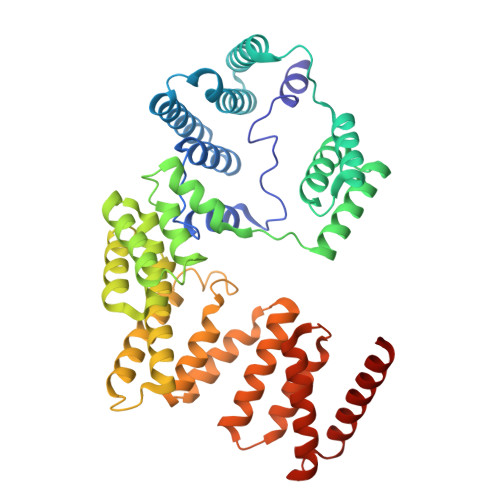
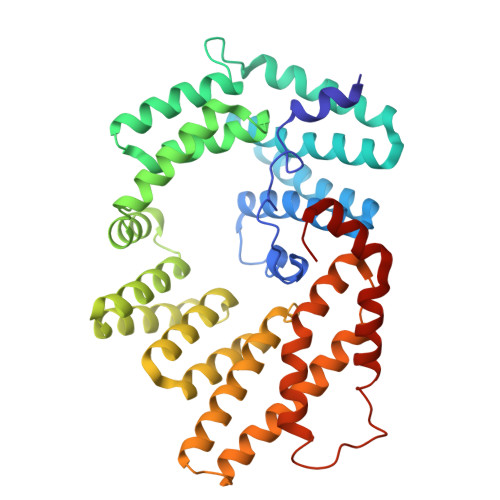
Structure of the IFIT2-IFIT3 heterodimer from Mus musculus


Experimental Data Snapshot

  • Method: ELECTRON MICROSCOPY
  • Resolution: 3.22 Å
  • Aggregation State: PARTICLE 
  • Reconstruction Method: SINGLE PARTICLE 

wwPDB Validation   3D Report Full Report


This is version 1.0 of the entry. See complete history


Literature

Short 5' UTRs serve as a marker for viral mRNA translation inhibition by the IFIT2-IFIT3 antiviral complex.

Glasner, D.R.Todd, C.Cook, B.D'Urso, A.Khosla, S.Estrada, E.Wagner, J.D.Bartels, M.D.Ford, P.Prych, J.Hatch, K.Yee, B.A.Ego, K.M.Liang, Q.Holland, S.R.Case, J.B.Corbett, K.D.Diamond, M.S.Yeo, G.W.Herzik Jr., M.A.Van Nostrand, E.L.Daugherty, M.D.

(2025) bioRxiv 

  • DOI: https://doi.org/10.1101/2025.02.11.637299
  • Primary Citation of Related Structures:  
    9MK9

  • PubMed Abstract: 

    Recognition of "non-self" nucleic acids, including cytoplasmic dsDNA, dsRNA, or mRNAs lacking proper 5' cap structures, is critical for the innate immune response to viruses. Here, we demonstrate that short 5' untranslated regions (UTRs), a characteristic of many viral mRNAs, can also serve as a molecular pattern for innate immune recognition via the interferon-induced proteins IFIT2 and IFIT3. The IFIT2-IFIT3 heterodimer, formed through an intricate domain swap structure resolved by cryo-EM, mediates viral mRNA 5' end recognition, translation inhibition, and ultimately antiviral activity. Critically, 5' UTR lengths <50 nucleotides are necessary and sufficient to sensitize an mRNA to translation inhibition by the IFIT2-IFIT3 complex. Accordingly, diverse viruses whose mRNAs contain short 5' UTRs, such as vesicular stomatitis virus and parainfluenza virus 3, are sensitive to IFIT2-IFIT3-mediated antiviral activity. Our work thus reveals a pattern of antiviral nucleic acid immune recognition that takes advantage of the inherent constraints on viral genome size.


  • Organizational Affiliation
    • School of Biological Sciences, University of California, San Diego, CA, USA.

Macromolecules
Find similar proteins by:  (by identity cutoff)  |  3D Structure
Entity ID: 1
MoleculeChains Sequence LengthOrganismDetailsImage
Interferon-induced protein with tetratricopeptide repeats 2440Mus musculusMutation(s): 0 
Gene Names: Ifit2Garg39Ifi54Isg54
UniProt
Find proteins for Q64112 (Mus musculus)
Explore Q64112 
Go to UniProtKB:  Q64112
Entity Groups  
Sequence Clusters30% Identity50% Identity70% Identity90% Identity95% Identity100% Identity
UniProt GroupQ64112
Sequence Annotations
Expand
  • Reference Sequence
Find similar proteins by:  (by identity cutoff)  |  3D Structure
Entity ID: 2
MoleculeChains Sequence LengthOrganismDetailsImage
Interferon-induced protein with tetratricopeptide repeats 3382Mus musculusMutation(s): 0 
Gene Names: Ifit3Garg49Ifi49Isg49
UniProt & NIH Common Fund Data Resources
Find proteins for Q64345 (Mus musculus)
Explore Q64345 
Go to UniProtKB:  Q64345
IMPC:  MGI:1101055
Entity Groups  
Sequence Clusters30% Identity50% Identity70% Identity90% Identity95% Identity100% Identity
UniProt GroupQ64345
Sequence Annotations
Expand
  • Reference Sequence
Experimental Data & Validation

Experimental Data

  • Method: ELECTRON MICROSCOPY
  • Resolution: 3.22 Å
  • Aggregation State: PARTICLE 
  • Reconstruction Method: SINGLE PARTICLE 
EM Software:
TaskSoftware PackageVersion
MODEL REFINEMENTPHENIX1.21.1_5286
RECONSTRUCTIONcryoSPARC

Structure Validation

View Full Validation Report


Entry History & Funding Information

Deposition Data


Funding OrganizationLocationGrant Number
National Institutes of Health/National Human Genome Research Institute (NIH/NHGRI)United StatesU24 HG009889
National Institutes of Health/National Institute of Mental Health (NIH/NIMH)United StatesRF1 MH126719
National Institutes of Health/National Human Genome Research Institute (NIH/NHGRI)United StatesR01 HG011864
National Institutes of Health/National Human Genome Research Institute (NIH/NHGRI)United StatesNational Human Genome Research Institute
National Institutes of Health/National Human Genome Research Institute (NIH/NHGRI)United StatesU24 HG011735

Revision History  (Full details and data files)

  • Version 1.0: 2025-03-12
    Type: Initial release