Download Mendeley
Azapeptide-Based SARS-CoV-2 Main Protease Inhibitors: Design, Synthesis, Enzyme Inhibition, Structural Determination, and Antiviral Activity.
Flury, P., Vishwakarma, J., Sylvester, K., Higashi-Kuwata, N., Dabrowska, A.K., Delgado, R., Cuell, A., Basu, R., Taylor, A.B., de Oliveira, E.G., Magalhaes Serafim, M.S., Qiao, J., Chen, Y., Yang, S., O'Donoghue, A.J., Mitsuya, H., Gutschow, M., Laufer, S.A., Muller, C.E., Harris, R.S., Pillaiyar, T.(2025) J Med Chem 68: 19339-19376
- PubMed: 40932417 Search on PubMedSearch on PubMed Central
- DOI: https://doi.org/10.1021/acs.jmedchem.5c01520
- Primary Citation Related Structures:
9MDQ - PubMed Abstract:
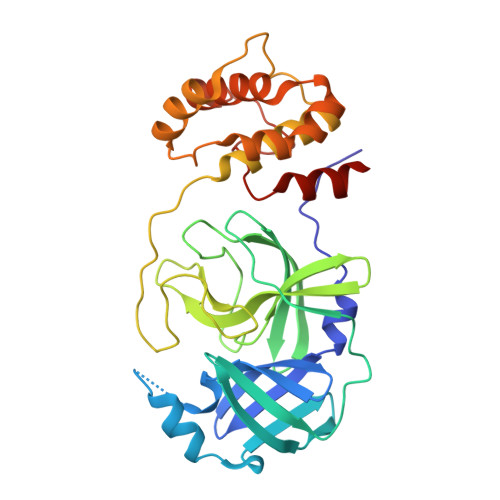
M pro of SARS-CoV-2 plays a vital role in the replication and pathogenesis of virus. Additionally, its high conservation within the Coronaviridae family makes it an attractive therapeutic target for developing broad-spectrum agents. This study describes the design, synthesis, and structure-activity relationships of azapeptide-based SARS-CoV-2 M pro inhibitors, leading to several compounds with nanomolar IC 50 values. Examples include 14r (IC 50 = 13.3 nM), 14s (IC 50 = 30.6 nM), 20a ( TPG-20a , IC 50 = 28.0 nM), and 20g (IC 50 = 30.4 nM). Some compounds inhibit MERS-CoV and SARS-CoV-1 M pro but not the human protease cathepsin L. Several inhibitors, such as 20a and 20f , exhibit antiviral activity with potencies comparable to nirmatrelvir and activity against the E166V-carrying SARS-CoV-2 variant (SARS-CoV-2 E166V ). An M pro cocrystal structure with 20a shows a covalent adduct with the catalytic Cys145. Overall, these new inhibitors are promising chemical tools that may contribute to the identification of future pan-anticoronaviral drugs.
- Institute of Pharmaceutical Sciences, Department of Pharmaceutical and Medicinal Chemistry, Eberhard Karls University Tübingen, Auf der Morgenstelle 8, Tübingen 72076, Germany.
Organizational Affiliation: