Download Mendeley
Structural characterization of five functional states of metabotropic glutamate receptor 8.
Zhao, J., Deng, Y., Xu, Z., Xu, C., Zhao, C., Li, Z., Sun, H., Tian, X., Song, Y., Cimadevila, M., Wang, H., Liu, Y., Zhang, X., Chen, Y., Sun, S., Yong, X., Su, L., He, Y., Zhong, Y., Yang, H., Pin, J.P., Yan, W., Shao, Z., Liu, J.(2025) Mol Cell 85: 3460-3473.e6
- PubMed: 40972528 Search on PubMed
- DOI: https://doi.org/10.1016/j.molcel.2025.08.019
- Primary Citation Related Structures:
9MB9, 9MBA, 9MBB, 9MBC, 9MBD - PubMed Abstract:
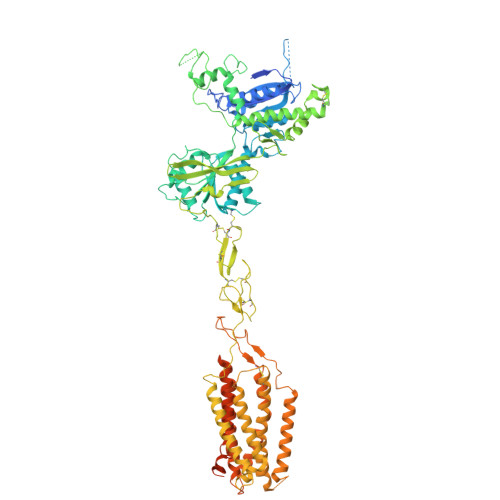
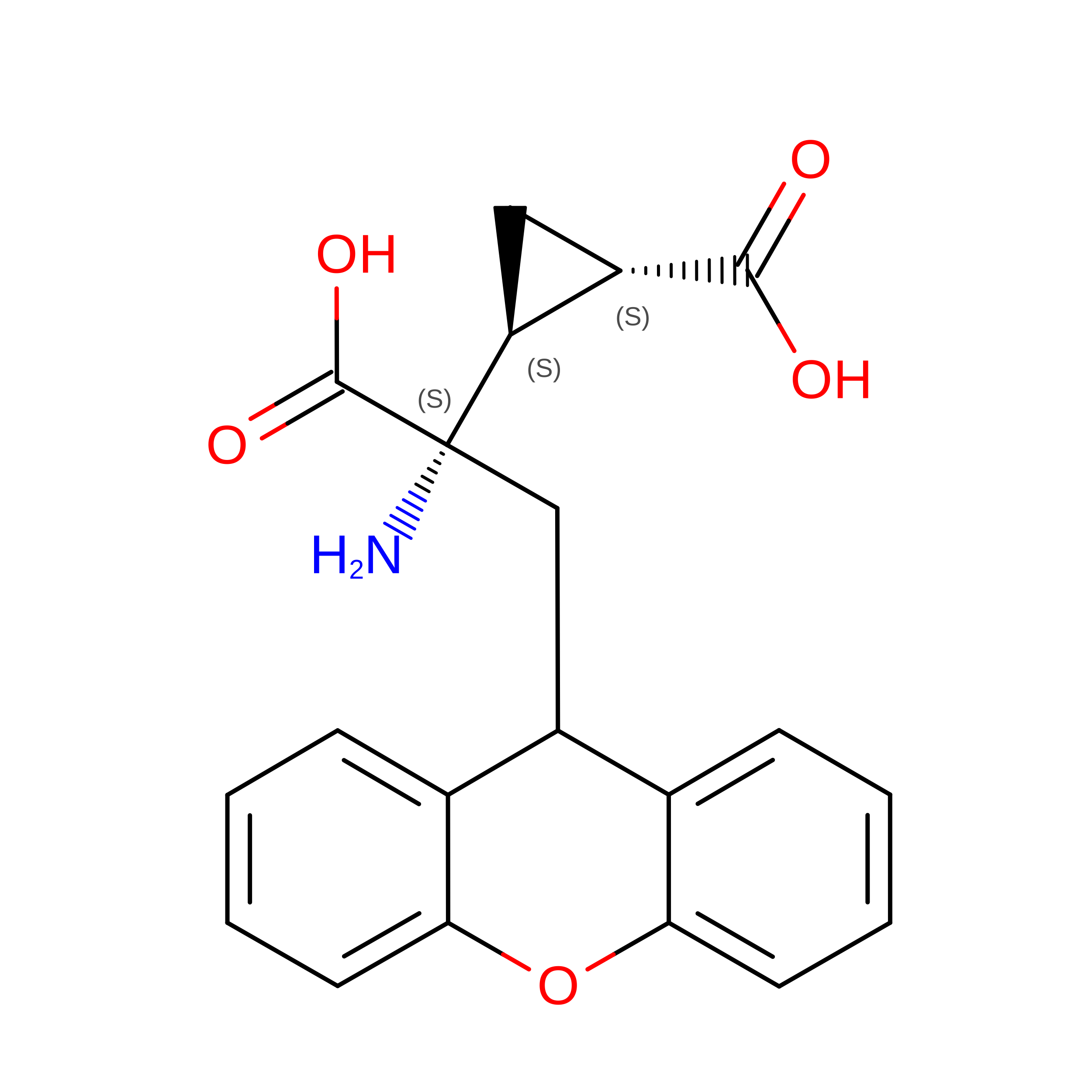
Metabotropic glutamate receptors (mGluRs) are dimeric class C G protein-coupled receptors, which play crucial roles in brain physiology and pathology. Among them, mGlu8 is the least characterized, though it is physiologically important. While recognized to signal via G i/o proteins, the involvement of β-arrestin is unknown. Here, we found that both mGlu8 agonists and positive allosteric modulators (PAMs) activate G i signaling, but mainly agonists induce β-arrestin recruitment. We solved five human mGlu8 cryo-electron microscopy (cryo-EM) structures in various states: apo, antagonist-bound, agonist + PAM-bound, agonist + PAM-bound with G i protein, and agonist-bound with β-arrestin1 states. They revealed a unique PAM-binding pocket at the extracellular side of the TM6/TM7 interface. Agonist and PAM promote active mGlu8 association with one G i protein asymmetrically (2:1), while two β-arrestin1 can interact symmetrically (2:2) to both subunits of an inactive dimer state to promote constitutive internalization. These findings elucidate how mGlu8 selectively engages transducers, offering insights into its signaling capabilities and selective drug development.
- Division of Nephrology and Kidney Research Institute, State Key Laboratory of Biotherapy, West China Hospital, Sichuan University, Chengdu 610041, China; Tianfu Jincheng Laboratory, Chengdu 610212, China.
Organizational Affiliation: