9LNG | pdb_00009lng

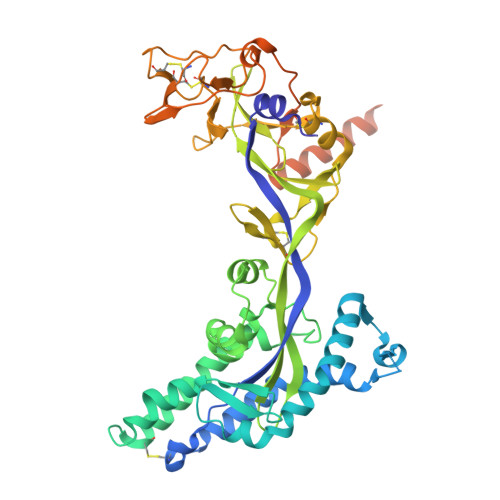
An antibody target the fusion protein of Nipah virus


Experimental Data Snapshot

  • Method: ELECTRON MICROSCOPY
  • Resolution: 2.45 Å
  • Aggregation State: PARTICLE 
  • Reconstruction Method: SINGLE PARTICLE 

wwPDB Validation   3D Report Full Report


This is version 1.1 of the entry. See complete history


Literature

A monoclonal antibody targeting conserved regions of pre-fusion protein cross-neutralizes Nipah and Hendra virus variants.

Li, T.Xu, H.Zhang, M.Nie, J.Liao, B.Xie, J.Jiang, Y.Liu, Y.Ge, P.Zhao, C.Sun, Z.Bai, Y.Tang, M.Su, X.Wang, Y.Huang, W.

(2025) Antiviral Res 240: 106215-106215

  • DOI: https://doi.org/10.1016/j.antiviral.2025.106215
  • Primary Citation of Related Structures:  
    9LNG

  • PubMed Abstract: 

    Nipah virus (NiV) and Hendra virus (HeV) have an extremely high case fatality, leading to hundreds of deaths in several countries around the globe. Belonging to the same genus Henipavirus (HNV), the two species have a high degree of sequence similarity, resulting in cross-neutralizing immunity under favorable conditions. Here, we obtained ten anti-NiV-F monoclonal antibodies using hybridoma technology, and verified that these antibodies had potent neutralizing activities against epidemic NiV strains from different regions using a pseudovirus assay, and the neutralizing concentration reached the nanogram per milliliter level. Moreover, two of the antibodies, NiF03-3C9 and NiF03-2F6, were found to have cross-neutralizing activity against HeV, which was even stronger than that against NiV. Epitope competition analysis revealed two classes of epitopes for these antibodies. Cryo-electron microscopy showed that NiF03-3C9 binds to lateral residues of the prefusion F protein trimer, highly conserved in both Nipah and Hendra. The protective potency of the antibodies was also validated using in vivo pseudovirus infection models of Nipah and Hendra viruses. The mAbs developed in this study and their conserved cross-neutralizing epitopes elucidated by structural analysis may contribute to the control of highly pathogenic HNV outbreaks.


  • Organizational Affiliation
    • Division of HIV/AIDS and Sex-transmitted Virus Vaccines, Institute for Biological Product Control, National Institutes for Food and Drug Control (NIFDC), Beijing, 102629, China; State Key Laboratory of Drug Regulatory Science, Beijing, 102629, China.

Macromolecules
Find similar proteins by:  (by identity cutoff)  |  3D Structure
Entity ID: 1
MoleculeChains Sequence LengthOrganismDetailsImage
Fusion glycoprotein F0A [auth B],
D [auth A],
G [auth C]
495Henipavirus nipahenseMutation(s): 0 
UniProt
Find proteins for Q9IH63 (Nipah virus)
Explore Q9IH63 
Go to UniProtKB:  Q9IH63
Entity Groups  
Sequence Clusters30% Identity50% Identity70% Identity90% Identity95% Identity100% Identity
UniProt GroupQ9IH63
Sequence Annotations
Expand
  • Reference Sequence
Find similar proteins by:  (by identity cutoff)  |  3D Structure
Entity ID: 2
MoleculeChains Sequence LengthOrganismDetailsImage
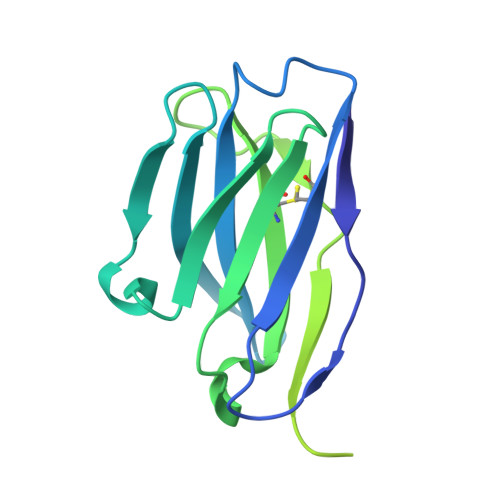
Fab NiF03-3C9 heavy chainB [auth H],
E [auth D],
H [auth E]
222Mus musculusMutation(s): 0 
Entity Groups  
Sequence Clusters30% Identity50% Identity70% Identity90% Identity95% Identity100% Identity
Sequence Annotations
Expand
  • Reference Sequence
Find similar proteins by:  (by identity cutoff)  |  3D Structure
Entity ID: 3
MoleculeChains Sequence LengthOrganismDetailsImage
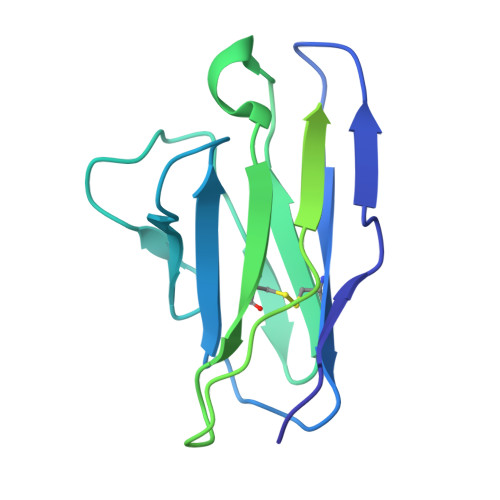
Fab NiF03-3C9 light chainC [auth L],
F,
I [auth G]
214Mus musculusMutation(s): 0 
Entity Groups  
Sequence Clusters30% Identity50% Identity70% Identity90% Identity95% Identity100% Identity
Sequence Annotations
Expand
  • Reference Sequence
Experimental Data & Validation

Experimental Data

  • Method: ELECTRON MICROSCOPY
  • Resolution: 2.45 Å
  • Aggregation State: PARTICLE 
  • Reconstruction Method: SINGLE PARTICLE 
EM Software:
TaskSoftware PackageVersion
MODEL REFINEMENTPHENIX1.20.1_4487:

Structure Validation

View Full Validation Report


Entry History & Funding Information

Deposition Data


Funding OrganizationLocationGrant Number
Ministry of Science and Technology (MoST, China)China2021YFC2301402

Revision History  (Full details and data files)

  • Version 1.0: 2025-07-02
    Type: Initial release
  • Version 1.1: 2025-07-09
    Changes: Data collection, Database references