Download Mendeley
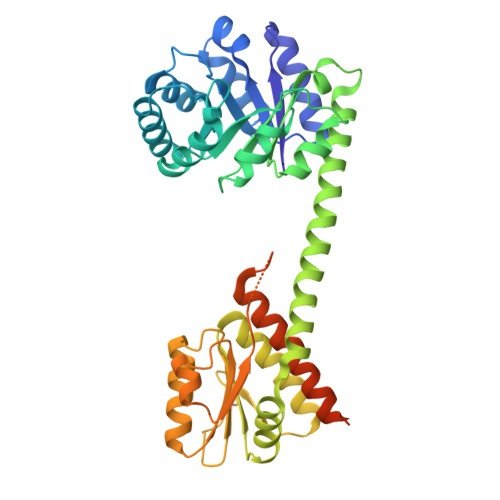
Crystal Structure, Mutations, and Catalytic Properties of 3-Hexulose-6-phosphate Synthase from Pyrococcus horikoshii.
Li, Y., Liu, Y., Ji, Y., Xu, H., Wang, H., Feng, Y., Liu, L.(2025) J Agric Food Chem 73: 17103-17113
- PubMed: 40580126 Search on PubMed
- DOI: https://doi.org/10.1021/acs.jafc.5c02365
- Primary Citation Related Structures:
9LJ9 - PubMed Abstract:
3-Hexulose-6-phosphate synthase, a key enzyme in the ribulose monophosphate pathway, plays a central role in formaldehyde assimilation and detoxification, offering great potential for third-generation green biomanufacturing. In this study, we determined the crystal structure of HPS from Pyrococcus horikoshii at a 2.64 Å resolution. Combined approaches, including molecular docking, multiple sequence alignment, and alanine scanning, identified critical catalytic residues. Two variants, T136C and V186W, exhibited over 6-fold higher activity than the wild type. Molecular dynamics simulations indicated increased structural rigidity and enhanced stability upon substrate (d-ribulose-5-phosphate) binding, along with significantly improved binding energies. Furthermore, an enzyme cascade converting d-xylose and formaldehyde to d-fructose-6-phosphate was constructed to evaluate the HPS activity under optimized conditions. These findings provide insights into the catalytic mechanism of HPS and offer a basis for its application in one-carbon bioconversion.
- College of Life Science and Technology, Beijing University of Chemical Technology, No. 15 East Road of North Third Ring Road, Beijing 100029, China.
Organizational Affiliation: