Download Mendeley
Discovery of Potent, Allosteric GSTO1 Covalent Inhibitors with a New Binding Mode.
Sun, Y., Zhang, F., Zhou, L., Feng, Y., Yang, S., Lu, Q., Yuan, X., Hou, W., Liu, B., Guo, Z., Chen, L., Peng, B., Yin, X., Zhang, Y., Yang, J., Chen, N., Lu, W.(2025) J Med Chem 68: 24075-24093
- PubMed: 41233953 Search on PubMed
- DOI: https://doi.org/10.1021/acs.jmedchem.5c01724
- Primary Citation Related Structures:
9LHF - PubMed Abstract:
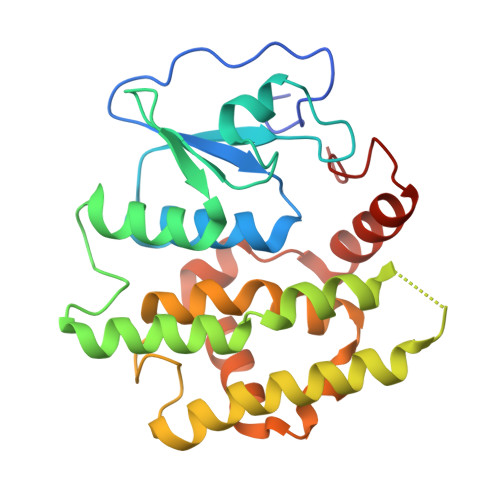
GSTO1 activates the NLRP3 inflammasome by deglutathionylating NEK7 at Cys253, driving proinflammatory responses. Using PRM-based targeted mass spectrometry, we identified compound A1 as a covalent GSTO1 inhibitor modifying Cys32. Ligand-based optimization generated analogues with diverse activities; among them, A13 exhibited moderate target engagement ( k inact / K I = 226 M -1 ·s -1 ), excellent cysteine selectivity confirmed by desthiobiotin iodoacetamide (DBIA)- and alkyne-based ABPP, and superior metabolic stability in human liver microsomes. High-resolution crystal structures revealed an unexpected A13 binding mode occupying a new hydrophobic pocket distinct from known GSTO1 inhibitors. Functionally, covalent targeting of GSTO1-C32 by A13 markedly reduced LPS-induced IL-1β and IL-18 secretion in human monocyte-derived macrophages. Collectively, these results identify A13 as a potent, selective, and metabolically stable lead compound for developing next-generation GSTO1 inhibitors targeting inflammatory diseases.
- Lingang Laboratory, Shanghai 200031, China.
Organizational Affiliation: