Download Mendeley
Molecular Insight Into the Hydrolysis of Phthalate Esters by a Family IV Esterase.
Rong, Z., Hong, L.G., Huo, Y.Y., Li, J., Zheng, D.Q., Ha, Y., Fan, J., Xu, X.W., Wu, Y.H.(2025) Environ Microbiol 27: e70134-e70134
- PubMed: 40600832 Search on PubMed
- DOI: https://doi.org/10.1111/1462-2920.70134
- Primary Citation Related Structures:
9LF7 - PubMed Abstract:
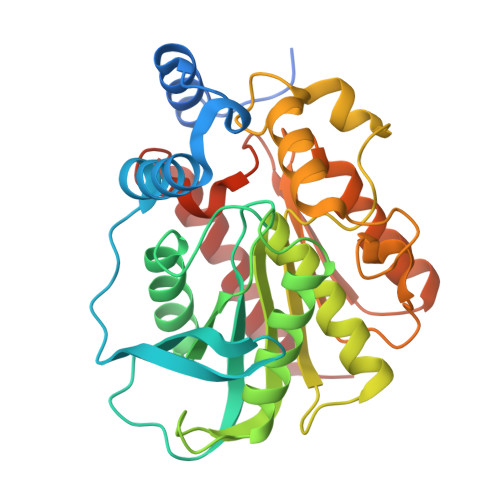
Phthalate esters (PAEs) are prevalent environmental contaminants, with their biodegradation efficiently driven by microorganisms through ester bond hydrolysis. This study investigates the mechanism of Poc14, a novel family IV esterase, using x-ray crystallography, bioinformatics, biochemistry and site-directed mutagenesis. Phylogenetic analysis classifies Poc14 as a family IV esterase with conserved catalytic motifs crucial for its activity. Poc14 retains over 80% activity at 50°C for 4 h and tolerates up to 5% methanol or DMF, though surfactants like Tweens inhibit its function. Poc14 activity is independent of metal ions, and the addition of EDTA further enhances its activity by approximately 130%. The 1.8 Å crystal structure reveals a CAP domain and two substrate channels. Enzyme assays show Poc14 hydrolyses short-chain diethyl phthalate (DEP) (K m = 0.068 mM, V max = 9975 μM/min/mg) but not long-chain di(2-ethylhexyl) phthalate (DEHP) due to steric hindrance. Molecular docking assessed Poc14's potential to hydrolyse DEP and DEHP after residue mutations, resulting in the Poc14-AAG variant. Poc14-AAG could hydrolyse one bond of DEHP and diester bonds of DEP. Our study positions Poc14 as a promising enzyme for environmental remediation, with potential for optimising DEHP degradation and exploring dimerisation effects.
- State Key Laboratory of Submarine Geoscience, Second Institute of Oceanography, Ministry of Natural Resources, Hangzhou, People's Republic of China.
Organizational Affiliation: