9LBG | pdb_00009lbg

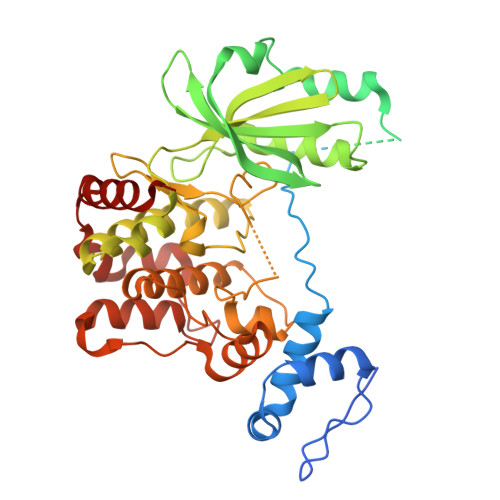
The crystal structure of the truncated PAK2 containing K278R mutant


Experimental Data Snapshot

  • Method: X-RAY DIFFRACTION
  • Resolution: 2.89 Å
  • R-Value Free: 
    0.233 (Depositor), 0.228 (DCC) 
  • R-Value Work: 
    0.195 (Depositor), 0.196 (DCC) 

Starting Model: experimental
View more details

wwPDB Validation   3D Report Full Report


This is version 1.1 of the entry. See complete history


Literature

Crystal structures of PAK2 reveal new insights into its autoinhibitory mechanism.

Hu, H.F.Luo, Z.Zhang, Y.Fang, X.Zhu, Z.Wu, J.W.Wang, Z.X.

(2025) Structure 33: 1663

  • DOI: https://doi.org/10.1016/j.str.2025.07.008
  • Primary Citation of Related Structures:  
    9LBF, 9LBG, 9M41

  • PubMed Abstract: 

    Type I p21-activated kinases (PAK1/2/3) exist in an auto-inhibited form and are stimulated by small G-protein binding and auto-phosphorylation. Previous structural and biochemical studies suggested that PAK1 is a dimer in crystals, and probably in a trans-inhibited conformation in solution. Here, we used multiple independent biochemical and biophysical methods to determine the oligomeric state and autoinhibitory mechanism of PAK2. Crystal structures of the full-length and N-terminal truncated PAK2 reveal the molecular basis underlying the PAK2 autoinhibition. Analytical ultracentrifugation studies show that these proteins have molecular weights that are consistent with monomeric species. The solution-phase structure of the full-length PAK2 by small angle X-ray scattering and computational modeling further shows a compact but elongated molecular shape. These results, taken together with the results of previous studies, demonstrate that in contrast with the most widely accepted model, all three type I PAKs are monomeric in solution and auto-inhibited in cis before activation.


  • Organizational Affiliation
    • MOE Key Laboratory of Geriatric Diseases and Immunology, Institute of Molecular Enzymology, Soochow University, Suzhou, Jiangsu 215123, P.R. China; MOE Key Laboratory for Protein Sciences, School of Life Sciences, Tsinghua University, Beijing 100084, P.R. China.

Macromolecules
Find similar proteins by:  (by identity cutoff)  |  3D Structure
Entity ID: 1
MoleculeChains Sequence LengthOrganismDetailsImage
Serine/threonine-protein kinase PAK 2
A, B
466Homo sapiensMutation(s): 1 
Gene Names: PAK2
EC: 2.7.11.1
UniProt & NIH Common Fund Data Resources
Find proteins for Q13177 (Homo sapiens)
Explore Q13177 
Go to UniProtKB:  Q13177
PHAROS:  Q13177
GTEx:  ENSG00000180370 
Entity Groups  
Sequence Clusters30% Identity50% Identity70% Identity90% Identity95% Identity100% Identity
UniProt GroupQ13177
Sequence Annotations
Expand
  • Reference Sequence
Experimental Data & Validation

Experimental Data

  • Method: X-RAY DIFFRACTION
  • Resolution: 2.89 Å
  • R-Value Free:  0.233 (Depositor), 0.228 (DCC) 
  • R-Value Work:  0.195 (Depositor), 0.196 (DCC) 
Space Group: H 3 2
Unit Cell:
Length ( Å )Angle ( ˚ )
a = 166.935α = 90
b = 166.935β = 90
c = 208.988γ = 120
Software Package:
Software NamePurpose
REFMACrefinement
HKL-2000data reduction
HKL-2000data scaling
PHASERphasing

Structure Validation

View Full Validation Report


Entry History & Funding Information

Deposition Data


Funding OrganizationLocationGrant Number
National Natural Science Foundation of China (NSFC)China--
Ministry of Science and Technology (MoST, China)China--

Revision History  (Full details and data files)

  • Version 1.0: 2025-08-13
    Type: Initial release
  • Version 1.1: 2025-10-22
    Changes: Database references