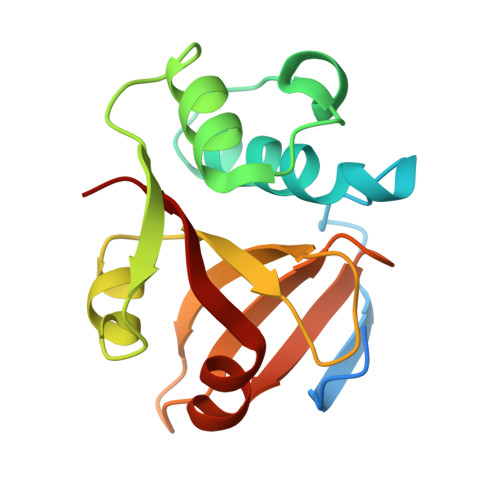
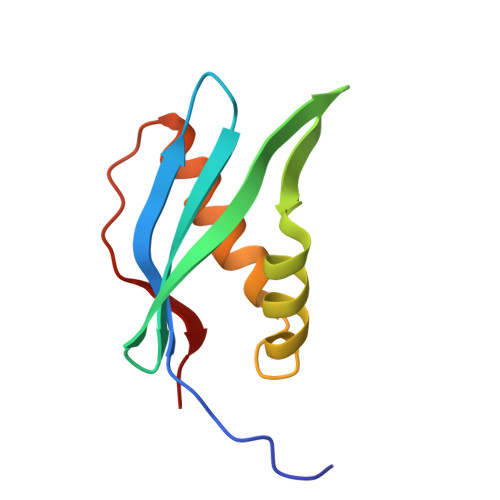
9L5U | pdb_00009l5u

Papain-like cysteine protease toxin/immunity pair


Experimental Data Snapshot

  • Method: X-RAY DIFFRACTION
  • Resolution: 1.87 Å
  • R-Value Free: 
    0.197 (Depositor), 0.198 (DCC) 
  • R-Value Work: 
    0.171 (Depositor), 0.172 (DCC) 
  • R-Value Observed: 
    0.172 (Depositor) 

wwPDB Validation   3D Report Full Report


This is version 1.0 of the entry. See complete history


Literature

An interbacterial cysteine protease toxin inhibits cell growth by targeting type II DNA topoisomerases GyrB and ParE.

Song, P.Y.Tsai, C.E.Chen, Y.C.Huang, Y.W.Chen, P.P.Wang, T.H.Hu, C.Y.Chen, P.Y.Ku, C.Hsia, K.C.Ting, S.Y.

(2025) PLoS Biol 23: e3003208-e3003208

  • DOI: https://doi.org/10.1371/journal.pbio.3003208
  • Primary Citation of Related Structures:  
    9L5U

  • PubMed Abstract: 

    Bacteria deploy a diverse arsenal of toxic effectors to antagonize competitors, profoundly influencing the composition of microbial communities. Previous studies have identified an interbacterial toxin predicted to exhibit proteolytic activity that is broadly distributed among gram-negative bacteria. However, the precise mechanism of intoxication remains unresolved. Here, we demonstrate that one such protease toxin from Escherichia coli, Cpe1, disrupts DNA replication and chromosome segregation by cleaving conserved sequences within the ATPase domain of type II DNA topoisomerases GyrB and ParE. This cleavage effectively inhibits topoisomerase-mediated relaxation of supercoiled DNA, resulting in impaired bacterial growth. Cpe1 belongs to the papain-like cysteine protease family and is associated with toxin delivery pathways, including the type VI secretion system and contact-dependent growth inhibition. The structure of Cpe1 in complex with its immunity protein reveals a neutralization mechanism involving competitive substrate binding rather than active site occlusion, distinguishing it from previously characterized effector-immunity pairs. Our findings unveil a unique mode of interbacterial intoxication and provide insights into how bacteria protect themselves from self-poisoning by protease toxins.


  • Organizational Affiliation
    • Molecular and Cell Biology, Taiwan International Graduate Program, Academia Sinica and National Defense Medical Center, Taipei, Taiwan.

Macromolecules
Find similar proteins by:  (by identity cutoff)  |  3D Structure
Entity ID: 1
MoleculeChains Sequence LengthOrganismDetailsImage
DUF4150 domain-containing protein
A, B
156Escherichia coli DSM 30083 = JCM 1649 = ATCC 11775Mutation(s): 0 
Gene Names: xmtUD3C88_22085IFC14_004794NCTC9001_00711
UniProt
Find proteins for P0DXX9 (Escherichia coli O1:K1:H7 (strain ATCC 11775 / DSM 30083 / JCM 1649 / NBRC 102203 / NCTC 9001 / U5/41))
Explore P0DXX9 
Go to UniProtKB:  P0DXX9
Entity Groups  
Sequence Clusters30% Identity50% Identity70% Identity90% Identity95% Identity100% Identity
UniProt GroupP0DXX9
Sequence Annotations
Expand
  • Reference Sequence
Find similar proteins by:  (by identity cutoff)  |  3D Structure
Entity ID: 2
MoleculeChains Sequence LengthOrganismDetailsImage
Cpi1
C, D
96Escherichia coli DSM 30083 = JCM 1649 = ATCC 11775Mutation(s): 0 
Gene Names: aec11xmtVB6R31_003793BK383_27470BvCmsNSP007_02591D3C88_22090IFC14_004793NCTC9001_00710
UniProt
Find proteins for P0DXY0 (Escherichia coli O1:K1:H7 (strain ATCC 11775 / DSM 30083 / JCM 1649 / NBRC 102203 / NCTC 9001 / U5/41))
Explore P0DXY0 
Go to UniProtKB:  P0DXY0
Entity Groups  
Sequence Clusters30% Identity50% Identity70% Identity90% Identity95% Identity100% Identity
UniProt GroupP0DXY0
Sequence Annotations
Expand
  • Reference Sequence
Experimental Data & Validation

Experimental Data

  • Method: X-RAY DIFFRACTION
  • Resolution: 1.87 Å
  • R-Value Free:  0.197 (Depositor), 0.198 (DCC) 
  • R-Value Work:  0.171 (Depositor), 0.172 (DCC) 
  • R-Value Observed: 0.172 (Depositor) 
Space Group: P 43 21 2
Unit Cell:
Length ( Å )Angle ( ˚ )
a = 104.137α = 90
b = 104.137β = 90
c = 128.709γ = 90
Software Package:
Software NamePurpose
PHENIXrefinement
HKL-2000data reduction
PHENIXphasing

Structure Validation

View Full Validation Report


Entry History & Funding Information

Deposition Data


Funding OrganizationLocationGrant Number
Academia Sinica (Taiwan)Taiwan--

Revision History  (Full details and data files)

  • Version 1.0: 2025-06-04
    Type: Initial release