9L3T | pdb_00009l3t

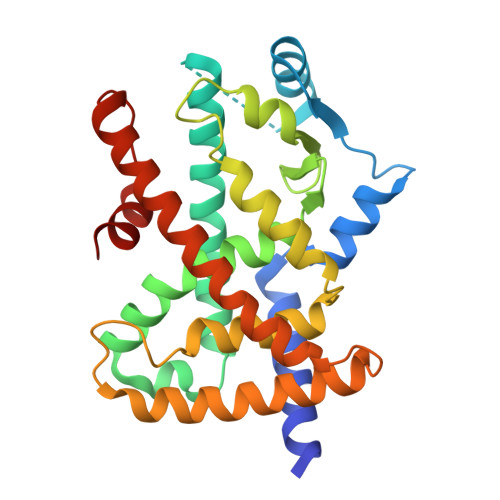
PPARgamma Ligand binding domain in complex with piperine


Experimental Data Snapshot

  • Method: X-RAY DIFFRACTION
  • Resolution: 2.36 Å
  • R-Value Free: 
    0.255 (Depositor), 0.260 (DCC) 
  • R-Value Work: 
    0.201 (Depositor), 0.200 (DCC) 

Starting Model: experimental
View more details

wwPDB Validation   3D Report Full Report


Ligand Structure Quality Assessment 


This is version 1.1 of the entry. See complete history


Literature

Molecular interactions between piperine and peroxisome proliferator-activated receptor gamma ligand-binding domain revealed using co-crystallization studies.

Egawa, D.Ishida, H.Katakawa, K.

(2025) Acta Crystallogr F Struct Biol Commun 81: 201-206

  • DOI: https://doi.org/10.1107/S2053230X25002377
  • Primary Citation of Related Structures:  
    9L3T

  • PubMed Abstract: 

    Piperine has been investigated for a diverse array of biological effects, including a potential role in modulating peroxisome proliferator-activated receptor gamma (PPARγ), a nuclear receptor that plays a pivotal role in regulating lipid and glucose metabolism. This study conducted a comprehensive co-crystallographic analysis of the complex of piperine with the PPARγ ligand-binding domain (PPARγ-LBD), with the objective of elucidating the precise binding interactions of piperine. The co-crystal structure revealed that piperine binds within the ligand-binding pocket of PPARγ-LBD via hydrogen-bonding and hydrophobic interactions with residues of the ligand-binding site. Notably, in contrast to conventional full agonists, piperine does not directly stabilize helix H12. This could contribute to the comparatively weaker agonistic activity of piperine. The results of this study also suggest that piperine binding facilitates a role as a partial agonist or even an antagonist under certain physiological conditions. Collectively, these findings contribute to a greater understanding of the manner in which piperine modulates PPARγ function and its potential as a therapeutic candidate for the treatment of metabolic disorders. Given its natural origin and relatively minimal side-effect profile, piperine and its derivatives could be promising alternatives to synthetic PPARγ modulators such as thiazolidinediones, which have significant side effects.


  • Organizational Affiliation
    • Department of Clinical Pharmacy, Shonan University of Medical Sciences, 16-10 Kamishinano, Totsuka-ku, Yokohama, Kanagawa 244-0806, Japan.

Macromolecules
Find similar proteins by:  (by identity cutoff)  |  3D Structure
Entity ID: 1
MoleculeChains Sequence LengthOrganismDetailsImage
Peroxisome proliferator-activated receptor gamma
A, B
276Homo sapiensMutation(s): 0 
Gene Names: PPARG
UniProt & NIH Common Fund Data Resources
Find proteins for P37231 (Homo sapiens)
Explore P37231 
Go to UniProtKB:  P37231
PHAROS:  P37231
GTEx:  ENSG00000132170 
Entity Groups  
Sequence Clusters30% Identity50% Identity70% Identity90% Identity95% Identity100% Identity
UniProt GroupP37231
Sequence Annotations
Expand
  • Reference Sequence
Small Molecules
Ligands 1 Unique
IDChains Name / Formula / InChI Key2D Diagram3D Interactions
AYR (Subject of Investigation/LOI)
Query on AYR

Download Ideal Coordinates CCD File 
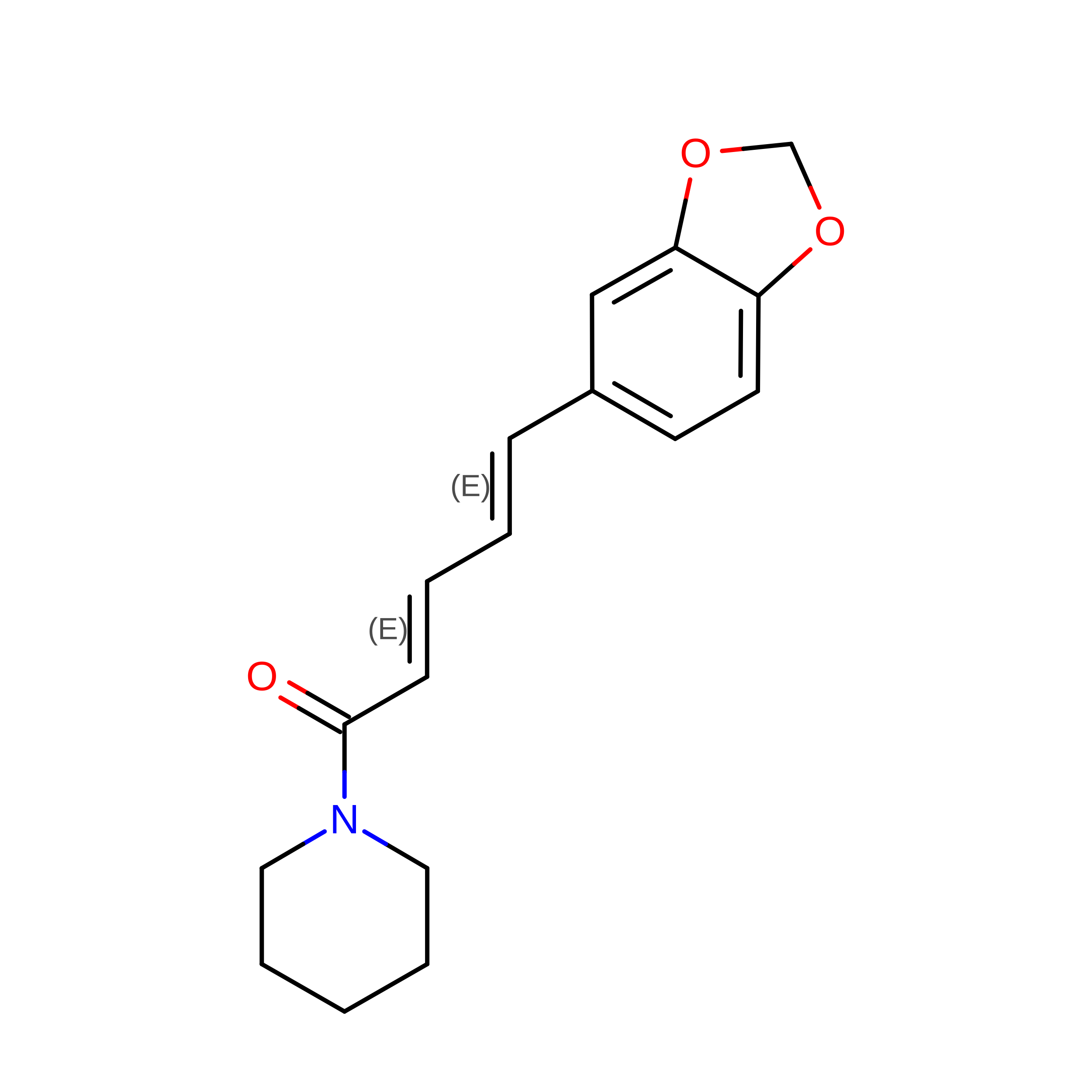
C [auth A](2E,4E)-5-(2H-1,3-benzodioxol-5-yl)-1-(piperidin-1-yl)penta-2,4-dien-1-one
C17 H19 N O3
MXXWOMGUGJBKIW-YPCIICBESA-N
Experimental Data & Validation

Experimental Data

  • Method: X-RAY DIFFRACTION
  • Resolution: 2.36 Å
  • R-Value Free:  0.255 (Depositor), 0.260 (DCC) 
  • R-Value Work:  0.201 (Depositor), 0.200 (DCC) 
Space Group: C 1 2 1
Unit Cell:
Length ( Å )Angle ( ˚ )
a = 93.43α = 90
b = 62.02β = 102.09
c = 119.49γ = 90
Software Package:
Software NamePurpose
REFMACrefinement
Aimlessdata scaling
iMOSFLMdata reduction
REFMACphasing

Structure Validation

View Full Validation Report


Ligand Structure Quality Assessment 


Entry History & Funding Information

Deposition Data


Funding OrganizationLocationGrant Number
Not funded--

Revision History  (Full details and data files)

  • Version 1.0: 2025-04-16
    Type: Initial release
  • Version 1.1: 2025-05-07
    Changes: Database references