Download Mendeley
Next-generation inhibitors of SARS-CoV-2 M pro overcome the deficiencies of Paxlovid.
Luo, G., Wang, G., Liao, C., Zhong, B., Fan, L., Zhang, J., Rao, J., Zhang, J., Wang, Z., Luo, M., Yan, Y., Lu, L., Xu, W., Wu, F., Gao, X., Lu, W.(2026) Nat Commun 17
- PubMed: 41935038 Search on PubMedSearch on PubMed Central
- DOI: https://doi.org/10.1038/s41467-026-71436-6
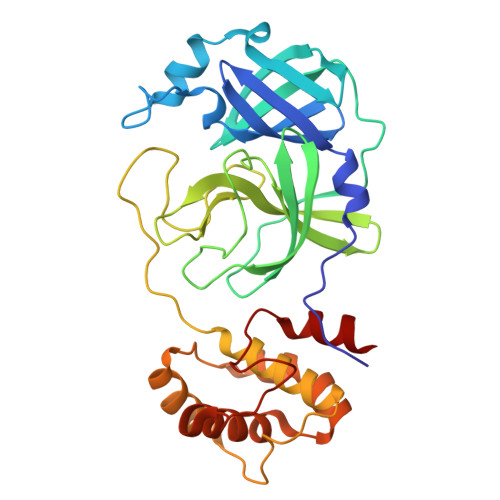
- Primary Citation Related Structures:
9L13 - PubMed Abstract:
It remains elusive to design peptidomimetic inhibitors of SARS-CoV-2 main protease (M pro ) refractory to multiple deficiencies of Paxlovid (ritonavir-boosted nirmatrelvir), pertaining mainly to E166X mutations-conferred drug resistance and inherent pharmacokinetic limitations to nirmatrelvir. We identify via virtual screening an iso-quinoline P1 moiety in place of the traditional γ-lactam and design iso-quinoline-containing inhibitors with high affinity for M pro and its nirmatrelvir-resistant E166X mutants. Further optimization at P4 cultivates distinctive peptidomimetic inhibitors with drastically improved pharmacokinetic properties and significantly enhanced antiviral efficacy independent of ritonavir. Two such inhibitors, FD3-32 and FD3-36, also potent against SARS-CoV-1 and MERS-CoV M pro , are more effective as a monotherapy regimen than Paxlovid in reducing viral loads in vivo and protecting infected male mice from acute lung injury. Here, we report the discovery of next-generation SARS-CoV-2 M pro inhibitors that overcome the deficiencies of Paxlovid, promising efficacious antivirals critical for mitigating the current and future pandemics of coronaviruses.
- Key Laboratory of Medical Molecular Virology (MOE/NHC/CAMS), Shanghai Institute of Infectious Disease and Biosecurity, School of Basic Medical Sciences, Shanghai Medical College, Fudan University, Shanghai, China.
Organizational Affiliation: