Download Mendeley
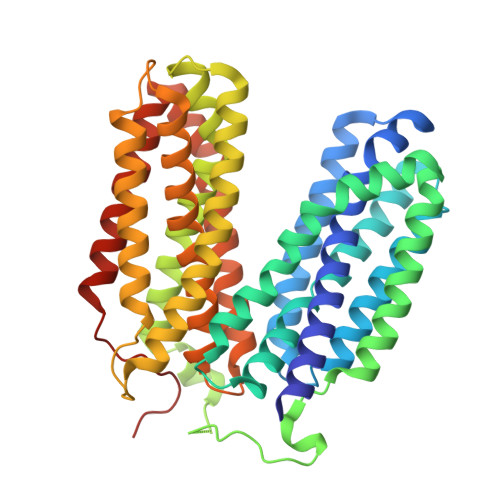
Structural basis for transport and inhibition of the human glucose-6-phosphate transporter G6PT.
Xia, Z., Wang, Y., Wu, D., Chi, C., Li, C., Chen, L., Jiang, D.(2025) Nat Commun 16: 9420-9420
- PubMed: 41136424 Search on PubMedSearch on PubMed Central
- DOI: https://doi.org/10.1038/s41467-025-64464-1
- Primary Citation Related Structures:
9KUY, 9KV0, 9KVV - PubMed Abstract:
The human glucose-6-phosphate transporter (G6PT) moves glucose-6-phosphate (G6P) into the lumen of endoplasmic reticulum, playing a vital role in glucose homeostasis. Dysregulation of G6PT causes glycogen storage disease 1b. Despite its functional importance, the structure, G6P recognition, and inhibition mechanism of G6PT remain unclear. Here, we report the cryo-EM structures of human G6PT in apo, G6P-bound, and the specific inhibitor chlorogenic acid (CHA)-bound forms, elucidating the structural basis for G6PT transport and inhibition. The G6P pocket comprises subsite A for phosphate and subsite B for glucose. The CHA occupies the G6P site and locks G6PT in a partly-occluded state. Functional assays demonstrate that G6PT activity is enhanced by co-expression of glucose-6-phosphatase (G6PC), but G6PT does not form a complex with G6PC. Together, this study provides a solid foundation for understanding the structure‒function relationships and pathology of G6PT and sheds light on the future development of potential therapeutics targeting G6PT.
- Beijing National Laboratory for Condensed Matter Physics, Laboratory of Soft Matter Physics, Institute of Physics, Chinese Academy of Sciences, Beijing, China.
Organizational Affiliation: