Download Mendeley
Molecular and Structural Characterization of a Chalcone di- C -Methyltransferase RdCMT from Rhododendron dauricum and Its Application in De Novo Biosynthesis of Farrerol in Pichia pastoris .
Zhang, M., Bao, Y.O., Dai, Z., Qian, Z., Yu, H., Zhou, J.J., Chen, Y., Wang, Z., Wang, K., Cai, M., Ye, M.(2025) J Am Chem Soc 147: 17132-17143
- PubMed: 40331654 Search on PubMed
- DOI: https://doi.org/10.1021/jacs.5c02654
- Primary Citation Related Structures:
9KUS - PubMed Abstract:
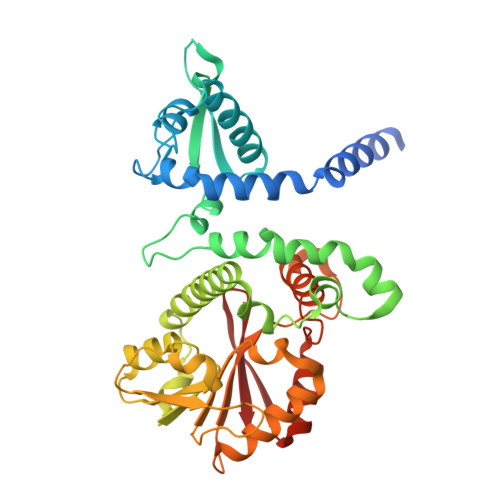
Methylation plays a crucial role in drug design and optimization. While numerous methyltransferases have been characterized from plants, C -methyltransferases, particularly those targeting phenolic skeletons, are rare. In this study, we identified a novel di- C -methyltransferase RdCMT from the medicinal plant Rhododendron dauricum . RdCMT catalyzes a sequential two-step 3'- C /5'- C -methylation of naringenin chalcone, leading to the biosynthesis of farrerol. RdCMT exhibited a strict substrate specificity for chalcones. Through combinatorial catalysis, a series of C -methylated flavonoids were synthesized. Moreover, farrerol was synthesized de novo in Nicotiana benthamiana and Pichia pastoris with yields of 0.4 mg/g (dry weight) and 149.0 mg/L, respectively. The structure of RdCMT was determined using cryo-electron microscopy (cryo-EM), revealing that residues R328 and G296 significantly influence the substrate specificity of RdCMT. This work not only introduces a potent biocatalyst for the preparation of C -methylated flavonoids but also offers insights into the catalytic mechanisms of C -methyltransferases.
- State Key Laboratory of Natural and Biomimetic Drugs, School of Pharmaceutical Sciences, Peking University, Beijing 100191, China.
Organizational Affiliation: