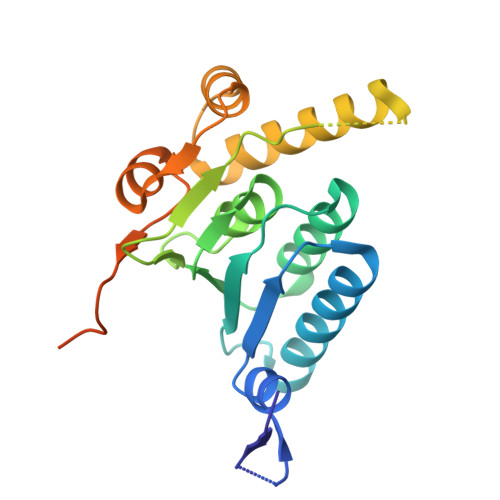
9KUF | pdb_00009kuf

Cryo-EM structure of HsClpP bound to CLPP-2068


Experimental Data Snapshot

  • Method: ELECTRON MICROSCOPY
  • Resolution: 2.45 Å
  • Aggregation State: PARTICLE 
  • Reconstruction Method: SINGLE PARTICLE 

Starting Model: experimental
View more details

wwPDB Validation   3D Report Full Report


This is version 1.1 of the entry. See complete history


Literature

Harnessing the Magic Methyl Effect: Discovery of CLPP-2068 as a Novel HsClpP Activator for the Treatment of Diffuse Large B-Cell Lymphoma.

Sun, M.Chen, B.Teng, D.Zhao, H.Liao, Y.Zhang, C.Huang, Q.Ma, H.Wang, C.Lin, X.Yu, P.Yuan, Q.Yu, J.Xu, L.Hu, X.Ye, F.Diao, X.Zheng, M.Yin, W.Zhou, Y.Li, J.Wang, M.

(2025) J Med Chem 68: 4287-4307

  • DOI: https://doi.org/10.1021/acs.jmedchem.4c02016
  • Primary Citation of Related Structures:  
    9KUF

  • PubMed Abstract: 

    The "magic methyl effect" has facilitated the successful development of numerous pharmaceutical compounds. During the development of Hs ClpP activators, we found that incorporating methyl groups into the bicyclic imipridone scaffolds significantly enhanced the activator activity at the enzymatic level. Further structure-activity relationship studies led to the identification of a highly promising compound, CLPP-2068 , which exhibited an EC 50 value of 50.4 nM. Cryo-electron microscopy techniques and computational analyses demonstrated that the introduction of methyl groups facilitated the formation of additional CH-π interactions between CLPP-2068 and Hs ClpP, thereby lowering the energy barriers during the binding process. Furthermore, additional pharmaceutical analyses indicated that CLPP-2068 exhibited favorable pharmacokinetic properties and effectively mitigated the potential hERG toxicity observed in imipridone-based Hs ClpP activators. Collectively, CLPP-2068 , developed using the magic methylation strategy, holds potential as a therapeutic agent for the treatment of diffuse large B-cell lymphoma, thereby expanding the clinical indications for Hs ClpP activators.


  • Organizational Affiliation
    • Zhongshan Institute for Drug Discovery, Shanghai Institute of Materia Medica, Chinese Academy of Sciences, Tsuihang New District, Zhongshan, Guangdong 528400, China.

Macromolecules
Find similar proteins by:  (by identity cutoff)  |  3D Structure
Entity ID: 1
MoleculeChains Sequence LengthOrganismDetailsImage
ATP-dependent Clp protease proteolytic subunit, mitochondrial
A, B, C, D, E
A, B, C, D, E, F, G, H, I, J, K, L, M, N
219Homo sapiensMutation(s): 0 
Gene Names: CLPP
EC: 3.4.21.92
UniProt & NIH Common Fund Data Resources
Find proteins for Q16740 (Homo sapiens)
Explore Q16740 
Go to UniProtKB:  Q16740
PHAROS:  Q16740
GTEx:  ENSG00000125656 
Entity Groups  
Sequence Clusters30% Identity50% Identity70% Identity90% Identity95% Identity100% Identity
UniProt GroupQ16740
Sequence Annotations
Expand
  • Reference Sequence
Small Molecules
Ligands 1 Unique
IDChains Name / Formula / InChI Key2D Diagram3D Interactions
A1EG3
Query on A1EG3

Download Ideal Coordinates CCD File 
AA [auth M]
BA [auth N]
O [auth A]
P [auth B]
Q [auth C]
AA [auth M],
BA [auth N],
O [auth A],
P [auth B],
Q [auth C],
R [auth D],
S [auth E],
T [auth F],
U [auth G],
V [auth H],
W [auth I],
X [auth J],
Y [auth K],
Z [auth L]
3-[[(7~{R})-2-[(4-bromophenyl)methylamino]-7-methyl-4-oxidanylidene-3,5,7,8-tetrahydropyrido[4,3-d]pyrimidin-6-yl]methyl]benzenecarbonitrile
C23 H22 Br N5 O
ZBPOHFMDQNQRRG-OAHLLOKOSA-N
Experimental Data & Validation

Experimental Data

  • Method: ELECTRON MICROSCOPY
  • Resolution: 2.45 Å
  • Aggregation State: PARTICLE 
  • Reconstruction Method: SINGLE PARTICLE 
EM Software:
TaskSoftware PackageVersion
RECONSTRUCTIONcryoSPARC4.4.1
MODEL REFINEMENTPHENIX1.21

Structure Validation

View Full Validation Report


Entry History & Funding Information

Deposition Data


Funding OrganizationLocationGrant Number
National Natural Science Foundation of China (NSFC)China--

Revision History  (Full details and data files)

  • Version 1.0: 2025-07-16
    Type: Initial release
  • Version 1.1: 2025-07-30
    Changes: Data collection, Database references, Experimental preparation