9KBO | pdb_00009kbo

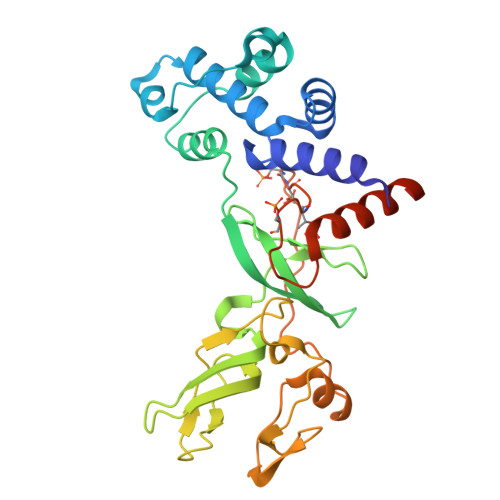
Crystal structure of human Shiftless (SFL) containing phosphorylation sites Ser249, Thr250, Thr253 and Ser256


Experimental Data Snapshot

  • Method: X-RAY DIFFRACTION
  • Resolution: 2.00 Å
  • R-Value Free: 
    0.286 (Depositor), 0.285 (DCC) 
  • R-Value Work: 
    0.222 (Depositor), 0.222 (DCC) 
  • R-Value Observed: 
    0.225 (Depositor) 

Starting Model: experimental
View more details

wwPDB Validation   3D Report Full Report


This is version 1.1 of the entry. See complete history


Literature

Phosphorylation of shiftless is important for inhibiting the programmed -1 ribosomal frameshift.

Zhang, Y.Li, Z.Chong, H.Hou, P.Hao, W.Li, M.Liu, Z.Jia, W.Qin, B.He, Y.Cui, S.

(2025) Sci Adv 11: eadw7471-eadw7471

  • DOI: https://doi.org/10.1126/sciadv.adw7471
  • Primary Citation of Related Structures:  
    9KBO

  • PubMed Abstract: 

    Shiftless (SFL) is a broad-spectrum inhibitor of programmed -1 ribosomal frameshift (-1 PRF) and exhibits various antiviral activities. Here, we characterized human SFL structurally and biochemically. The 2.0-angstrom resolution crystal structure of SFL reveals a boat-like module comprising an N-terminal helical bundle and three zinc fingers at the C terminus. A hyperphosphorylation loop (HPL) buried between the helical bundle and the zinc finger 1 harbors four phosphorylated residues (p-S249, p-T250 p-T253, and p-S256), which are important to protein folding. SFL forms monomers in solution and binds the HIV-1 -1 PRF sequence with nanomolar affinity ( K D  = 5.7 nanomolar). Disruption of HPL phosphorylation decreased the RNA binding affinity and undermined the SFL-mediated -1 PRF inhibition of various viruses. Proximity-dependent biotinylation identified three cellular Ser/Thr kinases-EEF2K, NEK9, and PBK-that phosphorylate SFL in cells. These findings shed light on the mechanisms underlying -1 PRF regulation by SFL and provide insights into the role of SFL in virus inhibition.


  • Organizational Affiliation
    • NHC Key Laboratory of Systems Biology of Pathogens, National Institute of Pathogen Biology, Chinese Academy of Medical Sciences & Peking Union Medical College, Beijing, China.

Macromolecules
Find similar proteins by:  (by identity cutoff)  |  3D Structure
Entity ID: 1
MoleculeChains Sequence LengthOrganismDetailsImage
Shiftless antiviral inhibitor of ribosomal frameshifting protein
A, B, C, D
291Homo sapiensMutation(s): 0 
Gene Names: SHFLC19orf66FLJ11286IRAVRYDENSFL
UniProt & NIH Common Fund Data Resources
Find proteins for Q9NUL5 (Homo sapiens)
Explore Q9NUL5 
Go to UniProtKB:  Q9NUL5
PHAROS:  Q9NUL5
GTEx:  ENSG00000130813 
Entity Groups  
Sequence Clusters30% Identity50% Identity70% Identity90% Identity95% Identity100% Identity
UniProt GroupQ9NUL5
Sequence Annotations
Expand
  • Reference Sequence
Small Molecules
Ligands 1 Unique
IDChains Name / Formula / InChI Key2D Diagram3D Interactions
ZN (Subject of Investigation/LOI)
Query on ZN

Download Ideal Coordinates CCD File 
E [auth A]
F [auth A]
G [auth A]
H [auth B]
I [auth B]
E [auth A],
F [auth A],
G [auth A],
H [auth B],
I [auth B],
J [auth B],
K [auth C],
L [auth C],
M [auth C],
N [auth D],
O [auth D]
ZINC ION
Zn
PTFCDOFLOPIGGS-UHFFFAOYSA-N
Modified Residues  2 Unique
IDChains TypeFormula2D DiagramParent
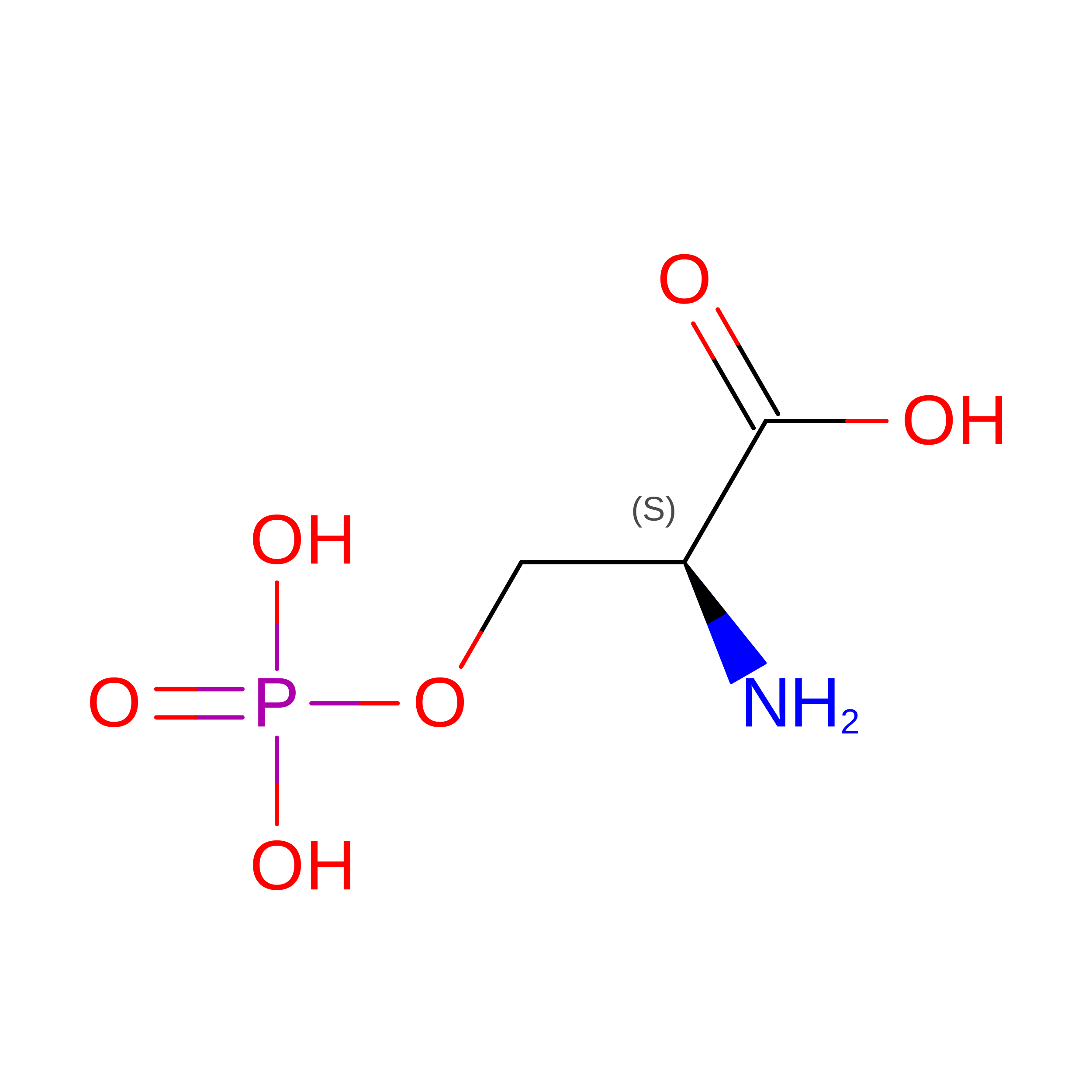
SEP
Query on SEP
A, B, C, D
L-PEPTIDE LINKINGC3 H8 N O6 PSER
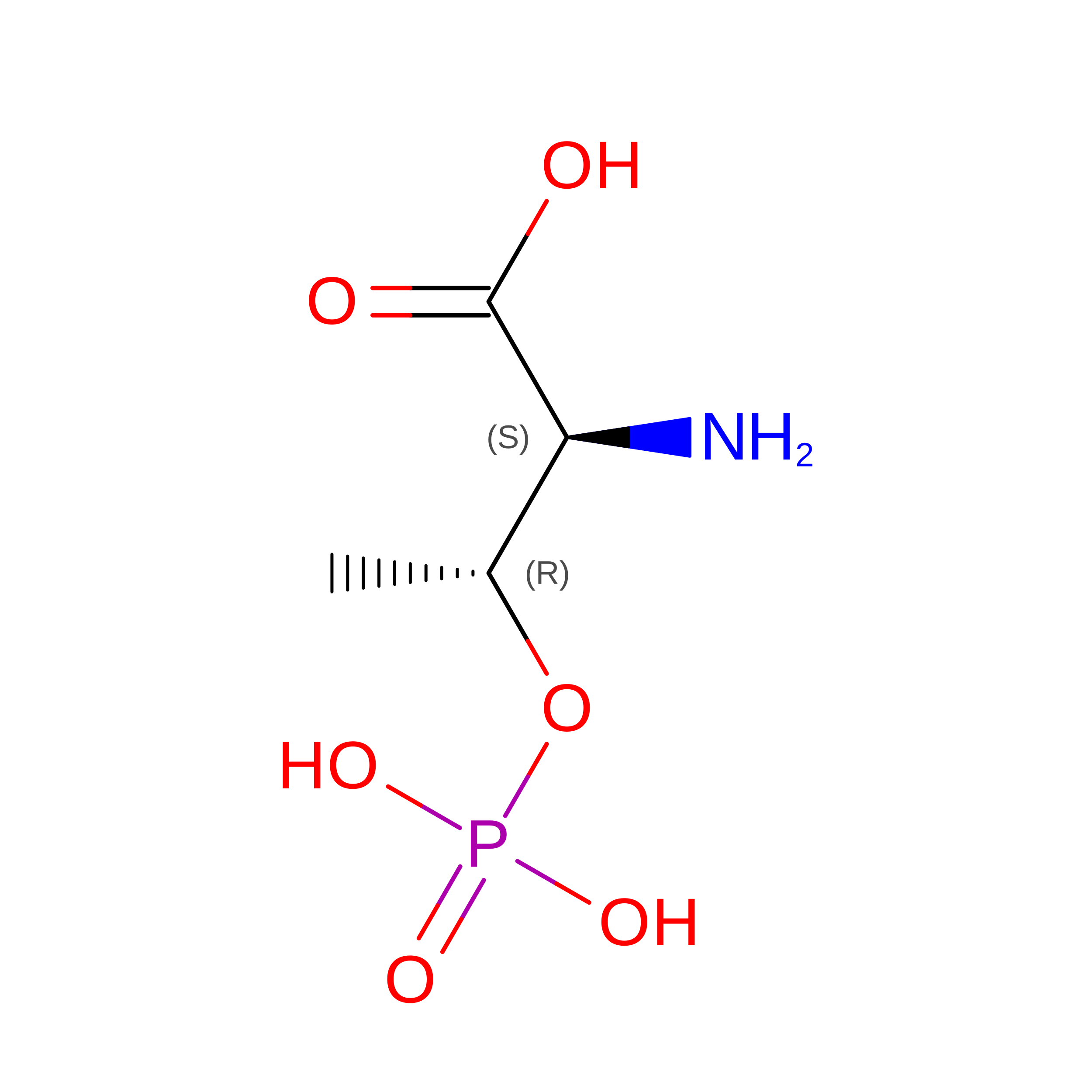
TPO
Query on TPO
A, B, C, D
L-PEPTIDE LINKINGC4 H10 N O6 PTHR
Experimental Data & Validation

Experimental Data

  • Method: X-RAY DIFFRACTION
  • Resolution: 2.00 Å
  • R-Value Free:  0.286 (Depositor), 0.285 (DCC) 
  • R-Value Work:  0.222 (Depositor), 0.222 (DCC) 
  • R-Value Observed: 0.225 (Depositor) 
Space Group: P 21 21 2
Unit Cell:
Length ( Å )Angle ( ˚ )
a = 211.719α = 90
b = 89.411β = 90
c = 82.265γ = 90
Software Package:
Software NamePurpose
PHENIXrefinement
PDB_EXTRACTdata extraction
XDSdata reduction
PHENIXphasing
STARANISOdata scaling

Structure Validation

View Full Validation Report


Entry History & Funding Information

Deposition Data


Funding OrganizationLocationGrant Number
Not funded--

Revision History  (Full details and data files)

  • Version 1.0: 2025-11-19
    Type: Initial release
  • Version 1.1: 2025-12-31
    Changes: Database references, Structure summary