Download Mendeley
Structure Profiling of Broad-Specificity Immunoassays: Multitarget Recognition for Sulfonylurea Adulteration in Food.
Yu, X., Zhou, T., Pan, K., Fan, M.H., Yan, X., Huang, X.A., Zhang, H., Shen, X., Xie, H., Gao, Y.G., Lei, H.(2025) J Agric Food Chem 73: 9348-9358
- PubMed: 40173361 Search on PubMed
- DOI: https://doi.org/10.1021/acs.jafc.5c00655
- Primary Citation Related Structures:
9KAS, 9KAT - PubMed Abstract:
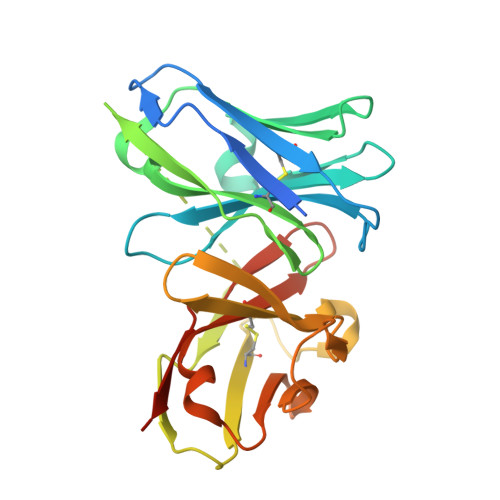
The limited understanding of the broad-specific antibody recognition mechanism significantly hinders the development of immunoassays for simultaneously detecting illegal adulterants. Herein, a recombinant antisulfonylureas (SUs) single-chain variable fragment (scFv), which retained the properties of its parental monoclonal antibody, was successfully generated. X-ray crystallography, molecular docking, functional assays, and mutation validation were used to investigate the structure-function relationships underlying antibody-SUs binding. Our study revealed three key mechanisms for broad specificity: (1) the conformational adaptability of the scFv, which enabled various SUs to access the binding pocket; (2) the role of the Trp98 residue in CDR-L3 in modulating binding affinities among multiple SUs; and (3) the design of haptens with common structures and more rigid R substituents, which emerged as a promising strategy for generating broad-specific antibodies. This study provides a comprehensive analysis of the broad-specific recognition mechanism, offering valuable insights for rational hapten design and targeted antibody evolution to advance multitarget immunoassays.
- Guangdong Provincial Key Laboratory of Food Quality and Safety, College of Food Science, South China Agricultural University, Guangzhou 510642, China.
Organizational Affiliation: