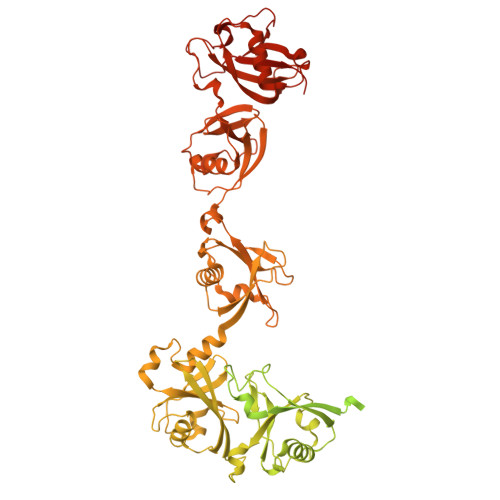
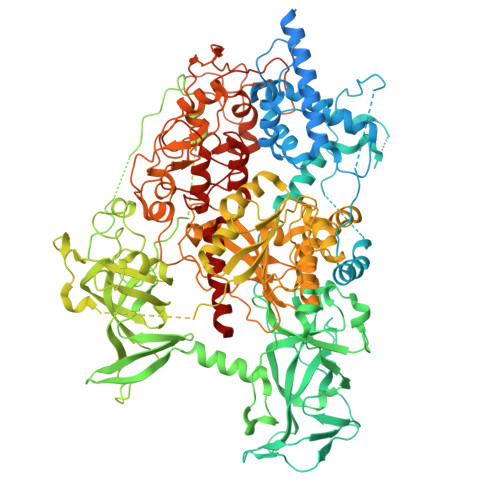
9K2X | pdb_00009k2x

Cryo-EM structure of USP7:DNMT1 complex; open conformation


Experimental Data Snapshot

  • Method: ELECTRON MICROSCOPY
  • Resolution: 3.75 Å
  • Aggregation State: PARTICLE 
  • Reconstruction Method: SINGLE PARTICLE 

wwPDB Validation   3D Report Full Report


This is version 1.1 of the entry. See complete history


Literature

Structures of USP7 in active and inactive states bound to DNMT1 revealed by cryo-EM.

Nakamura, N.Yoshimi, S.Kikuchi, A.Onoda, H.Kori, S.Nakanishi, M.Nishiyama, A.Arita, K.

(2025) Structure 33: 1510-1518.e5

  • DOI: https://doi.org/10.1016/j.str.2025.06.005
  • Primary Citation of Related Structures:  
    9K2W, 9K2X

  • PubMed Abstract: 

    The ubiquitin signal generated by UHRF1 is essential for DNA methylation maintenance by recruiting DNA methyltransferase 1 (DNMT1) to hemimethylated DNA through strong binding of its replication foci targeting sequence (RFTS) domain to ubiquitinated histone H3. The ubiquitin-specific protease 7 (USP7) forms a complex with DNMT1 and removes ubiquitin from H3. However, it remains unknown how USP7 deubiquitinates ubiquitinated H3 upon strong binding of the DNMT1 RFTS domain. Here, we show the activation mechanism of USP7 by combining biochemical and structural studies. USP7 is inactive toward ubiquitinated H3 in complex with the RFTS domain. However, when complexed with DNMT1, USP7 efficiently deubiquitinates ubiquitinated H3. Cryogenic electron microscopy (cryo-EM) single particle analysis revealed that USP7 bound to DNMT1 undergoes an open (inactive) and closed (active) conformational transition. Our findings provide mechanistic insights into the activation of USP7 upon binding to DNMT1 and contribute to a better understanding of the deubiquitination process in DNA methylation maintenance.


  • Organizational Affiliation
    • Structural Biology Laboratory, Graduate School of Medical Life Science, Yokohama City University, 1-7-29, Suehiro-cho, Tsurumi-ku, Yokohama 230-0045, Kanagawa, Japan.

Macromolecules
Find similar proteins by:  (by identity cutoff)  |  3D Structure
Entity ID: 1
MoleculeChains Sequence LengthOrganismDetailsImage
Ubiquitin carboxyl-terminal hydrolase 71,107Homo sapiensMutation(s): 0 
Gene Names: USP7HAUSP
EC: 3.4.19.12
UniProt & NIH Common Fund Data Resources
Find proteins for Q93009 (Homo sapiens)
Explore Q93009 
Go to UniProtKB:  Q93009
PHAROS:  Q93009
GTEx:  ENSG00000187555 
Entity Groups  
Sequence Clusters30% Identity50% Identity70% Identity90% Identity95% Identity100% Identity
UniProt GroupQ93009
Sequence Annotations
Expand
  • Reference Sequence
Find similar proteins by:  (by identity cutoff)  |  3D Structure
Entity ID: 2
MoleculeChains Sequence LengthOrganismDetailsImage
DNA (cytosine-5)-methyltransferase 11,271Homo sapiensMutation(s): 0 
Gene Names: DNMT1AIMCXXC9DNMT
EC: 2.1.1.37
UniProt & NIH Common Fund Data Resources
Find proteins for P26358 (Homo sapiens)
Explore P26358 
Go to UniProtKB:  P26358
PHAROS:  P26358
GTEx:  ENSG00000130816 
Entity Groups  
Sequence Clusters30% Identity50% Identity70% Identity90% Identity95% Identity100% Identity
UniProt GroupP26358
Sequence Annotations
Expand
  • Reference Sequence
Experimental Data & Validation

Experimental Data

  • Method: ELECTRON MICROSCOPY
  • Resolution: 3.75 Å
  • Aggregation State: PARTICLE 
  • Reconstruction Method: SINGLE PARTICLE 
EM Software:
TaskSoftware PackageVersion
MODEL REFINEMENTPHENIX

Structure Validation

View Full Validation Report


Entry History & Funding Information

Deposition Data


Funding OrganizationLocationGrant Number
Japan Society for the Promotion of Science (JSPS)JapanJP18H02392
Japan Society for the Promotion of Science (JSPS)JapanJP19H05294
Japan Society for the Promotion of Science (JSPS)JapanJP19H05741
Japan Society for the Promotion of Science (JSPS)Japan19H05285
Japan Society for the Promotion of Science (JSPS)Japan21H00272
Japan Society for the Promotion of Science (JSPS)Japan24K02001

Revision History  (Full details and data files)

  • Version 1.0: 2025-06-25
    Type: Initial release
  • Version 1.1: 2026-01-14
    Changes: Data collection, Database references