9K1L | pdb_00009k1l

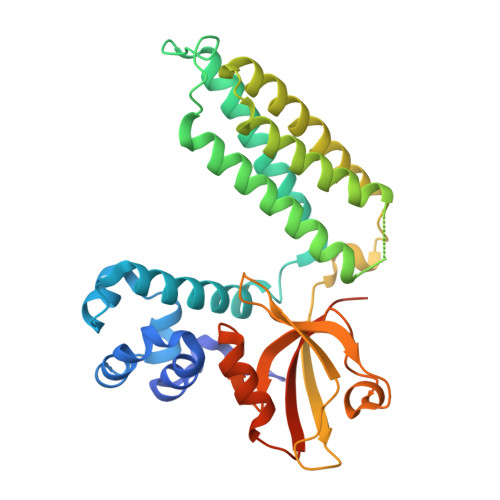
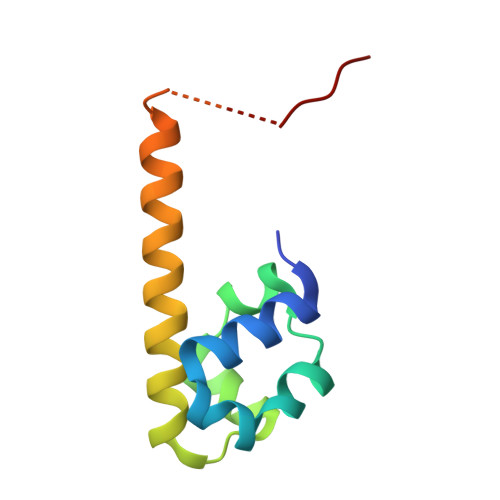
Complex structure of CNK2 and SAMD12


Experimental Data Snapshot

  • Method: X-RAY DIFFRACTION
  • Resolution: 2.85 Å
  • R-Value Free: 
    0.299 (Depositor), 0.307 (DCC) 
  • R-Value Work: 
    0.254 (Depositor), 0.266 (DCC) 
  • R-Value Observed: 
    0.256 (Depositor) 

Starting Model: experimental
View more details

wwPDB Validation   3D Report Full Report


This is version 1.1 of the entry. See complete history


Literature

SAMD12 as a Master Regulator of MAP4Ks by Decoupling Kinases From the CNKSR2 Scaffold.

Pan, W.Lin, Z.Chen, S.Li, J.Wang, Y.Chen, K.Zhang, M.

(2025) J Mol Biology 437: 169034-169034

  • DOI: https://doi.org/10.1016/j.jmb.2025.169034
  • Primary Citation of Related Structures:  
    9K1L

  • PubMed Abstract: 

    The MAP4K member TNIK and the multi-domain scaffold protein CNKSR2, both of which are clustered at neuronal synapses, interact with each other and are closely associated with neurodevelopmental disorders, although the mechanism underlying their interaction is unclear. In this study, we characterized the interaction mechanisms between MAP4K kinases (MAP4K4, MINK1 and TNIK) and the CNKSR1/2/3 scaffold proteins, and discovered that SAMD12, a familial adult myoclonic epilepsy disease gene product, or its close homolog SAMD10, binds to CNKSR1/2/3 with exceptionally strong affinities and can quantitatively displace MAP4K from CNKSR1/2/3 scaffolds. Additionally, we demonstrated that CNKSR2 acts as both a scaffold and an activator of TNIK during neuronal synapse development. Ectopic expression of SAMD12 can effectively alter synapse development, likely by inhibiting TNIK activity through the dissociation of the kinase from CNKSR2. Our findings may have broad implications on the roles of MAP4Ks and CNKSR1/2/3 in the nervous system and in other tissues under physiological and pathophysiological processes.


  • Organizational Affiliation
    • Shenzhen Key Laboratory of Biomolecular Assembling and Regulation, School of Life Sciences, Southern University of Science and Technology, Shenzhen 518055, China.

Macromolecules
Find similar proteins by:  (by identity cutoff)  |  3D Structure
Entity ID: 1
MoleculeChains Sequence LengthOrganismDetailsImage
Connector enhancer of kinase suppressor of ras 2319Mus musculusMutation(s): 0 
Gene Names: Cnksr2Kiaa0902
UniProt & NIH Common Fund Data Resources
Find proteins for Q80YA9 (Mus musculus)
Explore Q80YA9 
Go to UniProtKB:  Q80YA9
IMPC:  MGI:2661175
Entity Groups  
Sequence Clusters30% Identity50% Identity70% Identity90% Identity95% Identity100% Identity
UniProt GroupQ80YA9
Sequence Annotations
Expand
  • Reference Sequence
Find similar proteins by:  (by identity cutoff)  |  3D Structure
Entity ID: 2
MoleculeChains Sequence LengthOrganismDetailsImage
Sterile alpha motif domain-containing protein 1298Mus musculusMutation(s): 0 
Gene Names: Samd12
UniProt
Find proteins for Q0VE29 (Mus musculus)
Explore Q0VE29 
Go to UniProtKB:  Q0VE29
Entity Groups  
Sequence Clusters30% Identity50% Identity70% Identity90% Identity95% Identity100% Identity
UniProt GroupQ0VE29
Sequence Annotations
Expand
  • Reference Sequence
Small Molecules
Ligands 1 Unique
IDChains Name / Formula / InChI Key2D Diagram3D Interactions
GOL
Query on GOL

Download Ideal Coordinates CCD File 
C [auth A]GLYCEROL
C3 H8 O3
PEDCQBHIVMGVHV-UHFFFAOYSA-N
Experimental Data & Validation

Experimental Data

  • Method: X-RAY DIFFRACTION
  • Resolution: 2.85 Å
  • R-Value Free:  0.299 (Depositor), 0.307 (DCC) 
  • R-Value Work:  0.254 (Depositor), 0.266 (DCC) 
  • R-Value Observed: 0.256 (Depositor) 
Space Group: P 65 2 2
Unit Cell:
Length ( Å )Angle ( ˚ )
a = 109.307α = 90
b = 109.307β = 90
c = 203.484γ = 120
Software Package:
Software NamePurpose
PHENIXrefinement
PHENIXrefinement
HKL-3000data reduction
HKL-3000data scaling
PHASERphasing

Structure Validation

View Full Validation Report


Entry History & Funding Information

Deposition Data


Funding OrganizationLocationGrant Number
National Natural Science Foundation of China (NSFC)China--

Revision History  (Full details and data files)

  • Version 1.0: 2025-03-12
    Type: Initial release
  • Version 1.1: 2025-03-19
    Changes: Database references