9JV8 | pdb_00009jv8

Crystal structure of M. tuberculosis EccCb1-D2 domain


Experimental Data Snapshot

  • Method: X-RAY DIFFRACTION
  • Resolution: 2.20 Å
  • R-Value Free: 
    0.229 (Depositor), 0.229 (DCC) 
  • R-Value Work: 
    0.177 (Depositor), 0.182 (DCC) 
  • R-Value Observed: 
    0.182 (Depositor) 

Starting Model: experimental
View more details

wwPDB Validation 3D Report Full Report

Validation slider image for 9JV8

Ligand Structure Quality Assessment 


This is version 1.1 of the entry. See complete history

Literature

Structural analysis of M. tuberculosis EccC1 and its complex with EsxAB virulence factor using X-ray crystallography, molecular docking, and dynamics simulation techniques.

Saxena, A.K.Chandra, A.Srivastava, S.Kumar, R.

(2025) Int J Biol Macromol 319: 145279-145279

  • DOI: https://doi.org/10.1016/j.ijbiomac.2025.145279
  • Primary Citation Related Structures: 
    9JV8

  • PubMed Abstract: 

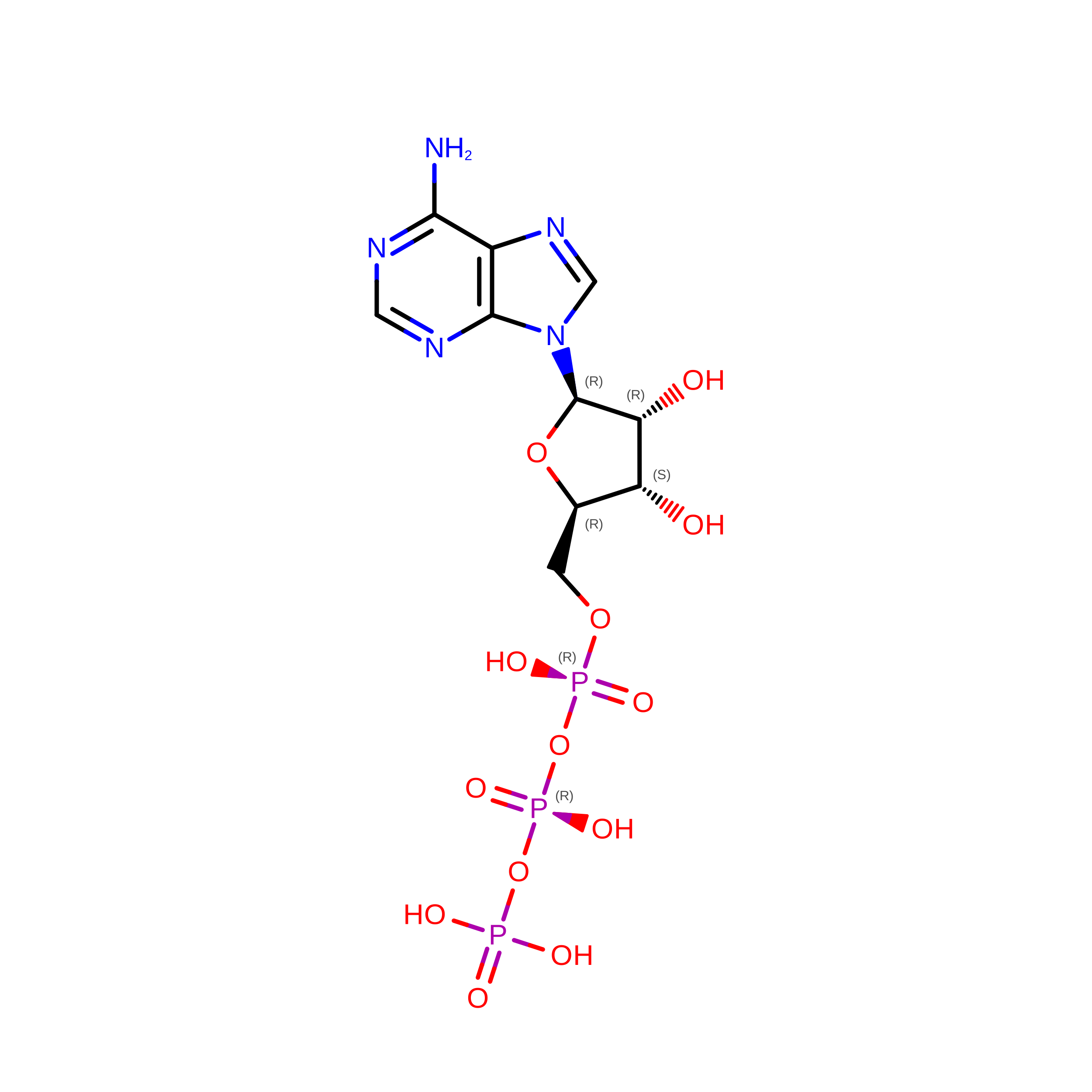
    M. tuberculosis ESX-1 system secretes virulence factors into host macrophages during infection, however, the mechanism of secretion is currently unknown. Here, we have determined the crystal structure of MtbEccCb1-D2 protein (Leu34-Ser313 residues, Mw ∼ 31.4 kDa) in complex with ATPγS and Mg 2+ , which adopts a classical Ftsk/SpoEIII type fold. The EccCb1-D2 showed two melting temperatures, Tm1 at 37.64 ± 0.08 °C and Tm2 at 65.85 ± 0.12 °C, during the unfolding pathway. Modeled ∆EccC1 and ∆EccC1 + EsxAB hexamers showed a channel (∼34 Å) involved in EsxAB (∼29 Å) translocation toward the inner membrane. At the entrance gate of the channel, the LxxxMxF motif of the EsxB export arm binds to the substrate binding pocket of the EccCb1-D3 protein. Inside the channel, the PL-1 and PL-2 pore loops, close to the α7-helix and the loop between β8-β9 strands in EccCa1-D1, EccCb1-D2, and EccCb1-D3 may be involved in EsxAB factor translocation. Stability, fluctuation, and compactness parameters in 100 ns dynamics simulation analysis showed the highest flexibility in ΔEccCa1, ∆EccC1, and ∆EccC1 + EsxAB hexamers and stability in ΔEccCb1 hexamer. Our EccCb1-D2 structure and dynamics simulation analysis on four modeled systems have revealed the mechanism involved in EsxAB translocation, a key target for the development of antivirulence inhibitors against M. tuberculosis.


  • Organizational Affiliation
    • Rm-403/440, Structural Biology Lab, School of Life Sciences, Jawaharlal Nehru University, New Delhi 67, India. Electronic address: ajaysaxena@mail.jnu.ac.in.

Macromolecule Content 

  • Total Structure Weight: 34.95 kDa 
  • Atom Count: 2,346 
  • Modeled Residue Count: 280 
  • Deposited Residue Count: 312 
  • Unique protein chains: 1

Macromolecules

Find similar proteins by:|  3D Structure
Entity ID: 1
MoleculeChains  Sequence LengthOrganismDetailsImage
ESX-1 secretion system protein EccCb1312Mycobacterium tuberculosis H37RvMutation(s): 0 
Gene Names: eccCb1snm2Rv3871
UniProt
Find proteins for P9WNB1 (Mycobacterium tuberculosis (strain ATCC 25618 / H37Rv))
Explore P9WNB1 
Go to UniProtKB:  P9WNB1
Entity Groups
Sequence Clusters30% Identity50% Identity70% Identity90% Identity95% Identity100% Identity
UniProt GroupP9WNB1
Sequence Annotations
Expand
Reference Sequence

Experimental Data & Validation

Experimental Data

  • Method: X-RAY DIFFRACTION
  • Resolution: 2.20 Å
  • R-Value Free:  0.229 (Depositor), 0.229 (DCC) 
  • R-Value Work:  0.177 (Depositor), 0.182 (DCC) 
  • R-Value Observed: 0.182 (Depositor) 
Space Group: P 21 21 21
Unit Cell:
Length ( Å )Angle ( ˚ )
a = 37.389α = 90
b = 75.642β = 90
c = 102.524γ = 90
Software Package:
Software NamePurpose
PHENIXrefinement
SCALEPACKdata scaling
PHASERphasing
HKL-3000data reduction

Structure Validation

View Full Validation Report


Ligand Structure Quality Assessment 


Entry History 

& Funding Information

Deposition Data

  • Released Date: 2025-10-08 
  • Deposition Author(s): Saxena, A.K.

Funding OrganizationLocationGrant Number
Science and Engineering Research Board (SERB)IndiaEMR/2016/000867

Revision History  (Full details and data files)

  • Version 1.0: 2025-10-08
    Type: Initial release
  • Version 1.1: 2026-04-22
    Changes: Database references