Download Mendeley
Conformational Plasticity in dsRNA-Binding Domains Drives Functional Divergence in RNA Recognition.
Patra, D., Paul, J., Rai, U., P S, A., Deshmukh, M.V.(2025) J Am Chem Soc 147: 17088-17100
- PubMed: 40326966
- DOI: https://doi.org/10.1021/jacs.5c02057
- Primary Citation Related Structures:
9JMT, 9JVC - PubMed Abstract:
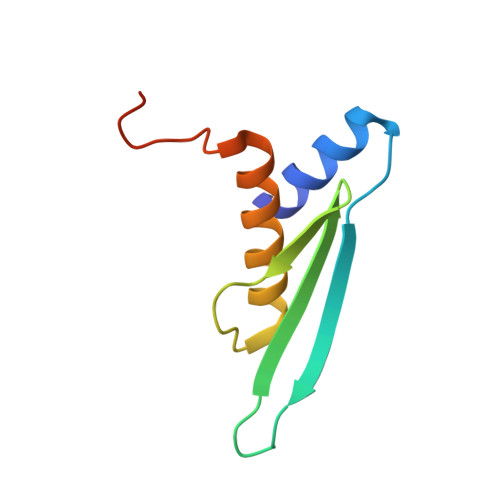
The functional specificity of proteins is often attributed to their sequence and structural homology while frequently neglecting the underlying conformational dynamics occurring at different time scales that can profoundly impact biological consequences. Using 15 N-CEST NMR and RDC-corrected metainference molecular dynamics simulations, here, we reveal differential substrate recognition mechanisms in two dsRNA-binding domain (dsRBD) paralogs, DRB2D1 and DRB3D1. Despite their nearly identical solution structures and conserved dsRNA interaction interfaces, DRB3D1 demonstrates structural plasticity that enables it to recognize conformationally flexible dsRNA, a feature notably absent in the more rigid DRB2D1. We present the pivotal role of intrinsic structural dynamics in driving functional divergence and provide insights into the mechanisms that govern specificity in dsRBD:dsRNA interactions. Importantly, our combined experimental and computational approach captures a cluster of intermediate conformations, complementing conventional methods to resolve the dominant ground state and sparsely populated excited states.
- CSIR─Centre for Cellular and Molecular Biology, Uppal Road, Hyderabad 500007, India.
Organizational Affiliation: