Download Mendeley
A proton-gated channel identified in the centipede antenna.
Dong, W., Yuan, L., Shang, J., Yang, F., Yang, S., Lu, X., Wang, Q., Luo, A., Geng, J., Cheng, J., Li, R., Wang, Y.(2025) EMBO Rep 26: 6083-6095
- PubMed: 41116071 Search on PubMedSearch on PubMed Central
- DOI: https://doi.org/10.1038/s44319-025-00606-2
- Primary Citation Related Structures:
9JF7 - PubMed Abstract:
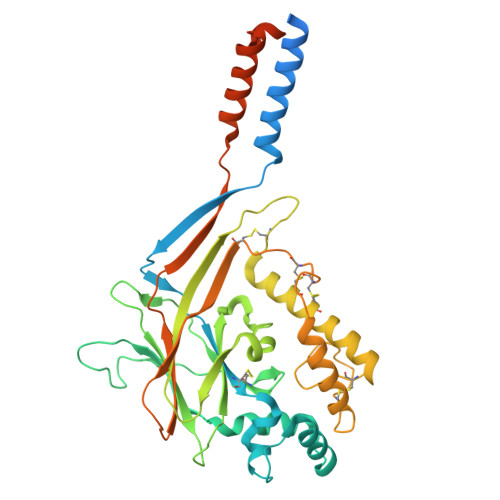
Acid sensing is essential for various biological processes in animals, yet it exhibits species-specific characteristics. In this study, we identified a proton-dissociation-permeated sodium channel (PDPNaC1) in the antennal sensory neurons of the centipede Scolopendra subspinipes mutilans. PDPNaC1, which is permeable to monovalent cations, assembles as a homotrimer. Unlike most proton-gated channels, where proton binding induces currents, PDPNaC1's transient ion-permeable state is triggered by proton dissociation. By resolving the high-resolution cryo-electron microscopy (cryo-EM) structure of PDPNaC1, combined with mutagenesis and electrophysiological analyses, we identified Gly378, rather than the Gly-Ala-Ser tract, as a key determinant of ion selectivity. Furthermore, Ser376, located in the ion-permeable pathway, likely serves as a proton-binding site, leading to an H + -blocking effect that results in proton-dissociated currents. Thus, the identification of PDPNaC1 suggests the remarkable diversity of proton responses and molecular mechanisms in DEG/ENaC family.
- College of Wildlife and Protected Area, Northeast Forestry University, Harbin, Heilongjiang, China.
Organizational Affiliation: