Download Mendeley
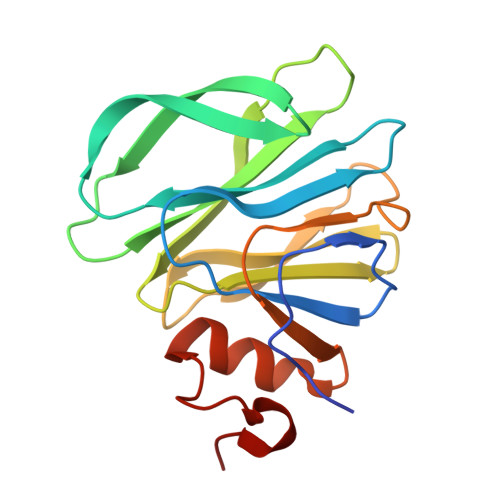
Specific binding of human P[28] rotavirus VP8* protein to blood group ABH antigens on type 1 chains.
Zheng, Y., Sun, X., Li, Y., Huang, B., Chen, Y., Zhou, H., Cao, C., Chai, W., Duan, Z., Li, D., Yan, J., Liang, X.(2025) PLoS Pathog 21: e1013298-e1013298
- PubMed: 40690515 Search on PubMedSearch on PubMed Central
- DOI: https://doi.org/10.1371/journal.ppat.1013298
- Primary Citation Related Structures:
9JAA, 9JAK - PubMed Abstract:
Group A rotavirus (RV) has been the major cause of acute gastroenteritis in infants and young children. Among the five P genogroups almost all P genotype RVs in P[II], P[III] and P[IV] genogroups that infect humans can bind glycan histo-blood group antigens (HBGAs) as the receptors on the host cell surface to infect host through the viral spike protein VP8*. Although P[I] is the largest genogroup, P[28] and P[10] are the only two genotype RVs infecting humans in the group. It has recently been found that a P[28] strain is related to bat RV and considered a possible product of reassortment between bat and human RVs. Bats are increasingly being recognized as an important reservoir for viruses crossing species barriers to infect humans. Unrevealing the interactions between RVs and host receptors is important for understanding RV evolution, infection, and epidemic. In the present study, using a multiphasic approach, including X-ray crystallography, glycan microarray with a dedicated probe library, bio-layer interferometry, site-specific mutagenesis, and molecular docking and dynamics simulations, we found that P[28]-VP8* can bind to all blood group A, B and H(O) antigens but on type 1 chain only, without the capability to bind to any Lewis epitopes or mucin O-glycan cores. Different from most of the prevalent human RVs, such as P[8], P[4] and P[6], the broad HBGA binding specificity of P[28]-VP8* and the fact of the recently identified a possible reassortment P[28] strain of bat and human RVs have raised the concern of a future possibility of P[I] genogroup RV epidemic. RV surveillance may also need to take the P[I] genogroup RVs into account in the future.
- State Key Laboratory of Phytochemistry and Natural Medicines, Dalian Institute of Chemical Physics, Chinese Academy of Sciences, Dalian, China.
Organizational Affiliation: