9J8G | pdb_00009j8g

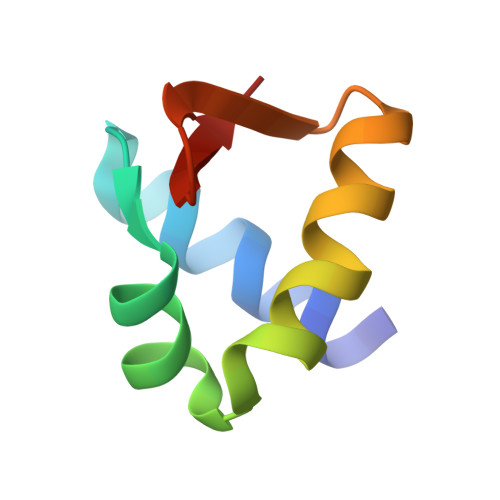
mouse zbp1 hybrid complex


Experimental Data Snapshot

  • Method: X-RAY DIFFRACTION
  • Resolution: 1.80 Å
  • R-Value Free: 
    0.234 (Depositor), 0.233 (DCC) 
  • R-Value Work: 
    0.201 (Depositor), 0.207 (DCC) 
  • R-Value Observed: 
    0.203 (Depositor) 

Starting Model: experimental
View more details

wwPDB Validation   3D Report Full Report


This is version 1.0 of the entry. See complete history


Literature

ZBP1 senses spliceosome stress through Z-RNA:DNA hybrid recognition.

He, J.Zhu, Y.Tian, Z.Liu, M.Gao, A.Fu, W.Lu, F.Sun, Y.Guo, Y.Pan, R.Ji, Y.Chen, J.Lu, H.Lin, J.Liang, X.Kim, C.Zhou, C.Jiao, H.

(2025) Mol Cell 85: 1790-1805.e7

  • DOI: https://doi.org/10.1016/j.molcel.2025.04.004
  • Primary Citation of Related Structures:  
    9J89, 9J8G

  • PubMed Abstract: 

    Z-DNA-binding protein 1 (ZBP1; also known as DAI or DLM-1) regulates cell death and inflammation by sensing left-handed double-helical nucleic acids, including Z-RNA and Z-DNA. However, the physiological conditions that generate Z-form nucleic acids (Z-NAs) and activate ZBP1-dependent signaling pathways remain largely elusive. In this study, we developed a probe, Zα-mFc, that specifically detected both Z-DNA and Z-RNA. Utilizing this probe, we discovered that inhibiting spliceosome causes nuclear accumulation of Z-RNA:DNA hybrids, which are sensed by ZBP1 via its Zα domains, triggering apoptosis and necroptosis in mammalian cells. Furthermore, we solved crystal structures of the human or mouse Zα1 domain complexed with a 6-bp RNA:DNA hybrid, revealing that the RNA:DNA hybrid adopts a left-handed conformation. Our findings demonstrate that the spliceosome acts as a checkpoint preventing accumulation of Z-RNA:DNA hybrids, which potentially function as endogenous ligands activating ZBP1-dependent cell death pathways.


  • Organizational Affiliation
    • Zhejiang Key Laboratory of Molecular Cancer Biology, Life Sciences Institute, Zhejiang University, Hangzhou 310058, China; Department of Neonatal Surgery, Children's Hospital, Zhejiang University School of Medicine, National Clinical Research Center for Child Health, Hangzhou 310052, China.

Macromolecules

Find similar proteins by:  (by identity cutoff)  |  3D Structure
Entity ID: 1
MoleculeChains Sequence LengthOrganismDetailsImage
Z-DNA-binding protein 159Mus musculusMutation(s): 0 
Gene Names: Zbp1Dlm1
UniProt
Find proteins for Q9QY24 (Mus musculus)
Explore Q9QY24 
Go to UniProtKB:  Q9QY24
Entity Groups  
Sequence Clusters30% Identity50% Identity70% Identity90% Identity95% Identity100% Identity
UniProt GroupQ9QY24
Sequence Annotations
Expand
  • Reference Sequence

Find similar nucleic acids by:  Sequence   |   3D Structure  

Entity ID: 2
MoleculeChains LengthOrganismImage
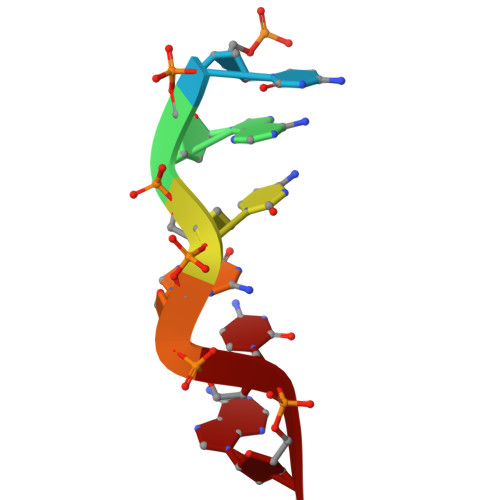
DNA (5'-D(P*CP*AP*CP*GP*CP*A)-3')B [auth C]6Homo sapiens
Sequence Annotations
Expand
  • Reference Sequence

Find similar nucleic acids by:  Sequence   |   3D Structure  

Entity ID: 3
MoleculeChains LengthOrganismImage
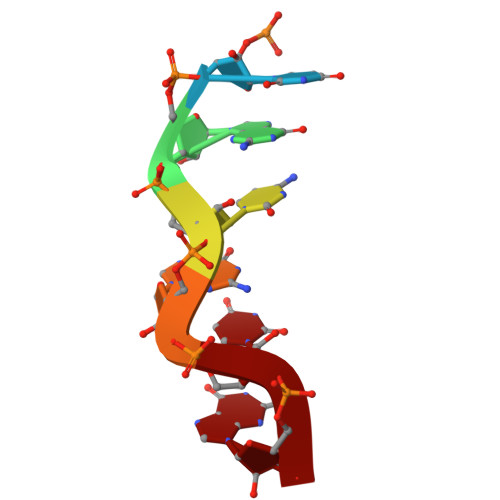
RNA (5'-R(P*UP*GP*CP*GP*UP*G)-3')C [auth B]6Homo sapiens
Sequence Annotations
Expand
  • Reference Sequence
Experimental Data & Validation

Experimental Data

  • Method: X-RAY DIFFRACTION
  • Resolution: 1.80 Å
  • R-Value Free:  0.234 (Depositor), 0.233 (DCC) 
  • R-Value Work:  0.201 (Depositor), 0.207 (DCC) 
  • R-Value Observed: 0.203 (Depositor) 
Space Group: P 65 2 2
Unit Cell:
Length ( Å )Angle ( ˚ )
a = 63.381α = 90
b = 63.381β = 90
c = 71.15γ = 120
Software Package:
Software NamePurpose
PHENIXrefinement
XDSdata reduction
Aimlessdata scaling
PHASERphasing

Structure Validation

View Full Validation Report


Entry History & Funding Information

Deposition Data


Funding OrganizationLocationGrant Number
National Science Foundation (NSF, China)China--

Revision History  (Full details and data files)

  • Version 1.0: 2025-06-25
    Type: Initial release