Download Mendeley
An Alternative Mechanism for C-C Desaturation Underscores a Dual-Controlled Mechanism for the Fate of Radical Intermediate in Iron(II)- and 2-(Oxo)glutarate-Dependent Oxygenase DfmD.
Zhang, X., Wang, L., Liu, J., Chen, T.Y., Yan, S., Chang, W.C., Shaik, S., Zhou, J., Wang, B.(2025) J Am Chem Soc 147: 20442-20455
- PubMed: 40480968 Search on PubMed
- DOI: https://doi.org/10.1021/jacs.5c02361
- Primary Citation Related Structures:
9J0J - PubMed Abstract:
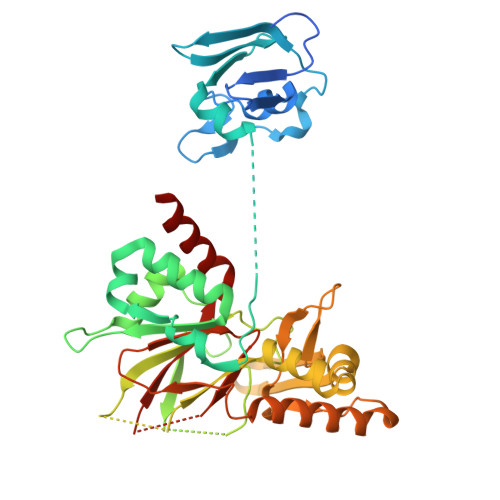
The C(sp 3 )-C(sp 3 ) desaturation catalyzed by iron(II)- and 2-(oxo)glutarate-dependent(Fe/2OG) oxygenase is a key step in the biosynthesis and modification of natural products. Similar to other C-H functionalization processes, the reaction is initiated by the active Fe(IV)-oxo species, which abstracts a hydrogen atom from the C-H bond. However, Fe/2OG desaturase suppresses the thermodynamically favored OH-rebound process. This is enigmatic since the substrate-cofactor disposition appears to be a favorable process which involves C-H activation followed by OH rebound. To decipher the mechanism, we studied here the biosynthesis of dehydrofosmidomycin by DfmD, an Fe/2OG enzyme that catalyzes the biosynthesis of the natural product through desaturation, rearrangement, and demethylation reactions. This study employed biochemical, crystallographic, and computational analysis of the reaction. Unlike the sequential hydrogen-atom transfer (HAT) mechanism and cation-dependent mechanism, our study reveals an alternative mechanism for C-C desaturation. This mechanism involves the formation of a three-member ring intermediate oxaphosphiran. We found that the thermodynamically favored formation of oxaphosphiran reduced the barrier for the desaturation reaction. Additionally, the H-bonding network disfavors the OH-rebound pathway. As such, this dual action of the enzyme enables the selective desaturation reaction while bypassing the hydroxylation process. This mechanism highlights the importance of protein machinery as a means of controlling the reactivity and selectivity of radical species.
- State Key Laboratory of Physical Chemistry of Solid Surfaces and Fujian Provincial Key Laboratory of Theoretical and Computational Chemistry, College of Chemistry and Chemical Engineering, Xiamen University, Xiamen 361005, P. R. China.
Organizational Affiliation: