Download Mendeley
Multi-Water Bridges Enable Design of BET BD1-Selective Inhibitors for Pancreatic Cancer Therapy.
Chen, X., Kang, W., Wu, T., Cao, D., Chen, Y., Du, Z., Yan, L., Meng, F., Wang, X., You, Q., Xiong, B., Guo, X., Jiang, Z.(2025) J Med Chem 68: 5719-5735
- PubMed: 40011026 Search on PubMed
- DOI: https://doi.org/10.1021/acs.jmedchem.4c03069
- Primary Citation Related Structures:
9IV5 - PubMed Abstract:
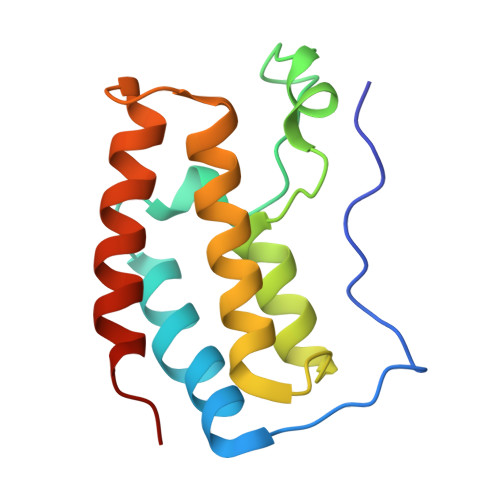
Rational design of bromodomain (BD)-selective inhibitors could mitigate on-target toxicities associated with pan-BET inhibition but is challenging despite the availability of high-resolution structures. By simultaneously forming water bridges with BD1-specific residues in both the BC ring and the ZA channel, we identified a potent and orally bioavailable BET BD1-selective inhibitor DDO-8958 , which exhibited a K D of 5.6 nM for BRD4 BD1 and a 214-fold selectivity for BRD4 BD1 over BD2. The cocrystal structure demonstrated a unique multi-water bridge mechanism involving BD1-specific residues K91- and D145-driven BD1 selectivity. DDO-8958 extensively influenced the oncogene expression and metabolic pathway, including oxidative phosphorylation in MIA PaCa-2. In vivo , DDO-8958 inhibited tumor growth and markedly augmented the therapeutic efficacy of the glycolysis inhibitor 2-DG. These findings illuminate that multi-water bridges enable design of BD1-selective inhibitors and a therapeutic strategy involving combined targeting of BD1-induced epigenetic reprogramming and glycolysis pathways for the management of pancreatic cancer.
- Jiang Su Key Laboratory of Drug Design and Optimization and State Key Laboratory of Natural Medicines, China Pharmaceutical University, Nanjing 210009, China.
Organizational Affiliation: