Download Mendeley
A metal ion mediated functional dichotomy encodes plasticity during translation quality control.
Gogoi, J., Pawar, K.I., Sivakumar, K., Bhatnagar, A., Suma, K., Ann, K.J., Pottabathini, S., Kruparani, S.P., Sankaranarayanan, R.(2025) Nat Commun 16: 3625-3625
- PubMed: 40240361 Search on PubMedSearch on PubMed Central
- DOI: https://doi.org/10.1038/s41467-025-58787-2
- Primary Citation Related Structures:
9IUW - PubMed Abstract:
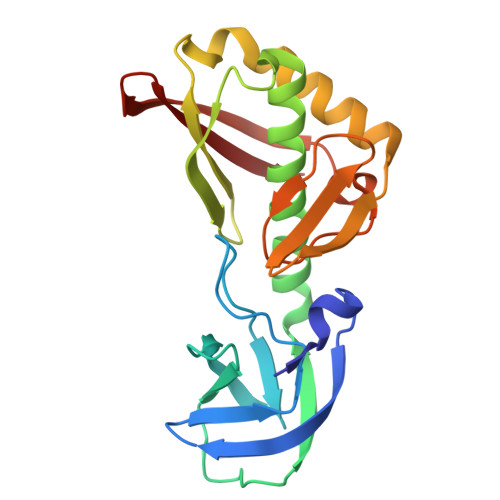
Proofreading during translation of the genetic code is a key process for not only translation quality control but also for its modulation under stress conditions to provide fitness advantage. A major class of proofreading modules represented by editing domains of alanyl-tRNA synthetase (AlaRS-Ed) and threonyl-tRNA synthetase (ThrRS-Ed) features a common fold and an invariant Zn 2+ binding motif across life forms. Here, we reveal the structural basis and functional consequence along with the necessity for their operational dichotomy, i.e., the metal ion is ubiquitous in one and inhibitor for the other. The universally conserved Zn 2+ in AlaRS-Ed protects its proofreading activity from reactive oxygen species (ROS) to maintain high fidelity Ala-codons translation, necessary for cell survival. On the other hand, mistranslation of Thr-codons is well tolerated by the cells, thereby allowing for a ROS-based modulation of ThrRS-Ed's activity. A single residue rooted over ~3.5 billion years of evolution has been shown to be primarily responsible for the functional divergence. The study presents a remarkable example of how protein quality control is integrated with redox signalling through leveraging the tunability of metal binding sites from the time of last universal common ancestor (LUCA).
- CSIR-Centre for Cellular and Molecular Biology, Hyderabad, 500007, Telangana, India.
Organizational Affiliation: