Download Mendeley
Mechanisms of urate transport and uricosuric drugs inhibition in human URAT1.
Guo, W., Wei, M., Li, Y., Xu, J., Zang, J., Chen, Y., Chen, L.(2025) Nat Commun 16: 1512-1512
- PubMed: 39929841 Search on PubMedSearch on PubMed Central
- DOI: https://doi.org/10.1038/s41467-025-56843-5
- Primary Citation Related Structures:
9IRW, 9IRX, 9IRY - PubMed Abstract:
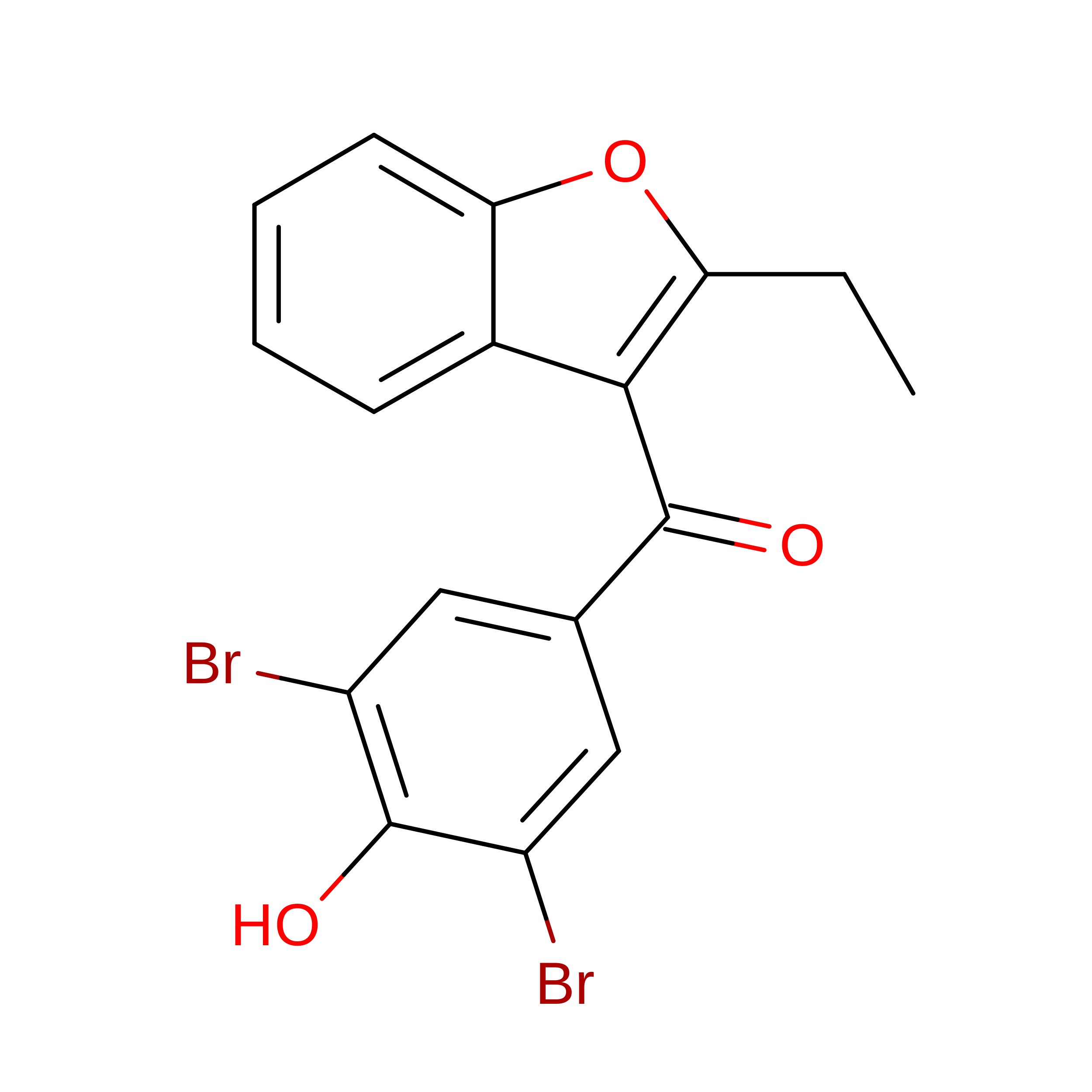
High urate levels in circulation lead to the accumulation of urate crystals in joints and ultimately inflammation and gout. The reabsorption process of urate in the kidney by the urate transporter URAT1 plays a pivotal role in controlling serum urate levels. Pharmacological inhibition of URAT1 by uricosuric drugs is a valid strategy for gout management. Despite the clinical significance of URAT1, its structural mechanism and dynamics remain incompletely understood. Here, we report the structures of human URAT1 (hURAT1) in complex with substrate urate or inhibitors benzbromarone and verinurad at resolution ranges from 3.0 to 3.3 Å. We observe urate in the central substrate-binding site of hURAT1 in the outward-facing conformation and urate is wrapped in the center of hURAT1 by five phenylalanines and coordinated by two positively charged residues on each side. Uricosuric compounds benzbromarone and verinurad occupy the urate-binding site of hURAT1 in the inward-facing conformation. Structural comparison between different conformations of hURAT1 reveals the rocker-switch-like mechanism for urate transport. Benzbromarone and verinurad exert their inhibitory effect by blocking not only the binding of urate but also the structural isomerization of hURAT1.
- State Key Laboratory of Membrane Biology, College of Future Technology, Institute of Molecular Medicine, Peking. University, Beijing Key Laboratory of Cardiometabolic Molecular Medicine, Beijing, 100871, China.
Organizational Affiliation: