Download Mendeley
Bacterial reverse transcriptase synthesizes long poly(A)-rich cDNA for antiphage defense.
Song, X.Y., Xia, Y., Zhang, J.T., Liu, Y.J., Qi, H., Wei, X.Y., Hu, H., Xia, Y., Liu, X., Ma, Y.F., Jia, N.(2025) Science 388: eads4639-eads4639
- PubMed: 40310939 Search on PubMed
- DOI: https://doi.org/10.1126/science.ads4639
- Primary Citation Related Structures:
9IOA, 9IOB - PubMed Abstract:
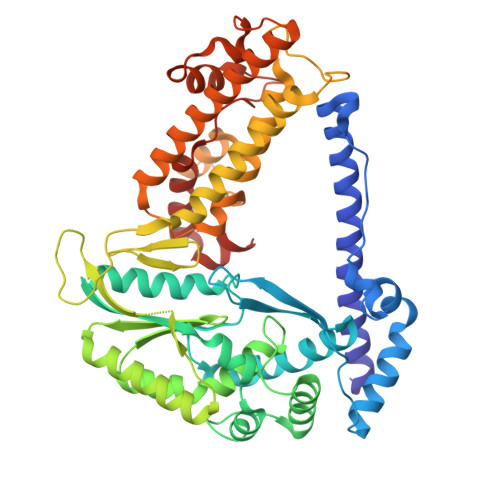
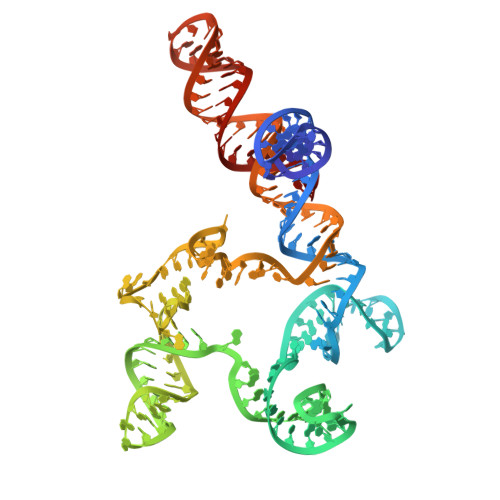
Prokaryotic defense-associated reverse transcriptases (DRTs) were recently identified with antiviral functions; however, their functional mechanisms remain largely unexplored. Here we show that DRT9 forms a hexameric complex with its upstream noncoding RNA (ncRNA) to mediate antiphage defense by inducing cell growth arrest through abortive infection. Upon phage infection, the phage-encoded ribonucleotide reductase NrdAB complex increases intracellular deoxyadenosine triphosphate levels, activating DRT9 to synthesize long, polyadenylate [poly(A)]-rich single-stranded complementary DNA (cDNA), which likely sequesters the essential phage single-stranded DNA binding (SSB) protein and disrupts phage propagation. We further determined the cryo-electron microscopy structure of the DRT9-ncRNA hexamer complex, providing mechanistic insights into its cDNA synthesis. These findings highlight the diversity of RT-based antiviral defense mechanisms, expand our understanding of RT biological functions, and provide a structural basis for developing DRT9-based biotechnological tools.
- Department of Biochemistry, SUSTech Homeostatic Medicine Institute, School of Medicine, Southern University of Science and Technology, Shenzhen, China.
Organizational Affiliation: