9IO0 | pdb_00009io0

INTERACTION BETWEEN A FLUOROQUINOLONE DERIVATIVE KG022 AND RNAS: EFFECT OF BASE PAIRS 5' ADJACENT TO THE BULGE OUT ESIDUES

  • Classification: RNA
  • Organism(s): Mus musculus
  • Mutation(s): No 

  • Deposited: 2024-07-08 Released: 2025-04-02 
  • Deposition Author(s): Ichijo, R., Kawai, G.
  • Funding Organization(s): Not funded

Experimental Data Snapshot

  • Method: SOLUTION NMR
  • Conformers Calculated: 100 
  • Conformers Submitted: 11 
  • Selection Criteria: structures with the lowest energy 

wwPDB Validation 3D Report Full Report

Validation slider image for 9IO0

This is version 1.1 of the entry. See complete history

Literature

Specific Interaction between a Fluoroquinolone Derivative, KG022, and RNAs with a Single Bulge.

Ichijo, R.Kawai, G.

(2025) Biochemistry 64: 2192-2199

  • DOI: https://doi.org/10.1021/acs.biochem.4c00669
  • Primary Citation Related Structures: 
    9IO0, 9IO1, 9IOR, 9IOS, 9IOU

  • PubMed Abstract: 

    Small compounds targeting RNAs are recognized as a promising modality in drug discovery. We have found that a fluoroquinolone derivative, KG022, binds to RNAs with single-bulged residues. It has been demonstrated by 1 H NMR that KG022 binds to RNAs with a bulged G or C and a GC or AU base pair at the 3' adjacent to the bulged residues. In the present study, the effects of the base pairs at the 5' adjacent to the bulged residues on the interaction of KG022 were analyzed mainly by 1 H NMR. It was found that KG022 prefers UA and CG base pairs at the 5' adjacent to the bulged residues, indicating that a stable complex is formed by the stacking interaction among the fluoroquinolone ring and the purine bases of the 5' and 3' sides. In addition, this was confirmed by analysis of the 19 F-NMR spectra. Analysis of temperature dependences of NMR spectra revealed that KG022 forms a more stable complex with RNAs having CG base pairs at the 5' adjacent position than those with UA base pairs. This work presented useful information for the development of small molecules having higher affinity to target RNAs.


  • Organizational Affiliation
    • Graduate School of Advanced Engineering, Chiba Institute of Technology, Tsudanuma 2-17-1, Narashino , Chiba275-0016, Japan.

Macromolecule Content 

  • Total Structure Weight: 6.51 kDa 
  • Atom Count: 433 
  • Modeled Residue Count: 19 
  • Deposited Residue Count: 19 
  • Unique nucleic acid chains: 1

Macromolecules

Find similar nucleic acids by:  Sequence
Entity ID: 1
MoleculeChains LengthOrganismImage
RNA (5'-R(*GP*GP*AP*UP*GP*GP*UP*UP*UP*CP*GP*AP*CP*CP*GP*AP*UP*CP*C)-3')19Mus musculus
Sequence Annotations
Expand
Reference Sequence

Small Molecules

Ligands 1 Unique
IDChains Name / Formula / InChI Key2D Diagram3D Interactions
53D
(Subject of Investigation/LOI)

Query on 53D


Download:Ideal Coordinates CCD File
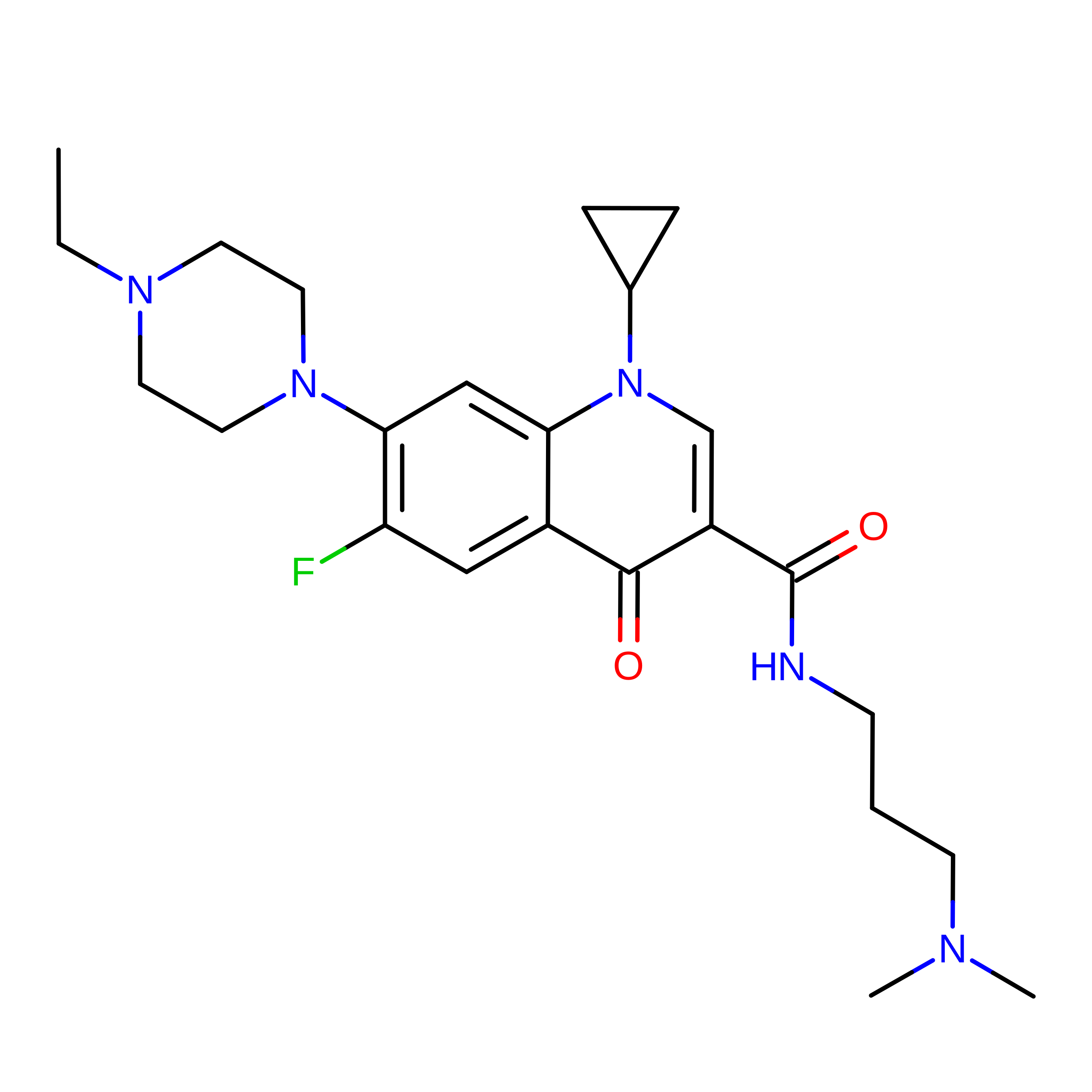
B [auth A]1-cyclopropyl-N-[3-(dimethylamino)propyl]-7-(4-ethylpiperazin-1-yl)-6-fluoranyl-4-oxidanylidene-quinoline-3-carboxamide
C24 H34 F N5 O2
SJAQLOUTDAIPJJ-UHFFFAOYSA-N

Experimental Data & Validation

Experimental Data

  • Method: SOLUTION NMR
  • Conformers Calculated: 100 
  • Conformers Submitted: 11 
  • Selection Criteria: structures with the lowest energy 

Structure Validation

View Full Validation Report


Entry History 

& Funding Information

Deposition Data


Funding OrganizationLocationGrant Number
Not funded--

Revision History  (Full details and data files)

  • Version 1.0: 2025-04-02
    Type: Initial release
  • Version 1.1: 2025-06-04
    Changes: Database references