Download Mendeley
Vibrio cholerae biofilm matrix assembly and growth are shaped by a glutamate-specific TAXI/TRAP protein.
Potapova, A., Oguchi, R., Jimmy, S., Evans, C.R., Yarrington, K.D., Winans, J.B., Piepoli, S., Older, E.A., Schakel, O.F., Wetherington, M.T., Garvey, W., Floyd, K.A., Vinogradov, E., Yunker, P.J., Sanchez, L.M., Nadell, C.D., Limoli, D.H., Dietrich, L.E.P., Sondermann, H., Yildiz, F.H.(2025) Proc Natl Acad Sci U S A 122: e2504869122-e2504869122
- PubMed: 41364770 Search on PubMed
- DOI: https://doi.org/10.1073/pnas.2504869122
- Primary Citation Related Structures:
9IBO, 9IBP - PubMed Abstract:
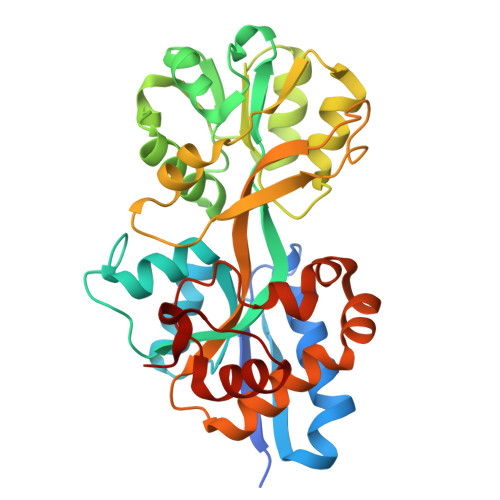
Biofilms are critical for the environmental persistence, survival, and infectivity of Vibrio cholerae , the causative agent of cholera. Here, we find that GluP, a glutamate-specific TRAP-TAXI protein, is an uncharacterized matrix component that plays a critical role in biofilm architecture. Loss of GluP reduces biofilm corrugation, expands colony size, and disperses cells from microcolonies, arguing that this factor maintains biofilm structure and organization. While GluP does not affect the abundance or localization of known matrix proteins, its absence reduces Vibrio exopolysaccharide (VPS) production. We determined the crystal structure of GluP, which revealed that GluP binds glutamate, and its biofilm-related phenotypes depend on this binding capability. We further examined the role of GluP in V. cholerae growth under defined conditions where L-glutamate serves as a carbon source, nitrogen source, or both. GluP-deficient strains specifically showed reduced growth when glucose was the carbon source and glutamate the nitrogen source. This defect is dependent on glutamate binding by GluP and highlights its role in coordinating nutrient acquisition and biofilm formation. Importantly, both biofilm assembly and growth defects occurred independently of the predicted membrane component of the Glu TRAP-TAXI system, GluQM. These findings indicate that GluP plays a dual role in biofilm assembly and growth, providing insight into its functional importance in V. cholerae physiology.
- Department of Microbiology and Environmental Toxicology, University of California-Santa Cruz, Santa Cruz, CA 95064.
Organizational Affiliation: