Download Mendeley
Structural basis of lipopolysaccharide assembly by the outer membrane translocon holo-complex.
Chen, H., Siroy, A., Morales, V., Gurvic, D., Quentin, Y., Balor, S., Abuta'a, Y.A., Marteau, M., Froment, C., Caumont-Sarcos, A., Marcoux, J., Stansfeld, P.J., Fronzes, R., Ieva, R.(2025) Nat Commun 16: 10404-10404
- PubMed: 41285762
- DOI: https://doi.org/10.1038/s41467-025-65370-2
- Primary Citation of Related Structures:
9I9Z, 9IA0, 9IA2, 9IA5 - PubMed Abstract:
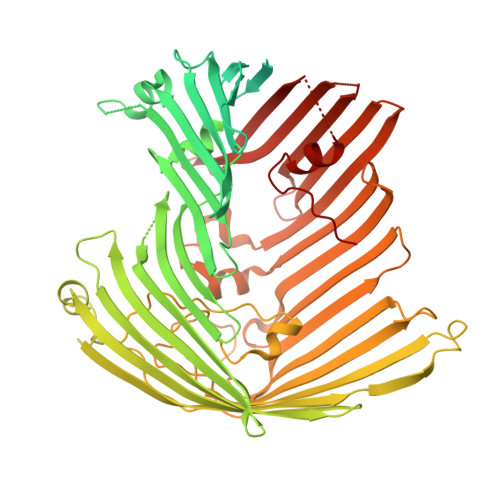
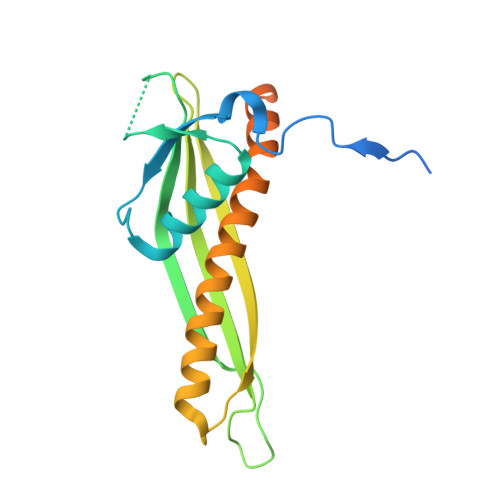
Lipopolysaccharide (LPS) assembly at the surfaces-exposed leaflet of the bacterial outer membrane (OM) is mediated by the OM LPS translocon. An essential transmembrane β-barrel protein, LptD, and a cognate lipoprotein, LptE, translocate LPS selectively into the OM external leaflet via a poorly understood mechanism. Here, we characterize two additional translocon subunits, the lipoproteins LptM and LptY (formerly YedD). We use single-particle cryo-EM analysis, functional assays and molecular dynamics simulations to visualize the roles of LptM and LptY at the translocon holo-complex LptDEMY, uncovering their impact on LptD conformational dynamics. Whereas LptY binds and stabilizes the periplasmic LptD β-taco domain that functions as LPS receptor, LptM intercalates the lateral gate of the β-barrel domain, promoting its opening and access by LPS. Remarkably, we demonstrate a conformational switch of the LptD β-taco/β-barrel interface alternating between contracted and extended states. β-strand 1 of LptD, which defines the mobile side of the lateral gate, binds LPS and performs a stroke movement toward the external leaflet during the contracted-to-extended state transition. Our findings support a detailed mechanistic framework explaining the selective transport of LPS to the membrane external leaflet.
- Laboratoire de Microbiologie et Génétique Moléculaires (LMGM), Centre de Biologie Intégrative (CBI), Université de Toulouse, CNRS, Toulouse, France.
Organizational Affiliation: