9I3U | pdb_00009i3u

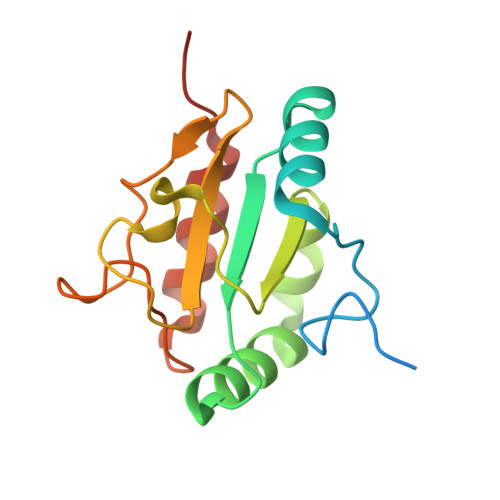
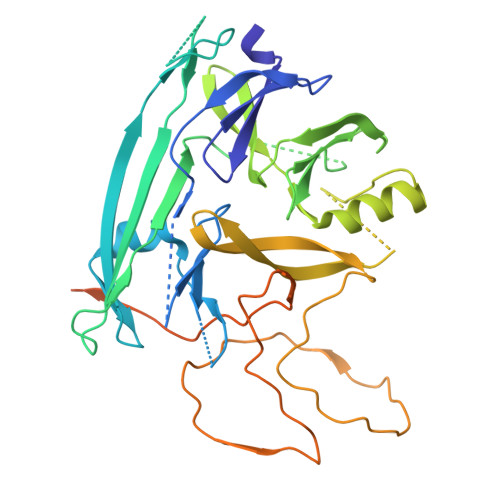
Cryo-EM structure of the AGR2 dimer in complex with the monomeric IRE1beta luminal domain


Experimental Data Snapshot

  • Method: ELECTRON MICROSCOPY
  • Resolution: 2.90 Å
  • Aggregation State: PARTICLE 
  • Reconstruction Method: SINGLE PARTICLE 

Starting Model: in silico
View more details

wwPDB Validation   3D Report Full Report


This is version 1.3 of the entry. See complete history


Literature

A structural basis for chaperone repression of stress signaling from the endoplasmic reticulum.

Neidhardt, L.Tung, J.Kuchersky, M.Milczarek, J.Kargas, V.Stott, K.Rosenzweig, R.Ron, D.Yan, Y.

(2025) Mol Cell 85: 4047

  • DOI: https://doi.org/10.1016/j.molcel.2025.09.032
  • Primary Citation of Related Structures:  
    9I3F, 9I3U

  • PubMed Abstract: 

    The endoplasmic reticulum (ER) unfolded protein response (UPR) is tuned by the balance between unfolded proteins and chaperones. Reserve chaperones suppress UPR transducers via their stress-sensing luminal domains, but the underlying mechanisms remain unclear. The ER chaperone AGR2 is known to repress the UPR transducer IRE1β. Here, structural prediction, X-ray crystallography, and NMR spectroscopy identify critical interactions between an AGR2 monomer and a regulatory loop in IRE1β's luminal domain. However, in the repressive complex, it is an AGR2 dimer that binds IRE1β. Cryoelectron microscopy (cryo-EM) reconstruction explains this feature: one AGR2 protomer engages the regulatory loop, while the second asymmetrically binds IRE1β's luminal domain's C terminus, blocking IRE1β-activating dimerization. Molecular dynamic simulations indicate that the second, disruptive AGR2 protomer exploits rare fluctuations in the IRE1β dimer that expose its binding site. Thus, AGR2 disrupts IRE1β dimers to suppress the UPR, priming the system for activation by chaperone clients that compete for AGR2.


  • Organizational Affiliation
    • Cambridge Institute for Medical Research, University of Cambridge, Cambridge CB2 0XY, UK. Electronic address: lneidhar@ic.ac.uk.

Macromolecules
Find similar proteins by:  (by identity cutoff)  |  3D Structure
Entity ID: 1
MoleculeChains Sequence LengthOrganismDetailsImage
Anterior gradient protein 2 homologA [auth B],
B [auth D]
155Homo sapiensMutation(s): 0 
Gene Names: AGR2AG2UNQ515/PRO1030
UniProt & NIH Common Fund Data Resources
Find proteins for O95994 (Homo sapiens)
Explore O95994 
Go to UniProtKB:  O95994
PHAROS:  O95994
GTEx:  ENSG00000106541 
Entity Groups  
Sequence Clusters30% Identity50% Identity70% Identity90% Identity95% Identity100% Identity
UniProt GroupO95994
Sequence Annotations
Expand
  • Reference Sequence
Find similar proteins by:  (by identity cutoff)  |  3D Structure
Entity ID: 2
MoleculeChains Sequence LengthOrganismDetailsImage
Serine/threonine-protein kinase/endoribonuclease IRE2C [auth A]395Homo sapiensMutation(s): 0 
Gene Names: ERN2IRE2
EC: 2.7.11.1 (PDB Primary Data), 3.1.26 (PDB Primary Data)
UniProt & NIH Common Fund Data Resources
Find proteins for Q76MJ5 (Homo sapiens)
Explore Q76MJ5 
Go to UniProtKB:  Q76MJ5
PHAROS:  Q76MJ5
GTEx:  ENSG00000134398 
Entity Groups  
Sequence Clusters30% Identity50% Identity70% Identity90% Identity95% Identity100% Identity
UniProt GroupQ76MJ5
Sequence Annotations
Expand
  • Reference Sequence
Experimental Data & Validation

Experimental Data

  • Method: ELECTRON MICROSCOPY
  • Resolution: 2.90 Å
  • Aggregation State: PARTICLE 
  • Reconstruction Method: SINGLE PARTICLE 
EM Software:
TaskSoftware PackageVersion
RECONSTRUCTIONcryoSPARC4.6.0
MODEL REFINEMENTPHENIX1.21.2_5419

Structure Validation

View Full Validation Report


Entry History & Funding Information

Deposition Data


Funding OrganizationLocationGrant Number
Wellcome TrustUnited KingdomSGAG/182

Revision History  (Full details and data files)

  • Version 1.0: 2025-10-22
    Type: Initial release
  • Version 1.1: 2025-10-29
    Changes: Data collection, Database references
  • Version 1.2: 2025-11-05
    Changes: Data collection, Database references
  • Version 1.3: 2025-11-19
    Changes: Data collection, Database references