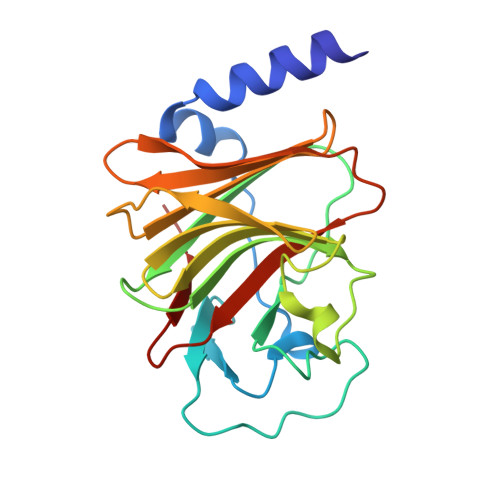
9I0T | pdb_00009i0t

Crystal structure of TRIM25 PRYSPRY covalently bound to 2-chloro-1-[4-(3-methyl-4-phenyl-phenyl)carbonyl-1,4-diazepan-1-yl]ethanone


Experimental Data Snapshot

  • Method: X-RAY DIFFRACTION
  • Resolution: 1.80 Å
  • R-Value Free: 
    0.245 (Depositor), 0.245 (DCC) 
  • R-Value Work: 
    0.222 (Depositor), 0.222 (DCC) 
  • R-Value Observed: 
    0.223 (Depositor) 

Starting Model: experimental
View more details

wwPDB Validation   3D Report Full Report


Ligand Structure Quality Assessment 


This is version 1.2 of the entry. See complete history


Literature

Discovery and optimisation of a covalent ligand for TRIM25 and its application to targeted protein ubiquitination.

McPhie, K.A.Esposito, D.Pettinger, J.Norman, D.Werner, T.Mathieson, T.Bush, J.T.Rittinger, K.

(2025) Chem Sci 16: 10432-10443

  • DOI: https://doi.org/10.1039/d5sc01540e
  • Primary Citation of Related Structures:  
    9I0T

  • PubMed Abstract: 

    The tripartite motif (TRIM) family of RING-type E3 ligases catalyses the formation of many different types of ubiquitin chains, and as such, plays important roles in diverse cellular functions, ranging from immune regulation to cancer signalling pathways. Few ligands have been discovered for TRIM E3 ligases, and these E3s are under-represented in the rapidly expanding field of induced proximity. Here we present the identification of a novel covalent ligand for the PRYSPRY substrate binding domain of TRIM25. We employ covalent fragment screening coupled with high-throughput chemistry direct-to-biology optimisation to efficiently elaborate covalent fragment hits. We demonstrate that our optimised ligand enhances the in vitro auto-ubiquitination activity of TRIM25 and engages TRIM25 in live cells. We also present the X-ray crystal structure of TRIM25 PRYSPRY in complex with this covalent ligand. Finally, we incorporate our optimised ligand into heterobifunctional proximity-inducing compounds and demonstrate the in vitro targeted ubiquitination of a neosubstrate by TRIM25.


  • Organizational Affiliation
    • Molecular Structure of Cell Signalling Laboratory, The Francis Crick Institute 1 Midland Road London NW1 1AT UK katrin.rittinger@crick.ac.uk.

Macromolecules
Find similar proteins by:  (by identity cutoff)  |  3D Structure
Entity ID: 1
MoleculeChains Sequence LengthOrganismDetailsImage
E3 ubiquitin/ISG15 ligase TRIM25199Homo sapiensMutation(s): 0 
Gene Names: TRIM25EFPRNF147ZNF147
EC: 6.3.2 (PDB Primary Data), 2.3.2.27 (PDB Primary Data)
UniProt & NIH Common Fund Data Resources
Find proteins for Q14258 (Homo sapiens)
Explore Q14258 
Go to UniProtKB:  Q14258
PHAROS:  Q14258
GTEx:  ENSG00000121060 
Entity Groups  
Sequence Clusters30% Identity50% Identity70% Identity90% Identity95% Identity100% Identity
UniProt GroupQ14258
Sequence Annotations
Expand
  • Reference Sequence
Small Molecules
Ligands 1 Unique
IDChains Name / Formula / InChI Key2D Diagram3D Interactions
A1IZK (Subject of Investigation/LOI)
Query on A1IZK

Download Ideal Coordinates CCD File 
B [auth A]1-[4-(3-methyl-4-phenyl-phenyl)carbonyl-1,4-diazepan-1-yl]ethanone
C21 H24 N2 O2
FIBAYMYQCFMKFA-UHFFFAOYSA-N
Experimental Data & Validation

Experimental Data

  • Method: X-RAY DIFFRACTION
  • Resolution: 1.80 Å
  • R-Value Free:  0.245 (Depositor), 0.245 (DCC) 
  • R-Value Work:  0.222 (Depositor), 0.222 (DCC) 
  • R-Value Observed: 0.223 (Depositor) 
Space Group: P 21 21 21
Unit Cell:
Length ( Å )Angle ( ˚ )
a = 44.36α = 90
b = 68.782β = 90
c = 69.831γ = 90
Software Package:
Software NamePurpose
PHENIXrefinement
DIALSdata reduction
Aimlessdata scaling
PHASERphasing

Structure Validation

View Full Validation Report


Ligand Structure Quality Assessment 


Entry History & Funding Information

Deposition Data


Funding OrganizationLocationGrant Number
The Francis Crick InstituteUnited KingdomCC2075
Wellcome TrustUnited KingdomCC2075
Cancer Research UKUnited KingdomCC2075
Medical Research Council (MRC, United Kingdom)United KingdomCC2075

Revision History  (Full details and data files)

  • Version 1.0: 2025-05-21
    Type: Initial release
  • Version 1.1: 2025-05-28
    Changes: Database references
  • Version 1.2: 2025-06-25
    Changes: Database references