Download Mendeley
The long and short of it: Distinct natural crystal packing strategies of Cry toxins from Bacillus thuringiensis.
Best, H.L., Williamson, L.J., Cutts, A.B., Galchenkova, M., Yefanov, O., Bryce-Sharron, N., Heath, E.A., de Wijn, R., Schubert, R., Munke, A., Henkel, A., Klopprogge, B., Scheer, T.E.S., Kremling, V., Awel, S., Pena, G., Knoska, J., Keloth, A., Maracke, J., Letrun, R., Sobolev, E., Bielecki, J., Melo, D., Kantamneni, S., Doerner, K., Kloos, M., Schulz, J., Xavier, P.L., Lauffer, M., Villanueva, M., Caballero, P., Waller-Evans, H., Lloyd-Evans, E., Uetrecht, C., Bean, R., Chapman, H.N., Crickmore, N., Rizkallah, P.J., Berry, C., Oberthur, D.(2026) Structure 34: 704-717.e3
- PubMed: 41734756 Search on PubMed
- DOI: https://doi.org/10.1016/j.str.2026.01.014
- Primary Citation Related Structures:
9H99, 9H9A, 9H9B, 9QXQ - PubMed Abstract:
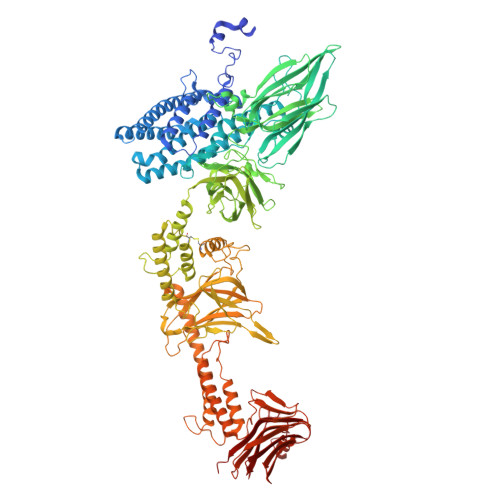
Bacillus thuringiensis (Bt) strains naturally produce pesticidal proteins as nanocrystalline inclusions that are extraordinarily stable in aqueous environments, but which dissolve selectively at specific pH conditions. These proteins have been used in agriculture for >50 years and are critical to global food security. The majority of previously determined Bt Cry protein structures lack the extended C-terminal "crystallization domain," which is thought to stabilize crystal packing and control selective solubility in insect targets, often via manipulation of disulfide bridges. It has also recently been shown to influence toxicity and target specificity. Here, we use serial femtosecond crystallography (SFX) to determine high-resolution full-length native structures of Cry1Ca18 (1.65 Å) and Cry8Ba2 (2.27 Å) in their natural nanocrystalline state. Differences in cysteine content (19 versus 4 residues) reveal distinct in vivo crystal-stabilization strategies. Understanding Bt toxin domain architecture and natural crystal formation is essential for improving biopesticide design and advancing agricultural genetic engineering.
- School of Biosciences, Cardiff University, Cardiff CF10 3AX, UK; Medicines Discovery Institute, Cardiff University, Cardiff CF10 3AX, UK.
Organizational Affiliation: