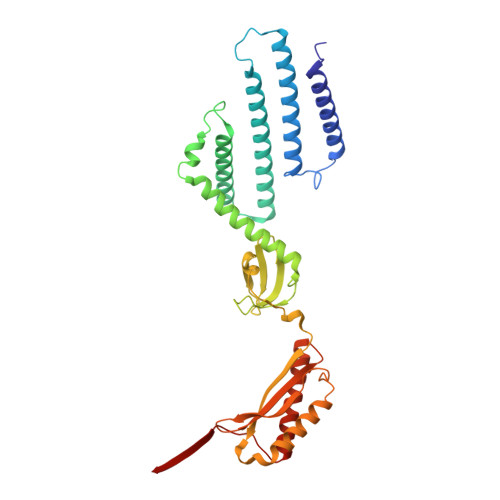
9H2P | pdb_00009h2p

YnaI in its open conformation purified in DDM showing ligand-filled pockets


Experimental Data Snapshot

  • Method: ELECTRON MICROSCOPY
  • Resolution: 2.30 Å
  • Aggregation State: PARTICLE 
  • Reconstruction Method: SINGLE PARTICLE 

wwPDB Validation   3D Report Full Report


This is version 1.0 of the entry. See complete history


Literature

Mechanosensitive channel engineering: A study on the mixing and matching of YnaI and MscS sensor paddles and pores.

Flegler, V.J.Rasmussen, A.Hedrich, R.Rasmussen, T.Bottcher, B.

(2025) Nat Commun 16: 7881-7881

  • DOI: https://doi.org/10.1038/s41467-025-63253-0
  • Primary Citation of Related Structures:  
    9H2P, 9H2S, 9H2V, 9H95

  • PubMed Abstract: 

    Osmotically varying environments are challenging for bacterial cells. Sudden drops in osmolytes cause an increased membrane tension and rupture the cells in the absence of protective mechanisms. One family of protective proteins are mechanosensitive channels of small conductance that open in response to membrane tension. Although these channels have a common architecture, they vary widely in the number of transmembrane helices, conductivity, and gating characteristics. Although there are various structures of channels in the open and closed state, the underlying common principles of the gating mechanism remain poorly understood. Here we show that YnaI opens by radial relocation of the transmembrane sensor paddles together with a shortening of the pore, which contrasts the prototypic smaller MscS. A chimera of both channels with the YnaI sensor paddles and the pore containing C-terminal part of MscS is functional and has the tension response of the paddle donor. Our research shows that elements with different structural opening mechanisms can be mixed and matched within one channel as long as they support the common area expansion on the periplasmic side.


  • Organizational Affiliation
    • Julius-Maximilians-Universität Würzburg, Biocenter and Rudolf-Virchow-Center, Josef-Schneider-Str. 2, Gebäude D15, Würzburg, Germany.

Macromolecules
Find similar proteins by:  (by identity cutoff)  |  3D Structure
Entity ID: 1
MoleculeChains Sequence LengthOrganismDetailsImage
Low conductance mechanosensitive channel YnaI
A, B, C, D, E
A, B, C, D, E, F, G
332Escherichia coliMutation(s): 0 
Gene Names: ynaIb1330JW1323
UniProt
Find proteins for P0AEB5 (Escherichia coli (strain K12))
Explore P0AEB5 
Go to UniProtKB:  P0AEB5
Entity Groups  
Sequence Clusters30% Identity50% Identity70% Identity90% Identity95% Identity100% Identity
UniProt GroupP0AEB5
Sequence Annotations
Expand
  • Reference Sequence
Small Molecules
Ligands 1 Unique
IDChains Name / Formula / InChI Key2D Diagram3D Interactions
D12 (Subject of Investigation/LOI)
Query on D12

Download Ideal Coordinates CCD File 
AA [auth D]
BA [auth D]
CA [auth D]
DA [auth D]
EA [auth D]
AA [auth D],
BA [auth D],
CA [auth D],
DA [auth D],
EA [auth D],
FA [auth E],
GA [auth E],
H [auth A],
HA [auth E],
I [auth A],
IA [auth E],
J [auth A],
JA [auth E],
K [auth A],
KA [auth E],
L [auth A],
LA [auth F],
M [auth A],
MA [auth F],
N [auth B],
NA [auth F],
O [auth B],
OA [auth F],
P [auth B],
PA [auth F],
Q [auth B],
QA [auth F],
R [auth B],
RA [auth G],
S [auth B],
SA [auth G],
T [auth C],
TA [auth G],
U [auth C],
UA [auth G],
V [auth C],
VA [auth G],
W [auth C],
WA [auth G],
X [auth C],
Y [auth C],
Z [auth D]
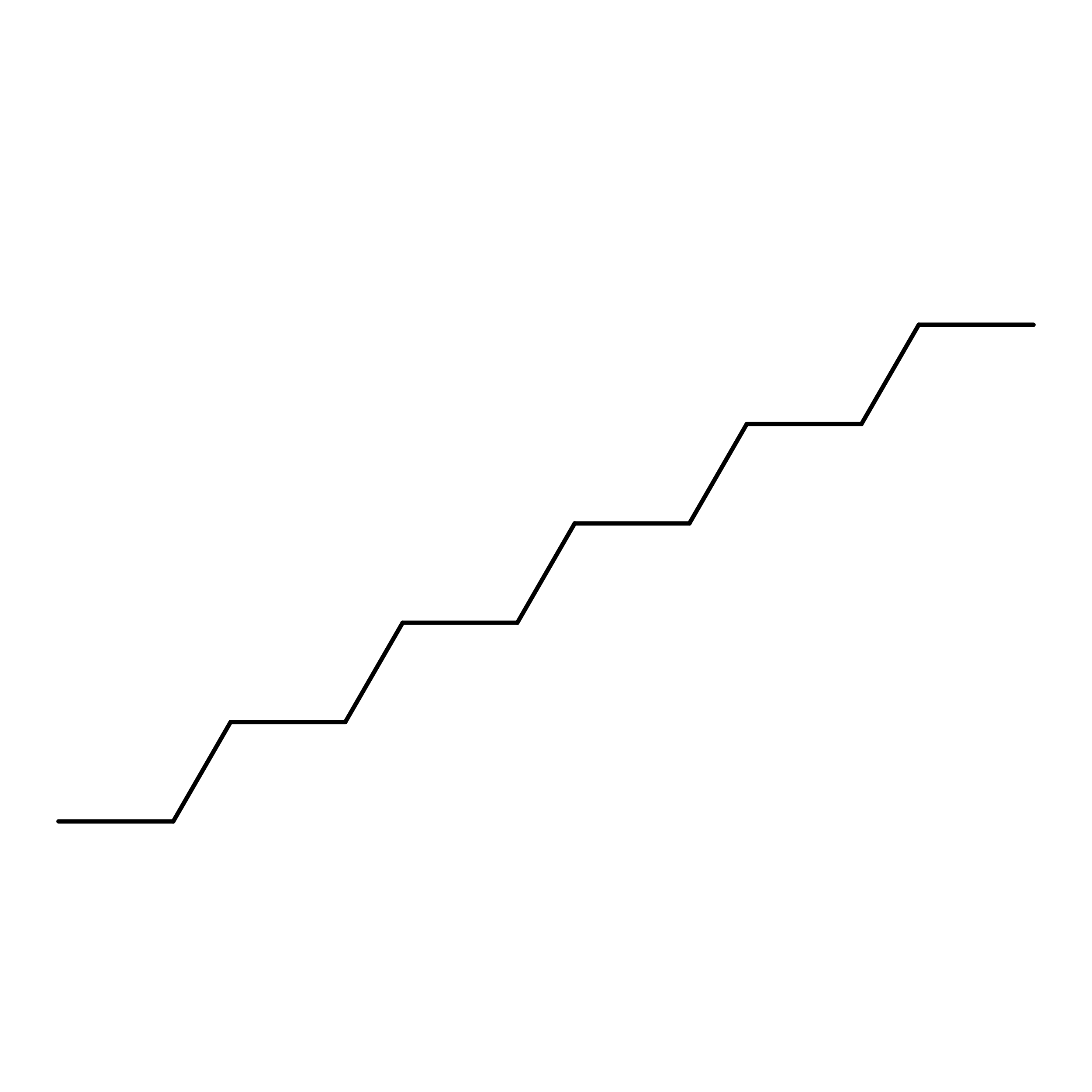
DODECANE
C12 H26
SNRUBQQJIBEYMU-UHFFFAOYSA-N
Experimental Data & Validation

Experimental Data

  • Method: ELECTRON MICROSCOPY
  • Resolution: 2.30 Å
  • Aggregation State: PARTICLE 
  • Reconstruction Method: SINGLE PARTICLE 
EM Software:
TaskSoftware PackageVersion
RECONSTRUCTIONcryoSPARC4.3

Structure Validation

View Full Validation Report


Entry History & Funding Information

Deposition Data


Funding OrganizationLocationGrant Number
German Research Foundation (DFG)Germany343886090

Revision History  (Full details and data files)

  • Version 1.0: 2025-09-24
    Type: Initial release