Download Mendeley
Identification and characterization of botulinum neurotoxin-like two-component toxins in Paeniclostridium ghonii.
Lee, P.G., Yin, L., Wei, X., Shi, J., Masuyer, G., Wentz, T.G., Chen, P., Xu, Y., Liang, J., Zhang, H., Persson Kosenina, S., Lobb, B., Mansfield, M., Gill, S.S., Pellett, S., Stenmark, P., Doxey, A.C., Dong, M.(2025) Sci Adv 11: eadx6145-eadx6145
- PubMed: 41223264 Search on PubMedSearch on PubMed Central
- DOI: https://doi.org/10.1126/sciadv.adx6145
- Primary Citation Related Structures:
9GY5 - PubMed Abstract:
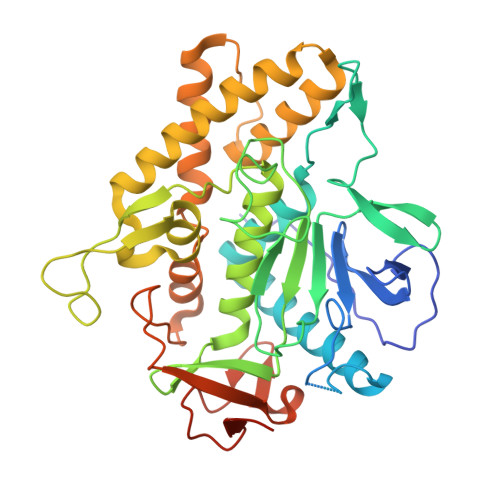
Insecticidal bacterial proteins play key roles in insect-bacteria interactions and have been used as biopesticides. Here, we identify two insecticidal proteins in Paeniclostridium ghonii , designated PG-toxin 1 (PG1) and PG-toxin 2 (PG2), which are homologs of botulinum neurotoxins (BoNTs). Unlike BoNTs, PG1 and PG2 contain two separate proteins: One is the protease light chain (LC), and the other is the heavy chain containing the translocation domain and the receptor binding domain. Crystal and cryo-electron microscopy structures show a conserved BoNT-like architecture but without an interchain disulfide bond. Functional characterizations establish that the LCs of PG1 and PG2 cleave insect synaptosomal-associated protein 25 (SNAP25), but not human or rat SNAP25, and microinjection of PG1 and PG2 caused paralysis and death in Drosophila and Aedes mosquitoes. These findings identified unique two-component BoNT-like insecticidal proteins, revealing insights into the evolution of the BoNT family of toxins, and broadening our understanding of bacteria that can be used for biopest controls.
- Department of Urology, Boston Children's Hospital, Boston, MA 02115, USA.
Organizational Affiliation: