Download Mendeley
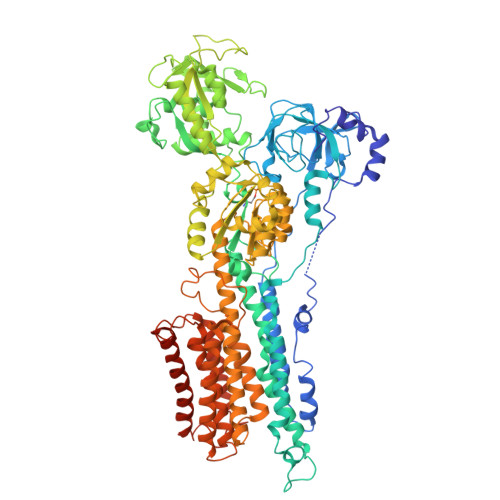
Structure of the [Ca]E2P intermediate of Ca 2+ -ATPase 1 from Listeria monocytogenes.
Basse Hansen, S., Flygaard, R.K., Kjaergaard, M., Nissen, P.(2025) EMBO Rep 26: 1709-1723
- PubMed: 40016426 Search on PubMedSearch on PubMed Central
- DOI: https://doi.org/10.1038/s44319-025-00392-x
- Primary Citation Related Structures:
9GQO - PubMed Abstract:
Active transport by P-type Ca 2+ -ATPases maintain internal calcium stores and a low cytosolic calcium concentration. Structural studies of mammalian sarco/endoplasmic reticulum Ca 2+ -ATPases (SERCA) have revealed several steps of the transport cycle, but a calcium-releasing intermediate has remained elusive. Single-molecule FRET studies of the bacterial Ca 2+ -ATPase LMCA1 revealed an intermediate of the transition between so-called [Ca]E1P and E2P states and suggested that calcium release from this intermediate was the essentially irreversible step of transport. Here, we present a 3.5 Å resolution cryo-EM structure for a four-glycine insertion mutant of LMCA1 in a lipid nanodisc obtained under conditions with calcium and ATP and adopting such an intermediate state, denoted [Ca]E2P. The cytosolic domains are positioned in the E2P-like conformation, while the calcium-binding transmembrane (TM) domain adopts a calcium-bound E1P-ADP-like conformation. Missing density for the E292 residue at the calcium site (the equivalent of SERCA1a E309) suggests flexibility and a site poised for calcium release and proton uptake. The structure suggests a mechanism where ADP release and re-organization of the cytoplasmic domains precede calcium release.
- Department of Molecular Biology and Genetics, Aarhus University, Aarhus, Denmark.
Organizational Affiliation: