Download Mendeley
Characterization of a two-component kinase that initiates the bacterial catabolism of hydroxyphenylethanones.
Dexter, G.N., Grigg, J.C., Zahn, M., Wheatley, E.J., Lian, J., Mohn, W.W., Eltis, L.D.(2025) J Biol Chem 301: 110210-110210
- PubMed: 40345584 Search on PubMedSearch on PubMed Central
- DOI: https://doi.org/10.1016/j.jbc.2025.110210
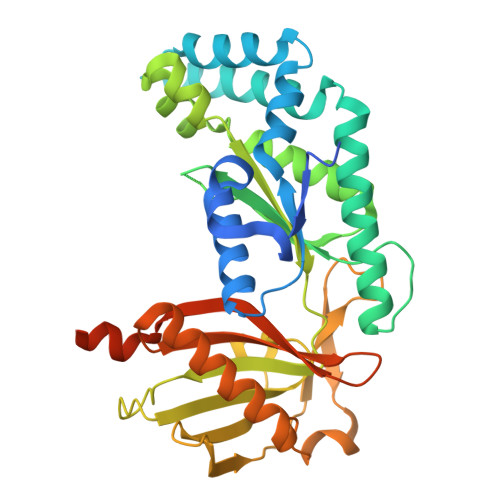
- Primary Citation Related Structures:
9GOJ - PubMed Abstract:
The prodigious ability of bacteria to catabolize aromatic compounds has sparked considerable efforts to engineer bacteria to valorize lignin, an underutilized component of biomass. Despite decades of study, key catabolic pathways and enzymes remain poorly characterized. We recently identified the hydroxyphenylethanone (Hpe) pathway, which enables Rhodococcus rhodochrous GD02 and other bacteria to catabolize 4-hydroxyacetophenone (HAP) and acetovanillone (AV), which are generated in the catalytic fractionation of lignin. Catabolism is initiated by a two-component, ATP-dependent dikinase, HpeHI, homologs of which are involved in the catabolism of other aromatic compounds. In biochemical studies, the kinase activity of HpeHI was highest at low ionic strength and low concentrations of Mn 2+ . HpeHI had the highest apparent specificity for HAP and AV (k cat /K M ≥ 250 mM -1 s -1 ) and had submicromolar K M values for these substrates, consistent with the enzyme acting as a scavenging system. The enzyme also transformed 4-hydroxybenzaldehyde, vanillin, acetosyringone, and phenol. A 1.8 Å crystal structure of HpeI revealed that it is homologous to the ATP-grasp domain of rifampin phosphotransferase (RPH), while an AlphaFold model of HpeH indicated that it is homologous to the swivel and rifampin-binding domains of RPH. Consistent with HpeHI using a similar mechanism where the swivel domain transits between the spatially distinct substrate-binding sites, substitution of the conserved His residue in HpeH abolished kinase activity. Moreover, the HpeH component alone catalyzed phosphotransfer from 4-phosphoacetophenone to AV. This study reveals a subfamily of small-molecule dikinases that comprises two components, some of which are involved in aromatic compound catabolism.
- Department of Microbiology and Immunology, Life Sciences Institute and Bioproducts Institute, The University of British Columbia, Vancouver, Canada.
Organizational Affiliation: