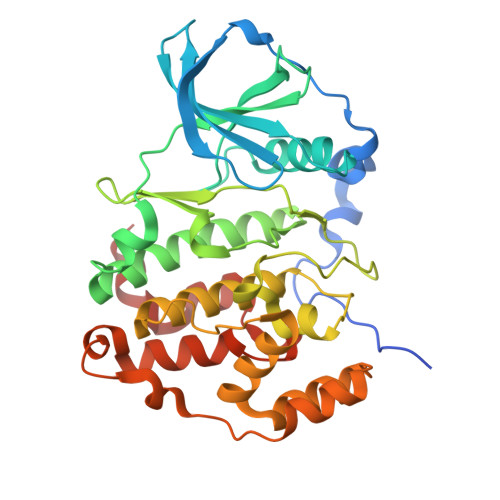
9GCW | pdb_00009gcw

Crystal structure of protein kinase CK2 catalytic subunit (csnk2a1 gene product) in complex with the dual CK2/HDAC inhibitor IOR-160


Experimental Data Snapshot

  • Method: X-RAY DIFFRACTION
  • Resolution: 1.86 Å
  • R-Value Free: 
    0.233 (Depositor), 0.235 (DCC) 
  • R-Value Work: 
    0.188 (Depositor), 0.189 (DCC) 
  • R-Value Observed: 
    0.190 (Depositor) 

Starting Model: experimental
View more details

wwPDB Validation 3D Report Full Report

Validation slider image for 9GCW

Ligand Structure Quality Assessment 


This is version 1.0 of the entry. See complete history

Literature

Targeting Casein Kinase 2 and Histone Deacetylase with a Dual Inhibitor Effectively Reduces Tumor Growth in a Triple-Negative Breast Cancer Xenograft Model.

Ortin, I.Ochoa-Callejero, L.Werner, C.Lindenblatt, D.Niefind, K.Martinez, A.de Pascual-Teresa, B.Ramos, A.

(2025) Acs Pharmacol Transl Sci 8: 2093-2105

  • DOI: https://doi.org/10.1021/acsptsci.5c00192
  • Primary Citation Related Structures: 
    9GCW, 9GXY

  • PubMed Abstract: 

    In a previous study, IOR-160 was identified as a potent dual inhibitor of CK2 and HDAC enzymes. In this study, we evaluated its selectivity and therapeutic potential. IOR-160 exhibited high selectivity for CK2 within a panel of 21 kinases and more widespread inhibitory activity against histone deacetylases (HDAC 1, 2, 3, and 6, low activity for HDAC8). Using a mouse model of triple-negative breast cancer (MDA-MB-231), we further explored its effects on disease progression. Notably, animals treated with IOR-160 exhibited no detectable signs of toxicity or behavioral side effects relative to untreated mice. In a xenograft study, IOR-160 significantly reduced tumor growth ( p = 0.0336) and decreased tumor burden ( p = 0.0454) compared to the vehicle (DMSO)-treated group. In addition, IOR-160 modulated critical cellular signaling pathways, demonstrated by the inhibition of AKT phosphorylation ( p = 0.0175) and a significant increase in acetylated α-tubulin ( p = 0.0023), confirming the dual action of IOR-160 in vivo . Furthermore, X-ray crystallography revealed the binding mode of IOR-160 to CK2, showing high conservation compared to that of the known CK2 inhibitor CX-4945. These results suggest that IOR-160 has significant potential as an antitumor agent. Nonclinical and clinical studies become now necessary to validate the efficacy of this new chemical entity as a potential drug.


  • Organizational Affiliation
    • Departamento de Química y Bioquímica, Facultad de Farmacia, Universidad San Pablo-CEU, CEU Universities, Urbanización Montepríncipe, Boadilla del Monte 28668, Spain.

Macromolecule Content 

  • Total Structure Weight: 42.15 kDa 
  • Atom Count: 3,013 
  • Modeled Residue Count: 330 
  • Deposited Residue Count: 349 
  • Unique protein chains: 1

Macromolecules

Find similar proteins by:|  3D Structure
Entity ID: 1
MoleculeChains  Sequence LengthOrganismDetailsImage
Casein kinase II subunit alpha349Homo sapiensMutation(s): 0 
Gene Names: CSNK2A1
EC: 2.7.11.1
UniProt & NIH Common Fund Data Resources
Find proteins for P68400 (Homo sapiens)
Explore P68400 
Go to UniProtKB:  P68400
PHAROS:  P68400
GTEx:  ENSG00000101266 
Entity Groups
Sequence Clusters30% Identity50% Identity70% Identity90% Identity95% Identity100% Identity
UniProt GroupP68400
Sequence Annotations
Expand
Reference Sequence

Experimental Data & Validation

Experimental Data

  • Method: X-RAY DIFFRACTION
  • Resolution: 1.86 Å
  • R-Value Free:  0.233 (Depositor), 0.235 (DCC) 
  • R-Value Work:  0.188 (Depositor), 0.189 (DCC) 
  • R-Value Observed: 0.190 (Depositor) 
Space Group: P 43 21 2
Unit Cell:
Length ( Å )Angle ( ˚ )
a = 73.617α = 90
b = 73.617β = 90
c = 131.415γ = 90
Software Package:
Software NamePurpose
autoPROCdata reduction
autoPROCdata scaling
PHASERphasing
PHENIXrefinement

Structure Validation

View Full Validation Report


Ligand Structure Quality Assessment 


Entry History 

& Funding Information

Deposition Data


Funding OrganizationLocationGrant Number
German Research Foundation (DFG)GermanyNI 643/4-2
German Research Foundation (DFG)GermanyNI 643/11-1

Revision History  (Full details and data files)

  • Version 1.0: 2025-07-30
    Type: Initial release