Download Mendeley
Nucleotide-induced hyper-oligomerization inactivates transcription termination factor rho.
Wang, B., Said, N., Hilal, T., Finazzo, M., Wahl, M.C., Artsimovitch, I.(2025) Nat Commun 16: 1653-1653
- PubMed: 39952913 Search on PubMedSearch on PubMed Central
- DOI: https://doi.org/10.1038/s41467-025-56824-8
- Primary Citation Related Structures:
9FF7 - PubMed Abstract:
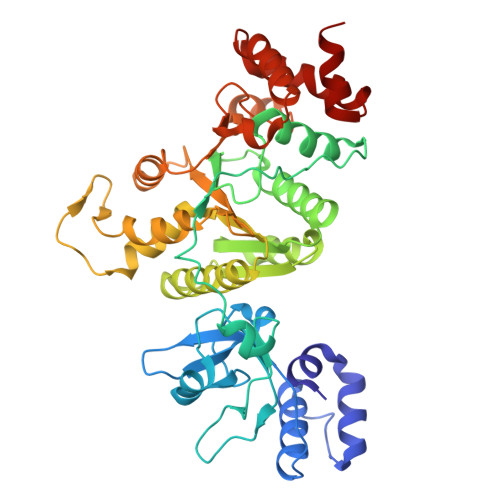
Bacterial RNA helicase ρ is a genome sentinel that terminates the synthesis of damaged and junk RNAs that are not translated by the ribosome. It is unclear how ρ is regulated during dormancy or stress, when translation is inefficient and RNAs are vulnerable to ρ-mediated release. We use cryogenic electron microscopy, biochemical, and genetic approaches to show that substitutions of residues in the connector between two ρ domains or ADP promote the formation of extended Escherichia coli ρ filaments. By contrast, (p)ppGpp induces the formation of transient ρ dodecamers. Our results demonstrate that ADP and (p)ppGpp nucleotides bound at subunit interfaces inhibit ρ ring closure that underpins the hexamer activation, thus favoring the assembly of inactive higher-order oligomers. Connector substitutions and antibiotics that inhibit RNA and protein syntheses trigger ρ aggregation in the cell. These and other recent data implicate aggregation as a widespread strategy to tune ρ activity.
- Department of Microbiology and Center for RNA Biology, The Ohio State University, Columbus, OH, USA.
Organizational Affiliation: