Download Mendeley
Probing the structure and thermodynamics of a multidomain psychrophilic chitinase from Moritella marina.
Bejger, M., Malecki, P.H., Biniek-Antosiak, K., Rypniewski, W.(2025) J Struct Biol 218: 108282-108282
- PubMed: 41456759 Search on PubMed
- DOI: https://doi.org/10.1016/j.jsb.2025.108282
- Primary Citation Related Structures:
4W5Z, 9FBO, 9FBP, 9FBQ, 9FBR, 9FBS - PubMed Abstract:
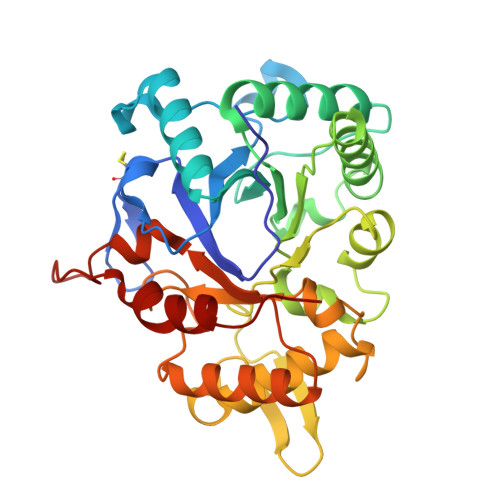
Studies of protein structure and stability have traditionally focused on individual domains, treating them as autonomous units, even though most proteins consist of multiple domains. This raises the question to what extent can multidomain proteins be considered as sums of their individual domains, and how neighboring domains influence one another. Chitinase Chi60 from the psychrophilic bacterium Moritella marina consists of four domains linked in sequence: a catalytic domain, two consecutive Ig-like domains, and a chitin-binding module. The modular architecture of this enzyme provides an opportunity to examine the structure and stability of a protein from which domains are systematically excised. A series of deletion mutants of the chitinase was designed and constructed, and their structures and thermal melting profiles were analyzed. The different domains exhibit distinct melting temperatures. The catalytic domain shows a complex melting profile. Each domain can fold and maintain its structural integrity when isolated, including the two tandem Ig-like domains that share sequence similarity. Although the interfaces between domains in this modular protein are small, it is still possible to detect the influence neighboring domains exert on one another. Some artificial combinations of domains are unstable and prone to degradation. This long, flexible molecule may be stabilized through dimerization when not engaged with the chitin substrate, with two of its domains participating in the interaction.
- Institute of Bioorganic Chemistry, Polish Academy of Sciences, ul. Noskowskiego 12/14, 61-704 Poznań, Poland.
Organizational Affiliation: