Download Mendeley
Loop engineering of enzymes to control their immobilization and ultimately fabricate more efficient heterogeneous biocatalysts.
Zeballos, N., Gines-Alcober, I., Macias-Leon, J., Andres-Sanz, D., Gonzalez-Ramirez, A.M., Sanchez-Costa, M., Merino, P., Hurtado-Guerrero, R., Lopez-Gallego, F.(2025) Protein Sci 34: e70040-e70040
- PubMed: 39840824 Search on PubMedSearch on PubMed Central
- DOI: https://doi.org/10.1002/pro.70040
- Primary Citation Related Structures:
9FBD - PubMed Abstract:
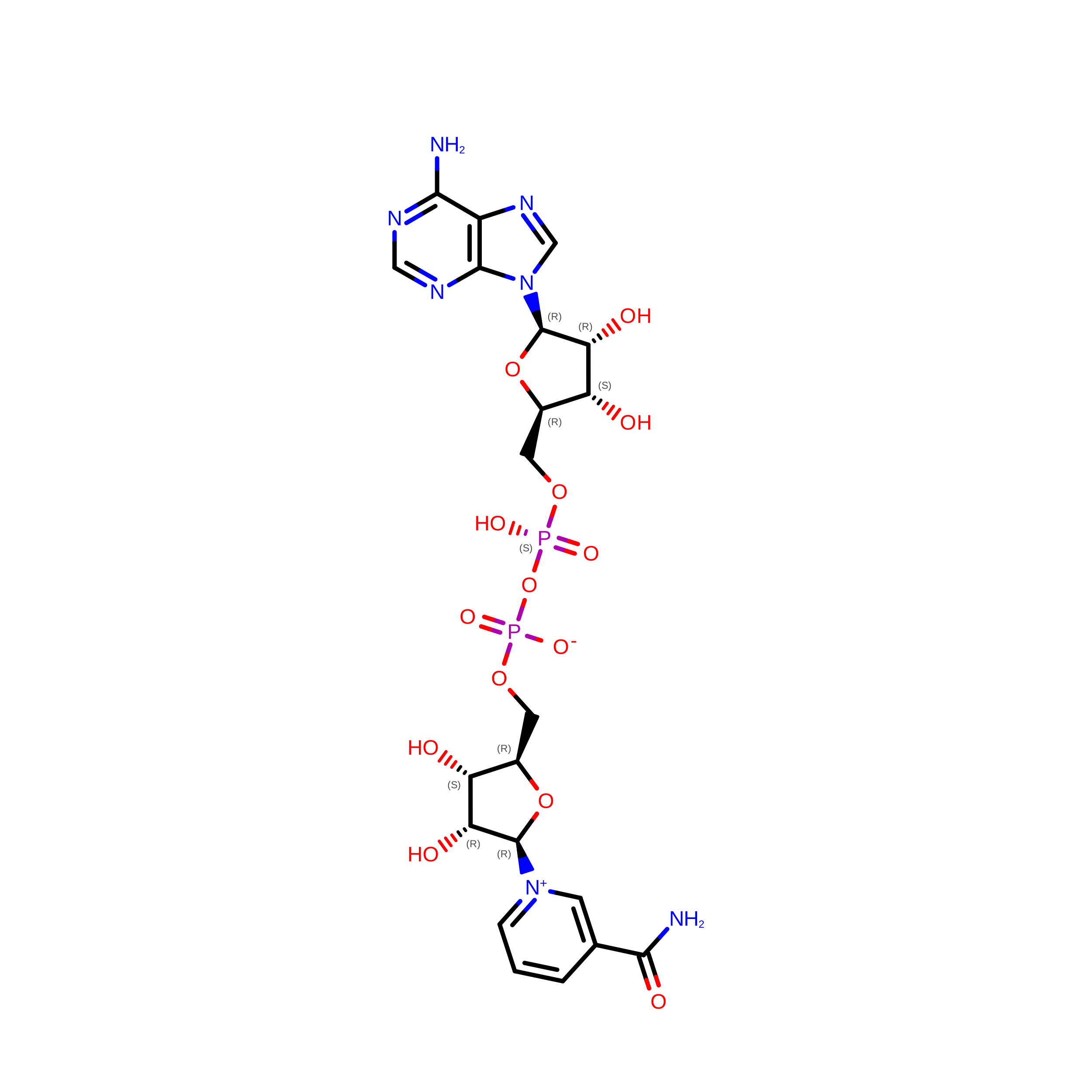
Enzyme immobilization is indispensable for enhancing enzyme performance in various industrial applications. Typically, enzymes require specific spatial arrangements for optimal functionality, underscoring the importance of correct orientation. Despite well-known N- or C-terminus tailoring techniques, alternatives for achieving orientation control are limited. Here, we propose a novel approach that tailors the enzyme surface with engineered His-rich loops. To that aim, we first solve the X-ray crystal structure of a hexameric alcohol dehydrogenase from Thermus thermophilus HB27 (TtHBDH) (PDB: 9FBD). Guided by this 3D structure, we engineer the enzyme surface with a new loop enriched with six His residues to control enzyme orientation. Molecular dynamics simulations reveal that the engineered loop's imidazole rings have greater solvent accessibility than those in native His residues, allowing for more efficient enzyme immobilization on certain metal chelate-functionalized carriers. Using carriers functionalized with iron (III)-catechol, the apparent V max of the immobilized loop variant doubles the immobilized His-tagged one, and vice versa when both variants are immobilized on carriers functionalized with copper (II)-imidodiacetic acid. His-tagged and loop-engineered TtHBDH show high operational stability reaching 100% bioconversion after 10 reaction cycles, yet the loop variant is faster than the His-tagged one.
- Center for Cooperative Research in Biomaterials (CIC biomaGUNE), Basque Research and Technology Alliance (BRTA), San Sebastián, Spain.
Organizational Affiliation: