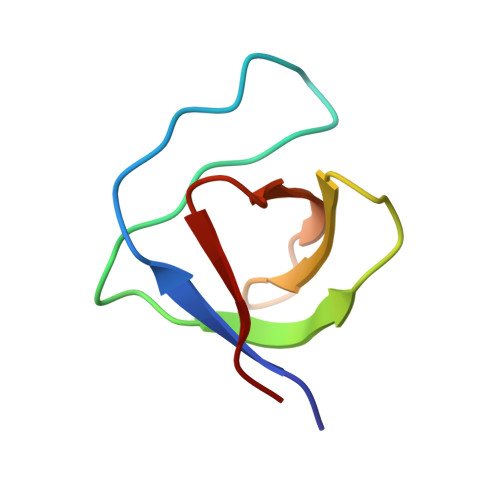
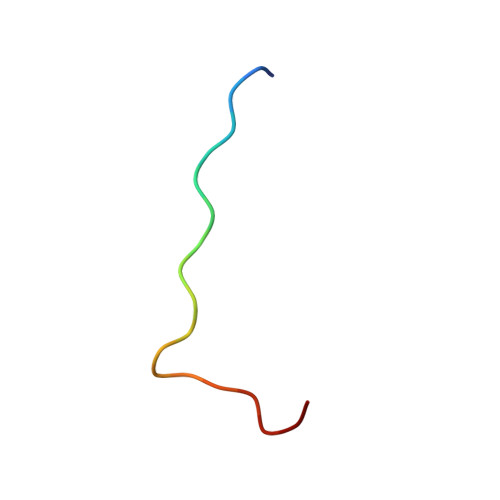
9EZO | pdb_00009ezo

Canonical class 2 structure of the human cortactin SH3 domain in complex with WIP-derived peptide


Experimental Data Snapshot

  • Method: SOLUTION NMR
  • Conformers Calculated: 80 
  • Conformers Submitted: 19 
  • Selection Criteria: structures with acceptable covalent geometry 

wwPDB Validation   3D Report Full Report


This is version 1.1 of the entry. See complete history


Literature

A Triple-pose Complex Between an Extended WIP Motif and a C-terminal SH3 Domain Modulates Cortactin Activity.

Sokolik, C.G.Chill, J.H.

(2025) J Mol Biology 437: 168984-168984

  • DOI: https://doi.org/10.1016/j.jmb.2025.168984
  • Primary Citation of Related Structures:  
    9EZN, 9EZO, 9EZP

  • PubMed Abstract: 

    The central domain of WASp-interacting protein (WIP) interacts with the cortactin SH3 domain through a previously undefined binding motif. This interaction affects extracellular matrix (ECM) degradation and the invasive phenotype of cells. Here, using NMR-based methods, we identify the major WIP epitope modulating this binding event as residues 168-183, an unexpectedly long segment uncharacteristic of SH3 peptidic ligands. A scanning mutagenesis analysis showed that peptide binding 'hotspots' are distributed throughout the binding sequence. To uncover the structural basis of WIP-cortactin recognition we utilized edited-filtered NOESY experiments to determine the structure of the intermediate-affinity SH3/peptide complex. Analysis of the NOESY pattern suggests that the peptide sequence dictates three interchanging binding modes, two oppositely oriented canonical poses involving N-terminal interactions, corresponding to class I and class II complexes, and a non-canonical pseudo-class II pose involving C-terminal interactions. The latter pose highlights the importance of the hydrophobic surface adjacent to the canonical binding grooves and accounts for the extended binding motif. Design of mutant peptides with increased affinity based on this multi-conformational complex demonstrates how these structural insights may impact design of improved inhibitors of the WIP-cortactin interaction with potential therapeutic applications.


  • Organizational Affiliation
    • Department of Chemistry, Bar Ilan University, Ramat Gan 52900 Israel.

Macromolecules
Find similar proteins by:  (by identity cutoff)  |  3D Structure
Entity ID: 1
MoleculeChains Sequence LengthOrganismDetailsImage
cDNA FLJ34459 fis, clone HLUNG2002916, highly similar to SRC SUBSTRATE CORTACTIN57Homo sapiensMutation(s): 0 
UniProt & NIH Common Fund Data Resources
Find proteins for Q14247 (Homo sapiens)
Explore Q14247 
Go to UniProtKB:  Q14247
PHAROS:  Q14247
GTEx:  ENSG00000085733 
Entity Groups  
Sequence Clusters30% Identity50% Identity70% Identity90% Identity95% Identity100% Identity
UniProt GroupQ14247
Sequence Annotations
Expand
  • Reference Sequence

Find similar proteins by:  Sequence   |   3D Structure  

Entity ID: 2
MoleculeChains Sequence LengthOrganismDetailsImage
WAS/WASL-interacting protein family member 119Homo sapiensMutation(s): 0 
UniProt & NIH Common Fund Data Resources
Find proteins for O43516 (Homo sapiens)
Explore O43516 
Go to UniProtKB:  O43516
PHAROS:  O43516
GTEx:  ENSG00000115935 
Entity Groups  
Sequence Clusters30% Identity50% Identity70% Identity90% Identity95% Identity100% Identity
UniProt GroupO43516
Sequence Annotations
Expand
  • Reference Sequence
Experimental Data & Validation

Experimental Data

  • Method: SOLUTION NMR
  • Conformers Calculated: 80 
  • Conformers Submitted: 19 
  • Selection Criteria: structures with acceptable covalent geometry 

Structure Validation

View Full Validation Report


Entry History & Funding Information

Deposition Data


Funding OrganizationLocationGrant Number
Israel Science FoundationIsrael964/19

Revision History  (Full details and data files)

  • Version 1.0: 2025-02-19
    Type: Initial release
  • Version 1.1: 2025-02-26
    Changes: Database references