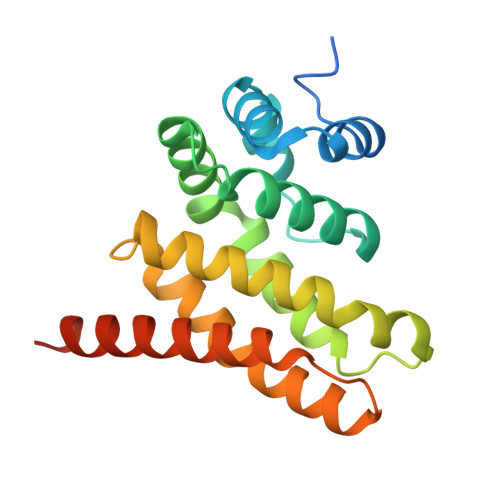
9EVE | pdb_00009eve

Crystal structure of the ARM domain of human ZNFX1


Experimental Data Snapshot

  • Method: X-RAY DIFFRACTION
  • Resolution: 3.67 Å
  • R-Value Free: 
    0.236 (Depositor), 0.230 (DCC) 
  • R-Value Work: 
    0.198 (Depositor), 0.197 (DCC) 
  • R-Value Observed: 
    0.202 (Depositor) 

Starting Model: in silico
View more details

wwPDB Validation   3D Report Full Report


This is version 1.3 of the entry. See complete history


Literature

A split-site E3 ligase mechanism enables ZNFX1 to ubiquitinate and cluster single-stranded RNA into ubiquitin-coated nucleoprotein particles.

Grabarczyk, D.B.Aird, E.J.Reznikow, V.Kirchgatterer, P.C.Ehrmann, J.F.Kurzbauer, R.Bell, L.E.Kellner, M.J.Aggarwal, R.Schleiffer, A.Faas, V.Deszcz, L.Meinhart, A.Versteeg, G.A.Penninger, J.M.Stelzl, L.S.Gaidt, M.M.Tessmer, I.Corn, J.E.Clausen, T.

(2025) Cell 188: 5995

  • DOI: https://doi.org/10.1016/j.cell.2025.08.006
  • Primary Citation of Related Structures:  
    9EVE, 9Q9Z

  • PubMed Abstract: 

    Eukaryotic cells use a multi-layered immune response to combat intracellular pathogens. The ubiquitin ligase ZNFX1 has emerged as a crucial yet little understood player that regulates the immune response while protecting against RNA viruses. Our study unveils the molecular mechanism of ZNFX1, mediated by the joint activity of a helicase serving as a nucleic acid sensor and a non-conventional E3 module featuring a split active site. We demonstrate that single-stranded RNA stimulates E3 activity by fostering dimerization of ZNFX1 subunits that translocate along nucleic acid tracks. Juxtaposed E3 domains complement each other, leading to the ubiquitination of ZNFX1 itself and engaged RNA molecules, while clustering nucleic acids into dense nucleoprotein particles. We show that the E3 ligase activity of ZNFX1 protects cells during an immune response and propose that ubiquitin-coated particles formed by ZNFX1 represent part of an ancient mechanism to regulate both foreign and host RNA in the cell.


  • Organizational Affiliation
    • Research Institute of Molecular Pathology, Vienna BioCenter, 1030 Vienna, Austria. Electronic address: daniel.grabarczyk@imp.ac.at.

Macromolecules
Find similar proteins by:  (by identity cutoff)  |  3D Structure
Entity ID: 1
MoleculeChains Sequence LengthOrganismDetailsImage
NFX1-type zinc finger-containing protein 1
A, B
199Homo sapiensMutation(s): 0 
Gene Names: ZNFX1KIAA1404
UniProt & NIH Common Fund Data Resources
Find proteins for Q9P2E3 (Homo sapiens)
Explore Q9P2E3 
Go to UniProtKB:  Q9P2E3
PHAROS:  Q9P2E3
GTEx:  ENSG00000124201 
Entity Groups  
Sequence Clusters30% Identity50% Identity70% Identity90% Identity95% Identity100% Identity
UniProt GroupQ9P2E3
Sequence Annotations
Expand
  • Reference Sequence
Experimental Data & Validation

Experimental Data

  • Method: X-RAY DIFFRACTION
  • Resolution: 3.67 Å
  • R-Value Free:  0.236 (Depositor), 0.230 (DCC) 
  • R-Value Work:  0.198 (Depositor), 0.197 (DCC) 
  • R-Value Observed: 0.202 (Depositor) 
Space Group: P 1 21 1
Unit Cell:
Length ( Å )Angle ( ˚ )
a = 46.85α = 90
b = 51.57β = 101.746
c = 86.65γ = 90
Software Package:
Software NamePurpose
PHENIXrefinement
autoPROCdata reduction
autoPROCdata scaling
PHASERphasing

Structure Validation

View Full Validation Report


Entry History & Funding Information

Deposition Data


Funding OrganizationLocationGrant Number
H2020 Marie Curie Actions of the European CommissionEuropean Union--

Revision History  (Full details and data files)

  • Version 1.0: 2025-04-09
    Type: Initial release
  • Version 1.1: 2025-09-03
    Changes: Database references
  • Version 1.2: 2025-09-10
    Changes: Database references
  • Version 1.3: 2025-10-29
    Changes: Database references