Download Mendeley
Structural basis of the allosteric regulation of cyanobacterial glucose-6-phosphate dehydrogenase by the redox sensor OpcA.
Doello, S., Shvarev, D., Theune, M., Sauerwein, J., Klon, A., Keskin, E., Boehm, M., Gutekunst, K., Forchhammer, K.(2024) Proc Natl Acad Sci U S A 121: e2411604121-e2411604121
- PubMed: 39642196 Search on PubMedSearch on PubMed Central
- DOI: https://doi.org/10.1073/pnas.2411604121
- Primary Citation Related Structures:
9EMM, 9EMN - PubMed Abstract:
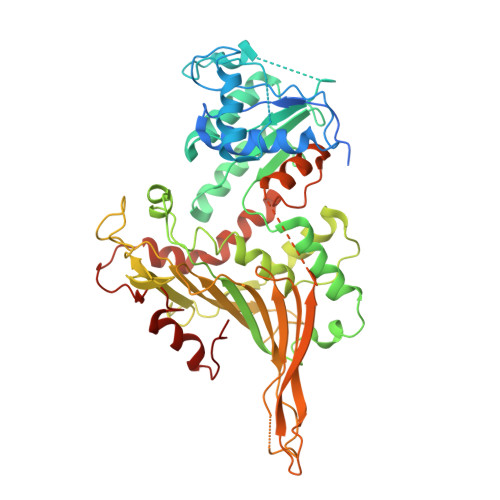
The oxidative pentose phosphate (OPP) pathway is a fundamental carbon catabolic route for generating reducing power and metabolic intermediates for biosynthetic processes. In addition, its first two reactions form the OPP shunt, which replenishes the Calvin-Benson cycle under certain conditions. Glucose-6-phosphate dehydrogenase (G6PDH) catalyzes the first and rate-limiting reaction of this metabolic route. In photosynthetic organisms, G6PDH is redox-regulated to allow fine-tuning and to prevent futile cycles while carbon is being fixed. In cyanobacteria, regulation of G6PDH requires the redox protein OpcA, but the underlying molecular mechanisms behind this allosteric activation remain elusive. Here, we used enzymatic assays and in vivo interaction analyses to show that OpcA binds G6PDH under different environmental conditions. However, complex formation enhances G6PDH activity when OpcA is oxidized and inhibits it when OpcA is reduced. To understand the molecular basis of this regulation, we used cryogenic electron microscopy to determine the structure of Synechocystis G6PDH and the G6PDH-OpcA complex. OpcA binds the G6PDH tetramer and induces conformational changes in the active site of G6PDH. The redox sensitivity of OpcA is achieved by intramolecular disulfide bridge formation, which influences the allosteric regulation of G6PDH. In vitro assays reveal that the level of G6PDH activation depends on the number of bound OpcA molecules, which implies that this mechanism allows delicate fine-tuning. Our findings unveil a unique molecular mechanism governing the regulation of the OPP in Synechocystis .
- Interfaculty Institute for Microbiology and Infection Medicine, Microbiology and Organismic Interactions, University of Tübingen, Tübingen 72076, Germany.
Organizational Affiliation: